

acetic acid gave tetrahydrofuran 177 as the major product (Scheme 47). Epoxide
formation and side chain manipulation gave cis-solamin [51].
Brown et al. also carried out the synthesis of membrarollin (Scheme 48)
[48]. Following the oxidative cyclization of triene 179 to give 180, dihydroxylation
of the remaining olefin and a subsequent orthoformate-initiated cyclization of 182
gave the second tetrahydrofuran ring of membrarollin as 183.
4.5 Osmium-Catalyzed Cyclizations
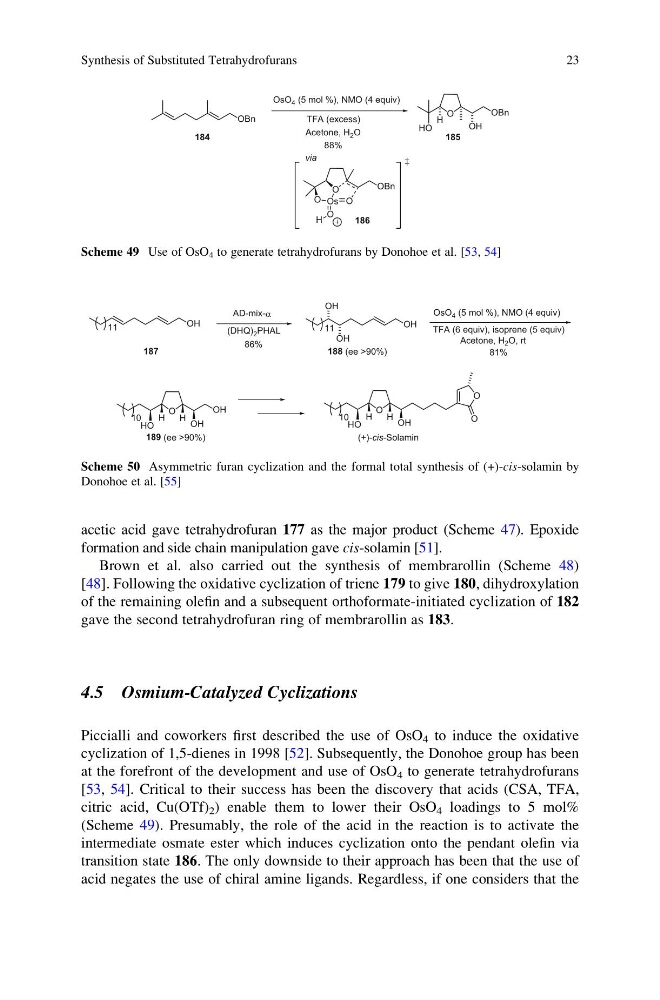
Piccialli and coworkers first described the use of OsO 4 to induce the oxidative
cyclization of 1,5-dienes in 1998 [52]. Subsequently, the Donohoe group has been
at the forefront of the development and use of OsO 4 to generate tetrahydrofurans
[53, 54]. Critical to their success has been the discovery that acids (CSA, TFA,
citric acid, Cu(OTf) 2 ) enable them to lower their OsO 4 loadings to 5 mol%
(Scheme 49). Presumably, the role of the acid in the reaction is to activate the
intermediate osmate ester which induces cyclization onto the pendant olefin via
transition state 186. The only downside to their approach has been that the use of
acid negates the use of chiral amine ligands. Regardless, if one considers that the
OBn
OsO 4 (5 mol %), NMO (4 equiv)
TFA (excess)
Acetone, H 2 O
88%
O
OBn
HO
H
OH
OBn
O Os
O
O
O
H
184
185
186
via
Scheme 49 Use of OsO 4 to generate tetrahydrofurans by Donohoe et al. [53, 54]
11
OH
AD-mix-α
11
OH
(DHQ) 2 PHAL
86%
OH
OH
OsO 4 (5 mol %), NMO (4 equiv)
TFA (6 equiv), isoprene (5 equiv)
Acetone, H 2 O, rt
81%
O
OH
HO
H
H OH
10
188 (ee >90%)
189 (ee >90%)
O
HO
H
H OH
10
O
O
(+)-cis-Solamin
187
Scheme 50 Asymmetric furan cyclization and the formal total synthesis of (+)-cis-solamin by
Donohoe et al. [55]
Synthesis of Substituted Tetrahydrofurans
23
formation and side chain manipulation gave cis-solamin [51].
Brown et al. also carried out the synthesis of membrarollin (Scheme 48)
[48]. Following the oxidative cyclization of triene 179 to give 180, dihydroxylation
of the remaining olefin and a subsequent orthoformate-initiated cyclization of 182
gave the second tetrahydrofuran ring of membrarollin as 183.
4.5 Osmium-Catalyzed Cyclizations
Piccialli and coworkers first described the use of OsO 4 to induce the oxidative
cyclization of 1,5-dienes in 1998 [52]. Subsequently, the Donohoe group has been
at the forefront of the development and use of OsO 4 to generate tetrahydrofurans
[53, 54]. Critical to their success has been the discovery that acids (CSA, TFA,
citric acid, Cu(OTf) 2 ) enable them to lower their OsO 4 loadings to 5 mol%
(Scheme 49). Presumably, the role of the acid in the reaction is to activate the
intermediate osmate ester which induces cyclization onto the pendant olefin via
transition state 186. The only downside to their approach has been that the use of
acid negates the use of chiral amine ligands. Regardless, if one considers that the
OBn
OsO 4 (5 mol %), NMO (4 equiv)
TFA (excess)
Acetone, H 2 O
88%
O
OBn
HO
H
OH
OBn
O Os
O
O
O
H
184
185
186
via
Scheme 49 Use of OsO 4 to generate tetrahydrofurans by Donohoe et al. [53, 54]
11
OH
AD-mix-α
11
OH
(DHQ) 2 PHAL
86%
OH
OH
OsO 4 (5 mol %), NMO (4 equiv)
TFA (6 equiv), isoprene (5 equiv)
Acetone, H 2 O, rt
81%
O
OH
HO
H
H OH
10
188 (ee >90%)
189 (ee >90%)
O
HO
H
H OH
10
O
O
(+)-cis-Solamin
187
Scheme 50 Asymmetric furan cyclization and the formal total synthesis of (+)-cis-solamin by
Donohoe et al. [55]
Synthesis of Substituted Tetrahydrofurans
23