

generation (37 % yield from the pure isomer). A second asymmetric
dihydroxylation effectively differentiated the remaining terminal olefins to give
diol 192 in 59 % yield along with 31 % of the corresponding tetraol. As an aside, the
authors showed that the tetraol could be recycled to generate more 192. Periodatemediated oxidative cleavage of the diol and Wittig olefination gave bis-cyclization
precursor 193. Impressively, when 193 was exposed to the oxidative cyclization
conditions under acidic conditions, both hydrolysis of the bis-acetonide and oxidative cyclization occurred to provide bis-tetrahydrofuran 194 in 77 % yield. Attachment of the requisite butenolide gave (+)-cis-sylvaticin.
In addition to dihydroxylations, Donohoe and coworkers have also used
aminohydroxylation of 1,5-dienes to synthesize tetrahydrofuran substrates
[58]. As in the dihydroxylation/cyclization sequence, they either employed a
one-pot or a two-pot protocol. An example of the one-pot reaction is illustrated
in Scheme 52. Exposure of (E,E)-diene 195 to aminohydroxylation conditions
efficiently gave 2,5-cis-tetrahydrofuran 196. Based on the proposed mechanism
for the reaction, it is not surprising that the reaction of (E,Z )-diene 197 gave
diastereomeric 2,5-cis-tetrahydrofuran 198 in 90 % yield. The aminohydroxylation
O
O
NH
O
O
1) K 2 OsO 2 (OH) 4 (1 mol %)
CH 3 CN, H 2 O, 50 °C
CSA, PNO, citric acid
2) Ac 2 O, Py, rt
O
HN
O
H
H
O
AcO
3
+ others (30%)
73%
K 2 OsO 2 (OH) 4 (1 mol %)
CH 3 CN, H 2 O, 50 °C
HO HN
O
O
199
200
201 (70%)
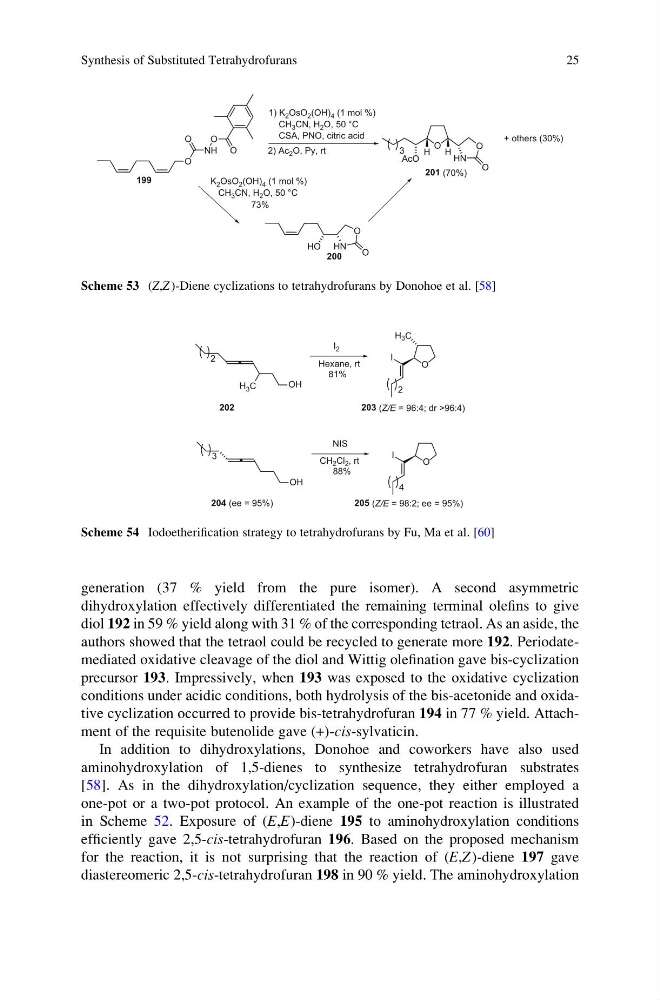
Scheme 53 (Z,Z )-Diene cyclizations to tetrahydrofurans by Donohoe et al. [58]
2
OH
I 2
Hexane, rt
H 3 C
O
H 3 C
I
2
205 (Z/E = 98:2; ee = 95%)
203 (Z/E = 96:4; dr >96:4)
3
OH
NIS
CH 2 Cl 2 , rt
O
I
4
81%
204 (ee = 95%)
88%
202
Scheme 54 Iodoetherification strategy to tetrahydrofurans by Fu, Ma et al. [60]
Synthesis of Substituted Tetrahydrofurans
25
dihydroxylation effectively differentiated the remaining terminal olefins to give
diol 192 in 59 % yield along with 31 % of the corresponding tetraol. As an aside, the
authors showed that the tetraol could be recycled to generate more 192. Periodatemediated oxidative cleavage of the diol and Wittig olefination gave bis-cyclization
precursor 193. Impressively, when 193 was exposed to the oxidative cyclization
conditions under acidic conditions, both hydrolysis of the bis-acetonide and oxidative cyclization occurred to provide bis-tetrahydrofuran 194 in 77 % yield. Attachment of the requisite butenolide gave (+)-cis-sylvaticin.
In addition to dihydroxylations, Donohoe and coworkers have also used
aminohydroxylation of 1,5-dienes to synthesize tetrahydrofuran substrates
[58]. As in the dihydroxylation/cyclization sequence, they either employed a
one-pot or a two-pot protocol. An example of the one-pot reaction is illustrated
in Scheme 52. Exposure of (E,E)-diene 195 to aminohydroxylation conditions
efficiently gave 2,5-cis-tetrahydrofuran 196. Based on the proposed mechanism
for the reaction, it is not surprising that the reaction of (E,Z )-diene 197 gave
diastereomeric 2,5-cis-tetrahydrofuran 198 in 90 % yield. The aminohydroxylation
O
O
NH
O
O
1) K 2 OsO 2 (OH) 4 (1 mol %)
CH 3 CN, H 2 O, 50 °C
CSA, PNO, citric acid
2) Ac 2 O, Py, rt
O
HN
O
H
H
O
AcO
3
+ others (30%)
73%
K 2 OsO 2 (OH) 4 (1 mol %)
CH 3 CN, H 2 O, 50 °C
HO HN
O
O
199
200
201 (70%)
Scheme 53 (Z,Z )-Diene cyclizations to tetrahydrofurans by Donohoe et al. [58]
2
OH
I 2
Hexane, rt
H 3 C
O
H 3 C
I
2
205 (Z/E = 98:2; ee = 95%)
203 (Z/E = 96:4; dr >96:4)
3
OH
NIS
CH 2 Cl 2 , rt
O
I
4
81%
204 (ee = 95%)
88%
202
Scheme 54 Iodoetherification strategy to tetrahydrofurans by Fu, Ma et al. [60]
Synthesis of Substituted Tetrahydrofurans
25