

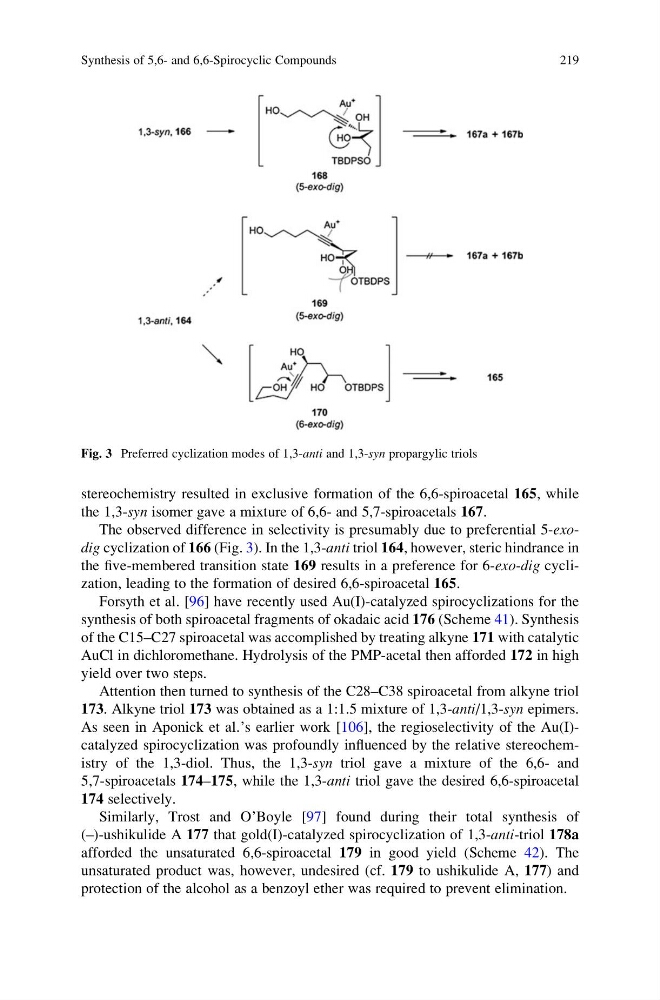
stereochemistry resulted in exclusive formation of the 6,6-spiroacetal 165, while
the 1,3-syn isomer gave a mixture of 6,6- and 5,7-spiroacetals 167.
The observed difference in selectivity is presumably due to preferential 5-exodig cyclization of 166 (Fig. 3). In the 1,3-anti triol 164, however, steric hindrance in
the five-membered transition state 169 results in a preference for 6-exo-dig cyclization, leading to the formation of desired 6,6-spiroacetal 165.
Forsyth et al. [96] have recently used Au(I)-catalyzed spirocyclizations for the
synthesis of both spiroacetal fragments of okadaic acid 176 (Scheme 41). Synthesis
of the C15–C27 spiroacetal was accomplished by treating alkyne 171 with catalytic
AuCl in dichloromethane. Hydrolysis of the PMP-acetal then afforded 172 in high
yield over two steps.
Attention then turned to synthesis of the C28–C38 spiroacetal from alkyne triol
173. Alkyne triol 173 was obtained as a 1:1.5 mixture of 1,3-anti/1,3-syn epimers.
As seen in Aponick et al.’s earlier work [106], the regioselectivity of the Au(I)catalyzed spirocyclization was profoundly influenced by the relative stereochemistry of the 1,3-diol. Thus, the 1,3-syn triol gave a mixture of the 6,6- and
5,7-spiroacetals 174–175, while the 1,3-anti triol gave the desired 6,6-spiroacetal
174 selectively.
Similarly, Trost and O’Boyle [97] found during their total synthesis of
(–)-ushikulide A 177 that gold(I)-catalyzed spirocyclization of 1,3-anti-triol 178a
afforded the unsaturated 6,6-spiroacetal 179 in good yield (Scheme 42). The
unsaturated product was, however, undesired (cf. 179 to ushikulide A, 177) and
protection of the alcohol as a benzoyl ether was required to prevent elimination.
Fig. 3 Preferred cyclization modes of 1,3-anti and 1,3-syn propargylic triols
Synthesis of 5,6- and 6,6-Spirocyclic Compounds
219
the 1,3-syn isomer gave a mixture of 6,6- and 5,7-spiroacetals 167.
The observed difference in selectivity is presumably due to preferential 5-exodig cyclization of 166 (Fig. 3). In the 1,3-anti triol 164, however, steric hindrance in
the five-membered transition state 169 results in a preference for 6-exo-dig cyclization, leading to the formation of desired 6,6-spiroacetal 165.
Forsyth et al. [96] have recently used Au(I)-catalyzed spirocyclizations for the
synthesis of both spiroacetal fragments of okadaic acid 176 (Scheme 41). Synthesis
of the C15–C27 spiroacetal was accomplished by treating alkyne 171 with catalytic
AuCl in dichloromethane. Hydrolysis of the PMP-acetal then afforded 172 in high
yield over two steps.
Attention then turned to synthesis of the C28–C38 spiroacetal from alkyne triol
173. Alkyne triol 173 was obtained as a 1:1.5 mixture of 1,3-anti/1,3-syn epimers.
As seen in Aponick et al.’s earlier work [106], the regioselectivity of the Au(I)catalyzed spirocyclization was profoundly influenced by the relative stereochemistry of the 1,3-diol. Thus, the 1,3-syn triol gave a mixture of the 6,6- and
5,7-spiroacetals 174–175, while the 1,3-anti triol gave the desired 6,6-spiroacetal
174 selectively.
Similarly, Trost and O’Boyle [97] found during their total synthesis of
(–)-ushikulide A 177 that gold(I)-catalyzed spirocyclization of 1,3-anti-triol 178a
afforded the unsaturated 6,6-spiroacetal 179 in good yield (Scheme 42). The
unsaturated product was, however, undesired (cf. 179 to ushikulide A, 177) and
protection of the alcohol as a benzoyl ether was required to prevent elimination.
Fig. 3 Preferred cyclization modes of 1,3-anti and 1,3-syn propargylic triols
Synthesis of 5,6- and 6,6-Spirocyclic Compounds
219