

pyranyl acetals [98]. Messerle and coworkers [99–103] have extended this work to
the synthesis of spiroacetals, through the development of several Ir- and Rh-based
catalysts for the hydroalkoxylation of internal alkynes (Fig. 4).
Additionally, other metals catalysts have also been exploited for this transformation, including a platinum complex used for the synthesis of spirastrellolide B
[104] and a mercury(II) catalyst for the synthesis of hippuristanol [105].
2.6.1 Aliphatic Spiroacetals: Gold, Platinum, Palladium, and Mercury
Catalysts
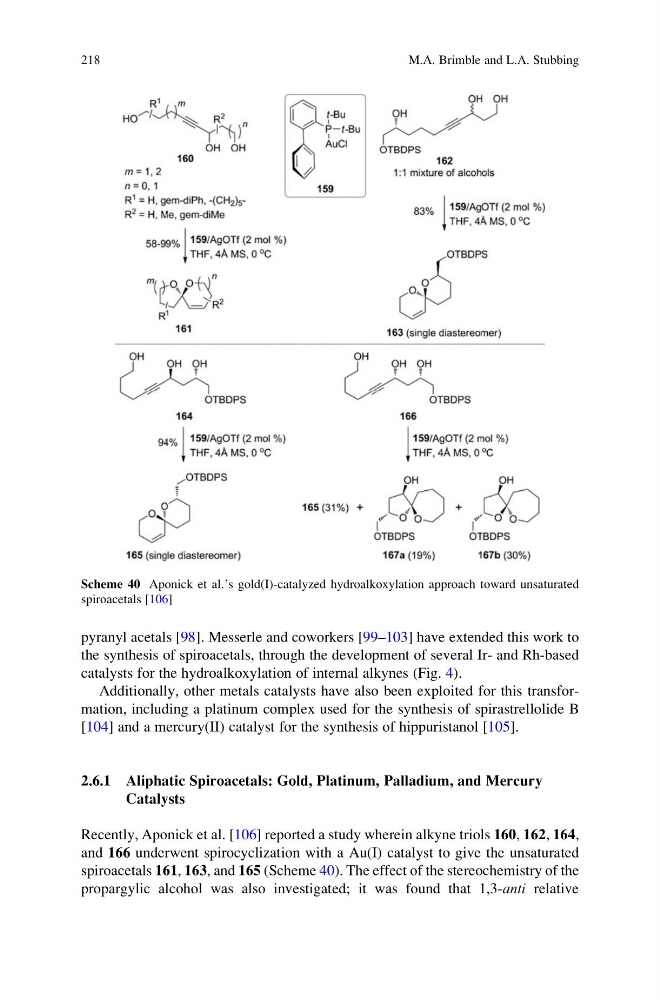
Recently, Aponick et al. [106] reported a study wherein alkyne triols 160, 162, 164,
and 166 underwent spirocyclization with a Au(I) catalyst to give the unsaturated
spiroacetals 161, 163, and 165 (Scheme 40). The effect of the stereochemistry of the
propargylic alcohol was also investigated; it was found that 1,3-anti relative
Scheme 40 Aponick et al.’s gold(I)-catalyzed hydroalkoxylation approach toward unsaturated
spiroacetals [106]
218
M.A. Brimble and L.A. Stubbing
the synthesis of spiroacetals, through the development of several Ir- and Rh-based
catalysts for the hydroalkoxylation of internal alkynes (Fig. 4).
Additionally, other metals catalysts have also been exploited for this transformation, including a platinum complex used for the synthesis of spirastrellolide B
[104] and a mercury(II) catalyst for the synthesis of hippuristanol [105].
2.6.1 Aliphatic Spiroacetals: Gold, Platinum, Palladium, and Mercury
Catalysts
Recently, Aponick et al. [106] reported a study wherein alkyne triols 160, 162, 164,
and 166 underwent spirocyclization with a Au(I) catalyst to give the unsaturated
spiroacetals 161, 163, and 165 (Scheme 40). The effect of the stereochemistry of the
propargylic alcohol was also investigated; it was found that 1,3-anti relative
Scheme 40 Aponick et al.’s gold(I)-catalyzed hydroalkoxylation approach toward unsaturated
spiroacetals [106]
218
M.A. Brimble and L.A. Stubbing