

In their work toward the cephalosporolides 5a–b and 181, Dudley and Tlais [95,
107] used a gold(I)-catalyzed intramolecular hydroalkoxylation strategy to form the
5,5-spiroacetal (Scheme 43). Treatment of alkyne 182 with a high catalyst loading
of AuCl afforded a mixture of spiroacetals 183a and 183b in good yield. Similarly,
in their successful synthesis of cephalosporolide E 5a, spirocyclization with AuCl,
followed by removal of the TBS-ether afforded the 5,5-spiroacetals 185 as an
approximately 1:1 mixture. Epimerization with zinc chloride and magnesium
oxide, followed by oxidation to the lactone completed the synthesis of 5a in
moderate yield.
Ramana et al. [89] opted for a Pd(II) catalyst for the intramolecular hydroalkoxylation of alkyne 186 in their synthesis of the enantiomeric cephalosporolides
189a and 189b (Scheme 44). The spirocyclization afforded a 1:1 mixture of the
spiroacetals 187, which were then elaborated to the ent-natural products via hydrolysis of the isopropylidene acetal, followed by oxidation and Barton–McCombie
deoxygenation.
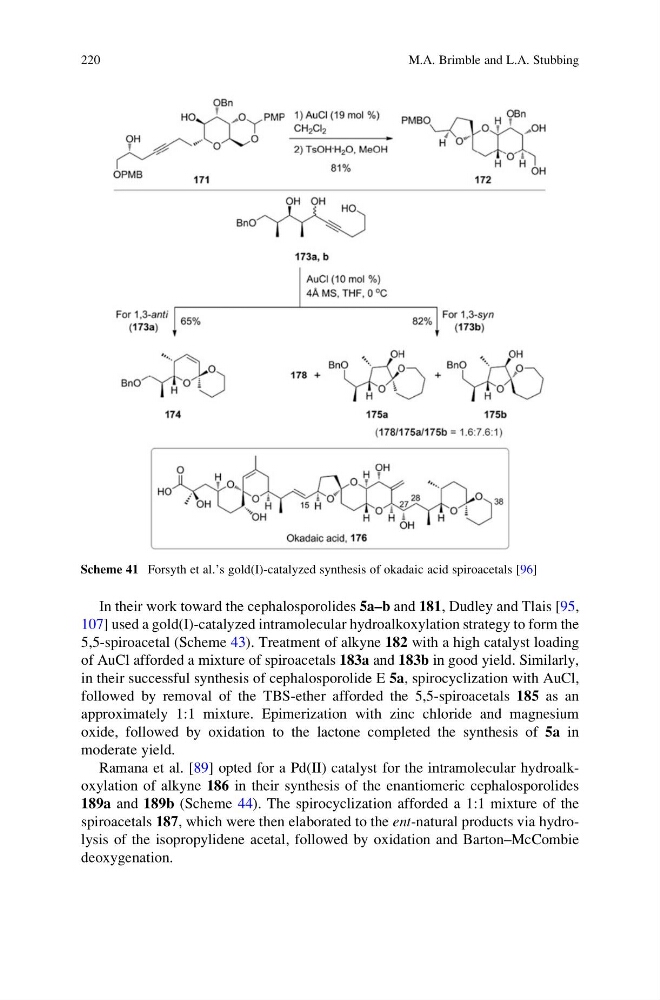
Scheme 41 Forsyth et al.’s gold(I)-catalyzed synthesis of okadaic acid spiroacetals [96]
220
M.A. Brimble and L.A. Stubbing
107] used a gold(I)-catalyzed intramolecular hydroalkoxylation strategy to form the
5,5-spiroacetal (Scheme 43). Treatment of alkyne 182 with a high catalyst loading
of AuCl afforded a mixture of spiroacetals 183a and 183b in good yield. Similarly,
in their successful synthesis of cephalosporolide E 5a, spirocyclization with AuCl,
followed by removal of the TBS-ether afforded the 5,5-spiroacetals 185 as an
approximately 1:1 mixture. Epimerization with zinc chloride and magnesium
oxide, followed by oxidation to the lactone completed the synthesis of 5a in
moderate yield.
Ramana et al. [89] opted for a Pd(II) catalyst for the intramolecular hydroalkoxylation of alkyne 186 in their synthesis of the enantiomeric cephalosporolides
189a and 189b (Scheme 44). The spirocyclization afforded a 1:1 mixture of the
spiroacetals 187, which were then elaborated to the ent-natural products via hydrolysis of the isopropylidene acetal, followed by oxidation and Barton–McCombie
deoxygenation.
Scheme 41 Forsyth et al.’s gold(I)-catalyzed synthesis of okadaic acid spiroacetals [96]
220
M.A. Brimble and L.A. Stubbing