

this intermediate contains a trityl ether moiety. Its acidic hydrolysis generates a diol
that is oxidized under Swern’s conditions into the corresponding diketo-aldehyde.
The latter undergoes intramolecular crotonalization with the cyclohexanone moiety
providing the bicyclo[4.3.0]hept-6-ene system 77. Palladium-catalyzed hydrolysis
of the allyl ester of 77 and subsequent decarboxylation gives a cyclohexanone
intermediate that is converted into enol triflate 78. The Pd-catalyzed carbonylation
of 78 and final saponification provides glycinoeclepin A.
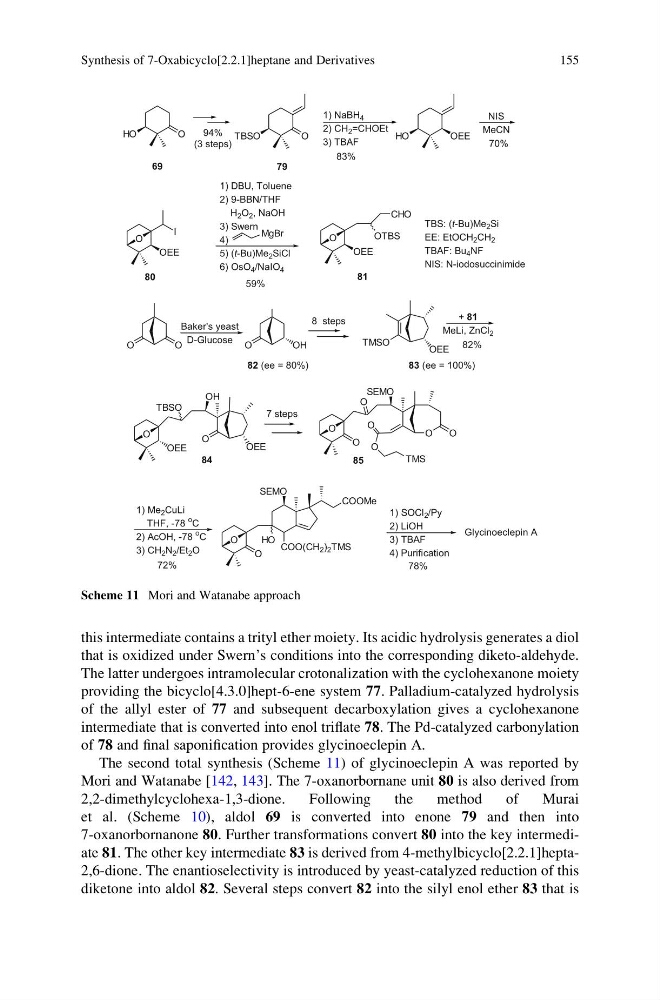
The second total synthesis (Scheme 11) of glycinoeclepin A was reported by
Mori and Watanabe [142, 143]. The 7-oxanorbornane unit 80 is also derived from
2,2-dimethylcyclohexa-1,3-dione.
Following
the
method
of
Murai
et al. (Scheme 10), aldol 69 is converted into enone 79 and then into
7-oxanorbornanone 80. Further transformations convert 80 into the key intermediate 81. The other key intermediate 83 is derived from 4-methylbicyclo[2.2.1]hepta2,6-dione. The enantioselectivity is introduced by yeast-catalyzed reduction of this
diketone into aldol 82. Several steps convert 82 into the silyl enol ether 83 that is
O
TBSO
OEE
HO
O
OEE
I
MgBr
OEE
O
OTBS
CHO
O
O
O
O H
OEE
TMSO
OEE
O
TBSO
O
OH
OEE
O
O
O
O
O
SEMO
O
TMS
O
O
O
COOMe
COO(CH 2 ) 2 TMS
HO
SEMO
81
Baker's yeast
D-Glucose
8 steps
82 (ee = 80%)
+ 81
MeLi, ZnCl 2
83 (ee = 100%)
84
1) Me 2 CuLi
THF, -78
o
C
2) AcOH, -78
o
C
3) CH 2 N 2 /Et 2 O
1) SOCl 2 /Py
2) LiOH
3) TBAF
4) Purification
85
TBS: (t-Bu)Me 2 Si
EE: EtOCH 2 CH 2
TBAF: Bu 4 NF
NIS: N-iodosuccinimide
79
80
69
1) NaBH 4
2) CH 2 =CHOEt
3) TBAF
NIS
MeCN
7 steps
Glycinoeclepin A
83%
94%
(3 steps)
70%
1) DBU, Toluene
2) 9-BBN/THF
H 2 O 2 , NaOH
3) Swern
4)
5) (t-Bu)Me 2 SiCl
6) OsO 4 /NaIO 4
59%
82%
72%
78%
O
HO
Scheme 11 Mori and Watanabe approach
Synthesis of 7-Oxabicyclo[2.2.1]heptane and Derivatives
155
that is oxidized under Swern’s conditions into the corresponding diketo-aldehyde.
The latter undergoes intramolecular crotonalization with the cyclohexanone moiety
providing the bicyclo[4.3.0]hept-6-ene system 77. Palladium-catalyzed hydrolysis
of the allyl ester of 77 and subsequent decarboxylation gives a cyclohexanone
intermediate that is converted into enol triflate 78. The Pd-catalyzed carbonylation
of 78 and final saponification provides glycinoeclepin A.
The second total synthesis (Scheme 11) of glycinoeclepin A was reported by
Mori and Watanabe [142, 143]. The 7-oxanorbornane unit 80 is also derived from
2,2-dimethylcyclohexa-1,3-dione.
Following
the
method
of
Murai
et al. (Scheme 10), aldol 69 is converted into enone 79 and then into
7-oxanorbornanone 80. Further transformations convert 80 into the key intermediate 81. The other key intermediate 83 is derived from 4-methylbicyclo[2.2.1]hepta2,6-dione. The enantioselectivity is introduced by yeast-catalyzed reduction of this
diketone into aldol 82. Several steps convert 82 into the silyl enol ether 83 that is
O
TBSO
OEE
HO
O
OEE
I
MgBr
OEE
O
OTBS
CHO
O
O
O
O H
OEE
TMSO
OEE
O
TBSO
O
OH
OEE
O
O
O
O
O
SEMO
O
TMS
O
O
O
COOMe
COO(CH 2 ) 2 TMS
HO
SEMO
81
Baker's yeast
D-Glucose
8 steps
82 (ee = 80%)
+ 81
MeLi, ZnCl 2
83 (ee = 100%)
84
1) Me 2 CuLi
THF, -78
o
C
2) AcOH, -78
o
C
3) CH 2 N 2 /Et 2 O
1) SOCl 2 /Py
2) LiOH
3) TBAF
4) Purification
85
TBS: (t-Bu)Me 2 Si
EE: EtOCH 2 CH 2
TBAF: Bu 4 NF
NIS: N-iodosuccinimide
79
80
69
1) NaBH 4
2) CH 2 =CHOEt
3) TBAF
NIS
MeCN
7 steps
Glycinoeclepin A
83%
94%
(3 steps)
70%
1) DBU, Toluene
2) 9-BBN/THF
H 2 O 2 , NaOH
3) Swern
4)
5) (t-Bu)Me 2 SiCl
6) OsO 4 /NaIO 4
59%
82%
72%
78%
O
HO
Scheme 11 Mori and Watanabe approach
Synthesis of 7-Oxabicyclo[2.2.1]heptane and Derivatives
155