

condensed with aldehyde 81 through a Mukaiyama cross-aldol reaction giving 84.
Several steps then convert aldol 84 into lactone 85 and finally into glycinoeclepin A
(Scheme 11).
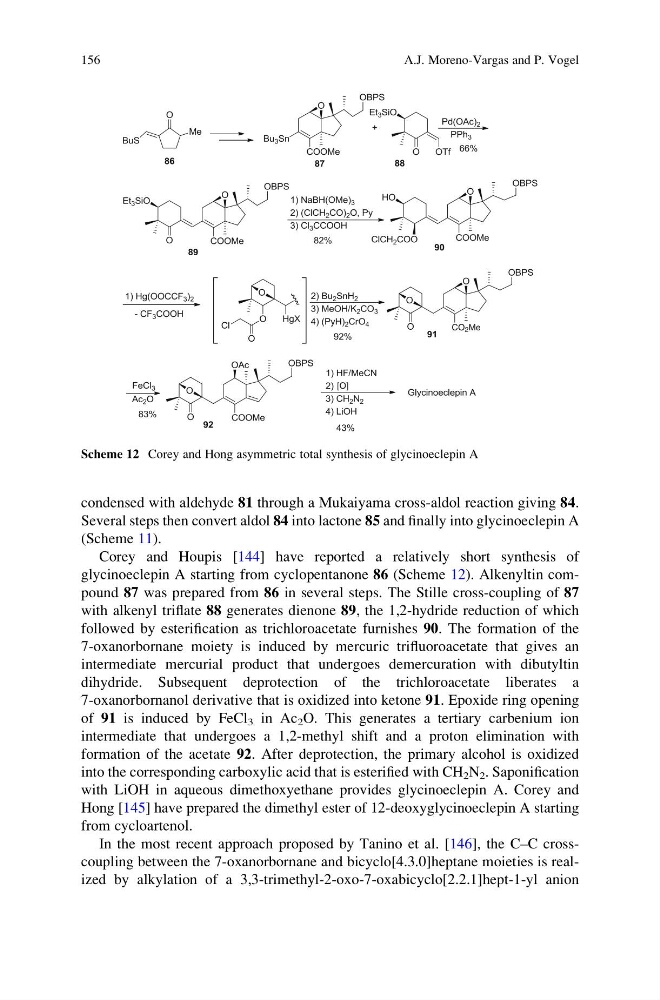
Corey and Houpis [144] have reported a relatively short synthesis of
glycinoeclepin A starting from cyclopentanone 86 (Scheme 12). Alkenyltin compound 87 was prepared from 86 in several steps. The Stille cross-coupling of 87
with alkenyl triflate 88 generates dienone 89, the 1,2-hydride reduction of which
followed by esterification as trichloroacetate furnishes 90. The formation of the
7-oxanorbornane moiety is induced by mercuric trifluoroacetate that gives an
intermediate mercurial product that undergoes demercuration with dibutyltin
dihydride. Subsequent deprotection of the trichloroacetate liberates a
7-oxanorbornanol derivative that is oxidized into ketone 91. Epoxide ring opening
of 91 is induced by FeCl 3 in Ac 2 O. This generates a tertiary carbenium ion
intermediate that undergoes a 1,2-methyl shift and a proton elimination with
formation of the acetate 92. After deprotection, the primary alcohol is oxidized
into the corresponding carboxylic acid that is esterified with CH 2 N 2 . Saponification
with LiOH in aqueous dimethoxyethane provides glycinoeclepin A. Corey and
Hong [145] have prepared the dimethyl ester of 12-deoxyglycinoeclepin A starting
from cycloartenol.
In the most recent approach proposed by Tanino et al. [146], the C–C crosscoupling between the 7-oxanorbornane and bicyclo[4.3.0]heptane moieties is realized by alkylation of a 3,3-trimethyl-2-oxo-7-oxabicyclo[2.2.1]hept-1-yl anion
CO2Me
[O]
Scheme 12 Corey and Hong asymmetric total synthesis of glycinoeclepin A
156
A.J. Moreno-Vargas and P. Vogel
Several steps then convert aldol 84 into lactone 85 and finally into glycinoeclepin A
(Scheme 11).
Corey and Houpis [144] have reported a relatively short synthesis of
glycinoeclepin A starting from cyclopentanone 86 (Scheme 12). Alkenyltin compound 87 was prepared from 86 in several steps. The Stille cross-coupling of 87
with alkenyl triflate 88 generates dienone 89, the 1,2-hydride reduction of which
followed by esterification as trichloroacetate furnishes 90. The formation of the
7-oxanorbornane moiety is induced by mercuric trifluoroacetate that gives an
intermediate mercurial product that undergoes demercuration with dibutyltin
dihydride. Subsequent deprotection of the trichloroacetate liberates a
7-oxanorbornanol derivative that is oxidized into ketone 91. Epoxide ring opening
of 91 is induced by FeCl 3 in Ac 2 O. This generates a tertiary carbenium ion
intermediate that undergoes a 1,2-methyl shift and a proton elimination with
formation of the acetate 92. After deprotection, the primary alcohol is oxidized
into the corresponding carboxylic acid that is esterified with CH 2 N 2 . Saponification
with LiOH in aqueous dimethoxyethane provides glycinoeclepin A. Corey and
Hong [145] have prepared the dimethyl ester of 12-deoxyglycinoeclepin A starting
from cycloartenol.
In the most recent approach proposed by Tanino et al. [146], the C–C crosscoupling between the 7-oxanorbornane and bicyclo[4.3.0]heptane moieties is realized by alkylation of a 3,3-trimethyl-2-oxo-7-oxabicyclo[2.2.1]hept-1-yl anion
CO2Me
[O]
Scheme 12 Corey and Hong asymmetric total synthesis of glycinoeclepin A
156
A.J. Moreno-Vargas and P. Vogel