

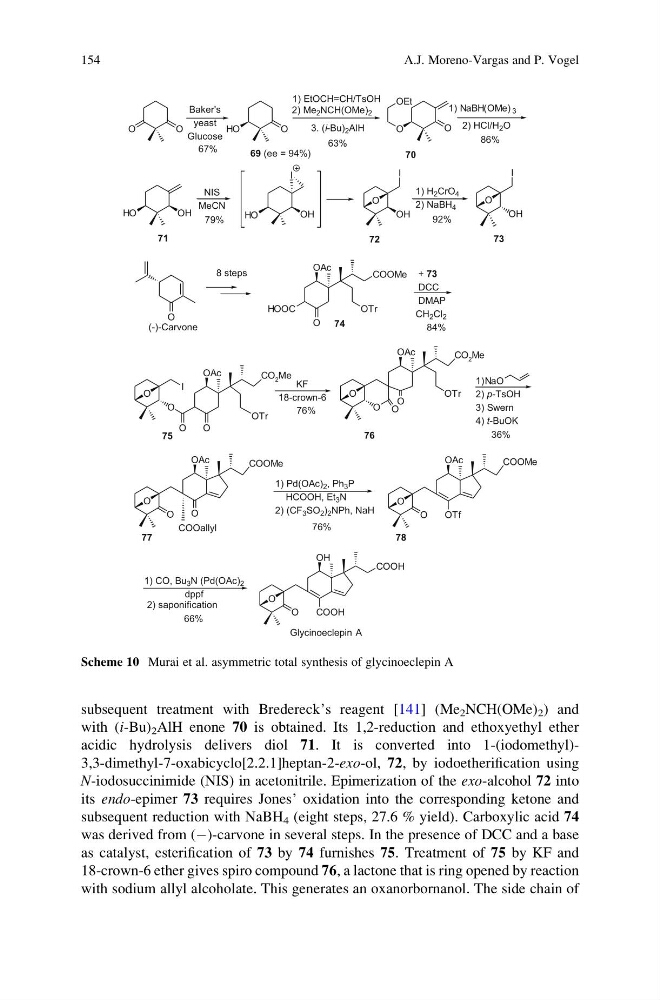
subsequent treatment with Bredereck’s reagent [141] (Me 2 NCH(OMe) 2 ) and
with (i-Bu) 2 AlH enone 70 is obtained. Its 1,2-reduction and ethoxyethyl ether
acidic hydrolysis delivers diol 71. It is converted into 1-(iodomethyl)3,3-dimethyl-7-oxabicyclo[2.2.1]heptan-2-exo-ol, 72, by iodoetherification using
N-iodosuccinimide (NIS) in acetonitrile. Epimerization of the exo-alcohol 72 into
its endo-epimer 73 requires Jones’ oxidation into the corresponding ketone and
subsequent reduction with NaBH 4 (eight steps, 27.6 % yield). Carboxylic acid 74
was derived from (À)-carvone in several steps. In the presence of DCC and a base
as catalyst, esterification of 73 by 74 furnishes 75. Treatment of 75 by KF and
18-crown-6 ether gives spiro compound 76, a lactone that is ring opened by reaction
with sodium allyl alcoholate. This generates an oxanorbornanol. The side chain of
O
I
OH
O
O
H O
O
O
O
OEt
OAc
O
COOMe
O
O
COOallyl
NaO
OAc
OTf
COOMe
O
O
O
OH
COOH
COOH
O
HO
OH
I
O
OAc
O
OTr
O
O
CO 2 Me
I
OH
HO
I
O
OH
O
1) NaBH(OMe) 3
OAc
O
OTr
CO 2 Me
O
O
O
OTr
HOOC
OAc
O
COOMe
Baker's
yeast
Glucose
2) Me 2 NCH(OMe) 2
70
NIS
MeCN
1) H 2 CrO 4
2) NaBH 4
72
73
KF
18-crown-6
(-)-Carvone
78
69 (ee = 94%)
3. (i-Bu) 2 AlH
2) HCl/H 2 O
71
74
2) saponification
1) EtOCH=CH/TsOH
+ 73
DCC
DMAP
CH 2 Cl 2
75
1)
2) p-TsOH
3) Swern
4) t-BuOK
76
77
1) Pd(OAc) 2 , Ph 3 P
HCOOH, Et 3 N
2) (CF 3 SO 2 ) 2 NPh, NaH
1) CO, Bu 3 N (Pd(OAc) 2
dppf
Glycinoeclepin A
79%
86%
8 steps
67%
63%
92%
84%
76%
36%
76%
66%
Scheme 10 Murai et al. asymmetric total synthesis of glycinoeclepin A
154
A.J. Moreno-Vargas and P. Vogel
with (i-Bu) 2 AlH enone 70 is obtained. Its 1,2-reduction and ethoxyethyl ether
acidic hydrolysis delivers diol 71. It is converted into 1-(iodomethyl)3,3-dimethyl-7-oxabicyclo[2.2.1]heptan-2-exo-ol, 72, by iodoetherification using
N-iodosuccinimide (NIS) in acetonitrile. Epimerization of the exo-alcohol 72 into
its endo-epimer 73 requires Jones’ oxidation into the corresponding ketone and
subsequent reduction with NaBH 4 (eight steps, 27.6 % yield). Carboxylic acid 74
was derived from (À)-carvone in several steps. In the presence of DCC and a base
as catalyst, esterification of 73 by 74 furnishes 75. Treatment of 75 by KF and
18-crown-6 ether gives spiro compound 76, a lactone that is ring opened by reaction
with sodium allyl alcoholate. This generates an oxanorbornanol. The side chain of
O
I
OH
O
O
H O
O
O
O
OEt
OAc
O
COOMe
O
O
COOallyl
NaO
OAc
OTf
COOMe
O
O
O
OH
COOH
COOH
O
HO
OH
I
O
OAc
O
OTr
O
O
CO 2 Me
I
OH
HO
I
O
OH
O
1) NaBH(OMe) 3
OAc
O
OTr
CO 2 Me
O
O
O
OTr
HOOC
OAc
O
COOMe
Baker's
yeast
Glucose
2) Me 2 NCH(OMe) 2
70
NIS
MeCN
1) H 2 CrO 4
2) NaBH 4
72
73
KF
18-crown-6
(-)-Carvone
78
69 (ee = 94%)
3. (i-Bu) 2 AlH
2) HCl/H 2 O
71
74
2) saponification
1) EtOCH=CH/TsOH
+ 73
DCC
DMAP
CH 2 Cl 2
75
1)
2) p-TsOH
3) Swern
4) t-BuOK
76
77
1) Pd(OAc) 2 , Ph 3 P
HCOOH, Et 3 N
2) (CF 3 SO 2 ) 2 NPh, NaH
1) CO, Bu 3 N (Pd(OAc) 2
dppf
Glycinoeclepin A
79%
86%
8 steps
67%
63%
92%
84%
76%
36%
76%
66%
Scheme 10 Murai et al. asymmetric total synthesis of glycinoeclepin A
154
A.J. Moreno-Vargas and P. Vogel