

3.5 Triterpenoid 7-Oxabicyclo[2.2.1]heptanes
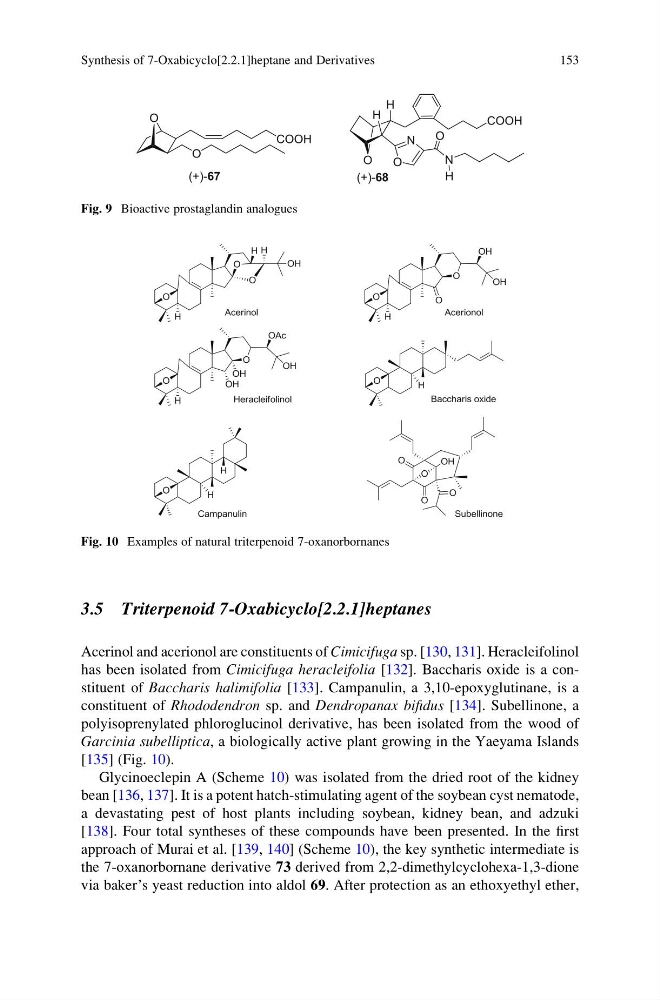
Acerinol and acerionol are constituents of Cimicifuga sp. [130, 131]. Heracleifolinol
has been isolated from Cimicifuga heracleifolia [132]. Baccharis oxide is a constituent of Baccharis halimifolia [133]. Campanulin, a 3,10-epoxyglutinane, is a
constituent of Rhododendron sp. and Dendropanax bifidus [134]. Subellinone, a
polyisoprenylated phloroglucinol derivative, has been isolated from the wood of
Garcinia subelliptica, a biologically active plant growing in the Yaeyama Islands
[135] (Fig. 10).
Glycinoeclepin A (Scheme 10) was isolated from the dried root of the kidney
bean [136, 137]. It is a potent hatch-stimulating agent of the soybean cyst nematode,
a devastating pest of host plants including soybean, kidney bean, and adzuki
[138]. Four total syntheses of these compounds have been presented. In the first
approach of Murai et al. [139, 140] (Scheme 10), the key synthetic intermediate is
the 7-oxanorbornane derivative 73 derived from 2,2-dimethylcyclohexa-1,3-dione
via baker’s yeast reduction into aldol 69. After protection as an ethoxyethyl ether,
Fig. 10 Examples of natural triterpenoid 7-oxanorbornanes
O
COOH
O
(+)-67
O
COOH
H
H
N
N
O
H
O
(+)-68
Fig. 9 Bioactive prostaglandin analogues
Synthesis of 7-Oxabicyclo[2.2.1]heptane and Derivatives
153
Acerinol and acerionol are constituents of Cimicifuga sp. [130, 131]. Heracleifolinol
has been isolated from Cimicifuga heracleifolia [132]. Baccharis oxide is a constituent of Baccharis halimifolia [133]. Campanulin, a 3,10-epoxyglutinane, is a
constituent of Rhododendron sp. and Dendropanax bifidus [134]. Subellinone, a
polyisoprenylated phloroglucinol derivative, has been isolated from the wood of
Garcinia subelliptica, a biologically active plant growing in the Yaeyama Islands
[135] (Fig. 10).
Glycinoeclepin A (Scheme 10) was isolated from the dried root of the kidney
bean [136, 137]. It is a potent hatch-stimulating agent of the soybean cyst nematode,
a devastating pest of host plants including soybean, kidney bean, and adzuki
[138]. Four total syntheses of these compounds have been presented. In the first
approach of Murai et al. [139, 140] (Scheme 10), the key synthetic intermediate is
the 7-oxanorbornane derivative 73 derived from 2,2-dimethylcyclohexa-1,3-dione
via baker’s yeast reduction into aldol 69. After protection as an ethoxyethyl ether,
Fig. 10 Examples of natural triterpenoid 7-oxanorbornanes
O
COOH
O
(+)-67
O
COOH
H
H
N
N
O
H
O
(+)-68
Fig. 9 Bioactive prostaglandin analogues
Synthesis of 7-Oxabicyclo[2.2.1]heptane and Derivatives
153