

2B (PP2B)] which is a calcium- and calmodulin-regulated enzyme composed
of a 59-kDa catalytic subunit (CnA) and a 19-kDa calcium-binding subunit (CnB)
[49, 50]. This enzyme is a key signaling enzyme in T-lymphocyte activation.
Its inhibition in T-lymphocytes prevents the formation of active transcription
factors such as NF-AT and NF-IL2A, which are essential for interleukin-2 (IL2)
gene expression [51]. Inhibition of calcineurin leads to the disruption of the
cellular immune response since IL2 is necessary for the T-cell proliferation.
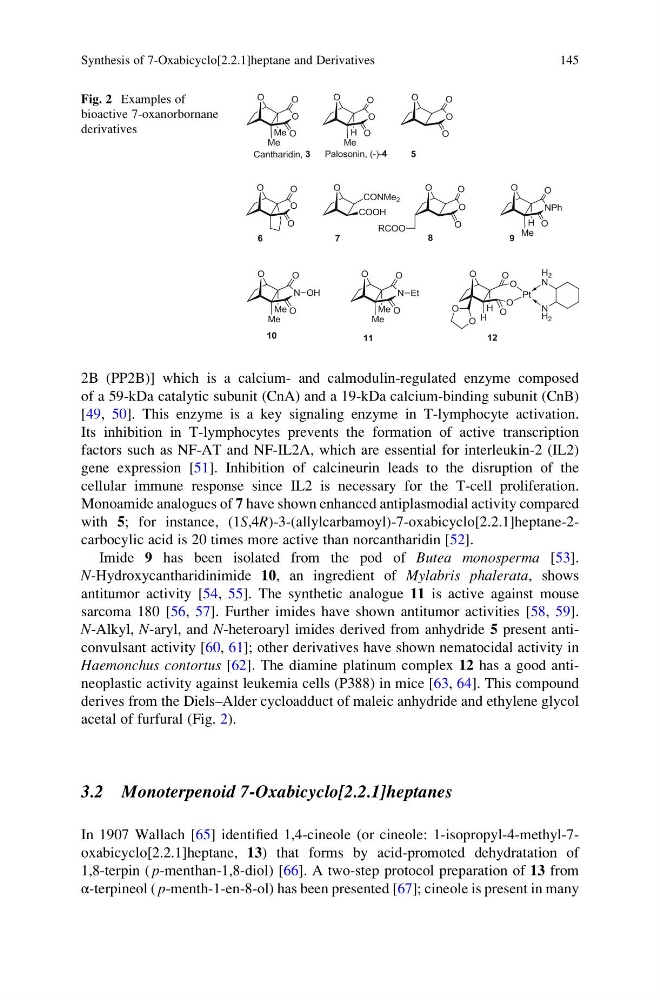
Monoamide analogues of 7 have shown enhanced antiplasmodial activity compared
with 5; for instance, (1S,4R)-3-(allylcarbamoyl)-7-oxabicyclo[2.2.1]heptane-2carbocylic acid is 20 times more active than norcantharidin [52].
Imide 9 has been isolated from the pod of Butea monosperma [53].
N-Hydroxycantharidinimide 10, an ingredient of Mylabris phalerata, shows
antitumor activity [54, 55]. The synthetic analogue 11 is active against mouse
sarcoma 180 [56, 57]. Further imides have shown antitumor activities [58, 59].
N-Alkyl, N-aryl, and N-heteroaryl imides derived from anhydride 5 present anticonvulsant activity [60, 61]; other derivatives have shown nematocidal activity in
Haemonchus contortus [62]. The diamine platinum complex 12 has a good antineoplastic activity against leukemia cells (P388) in mice [63, 64]. This compound
derives from the Diels–Alder cycloadduct of maleic anhydride and ethylene glycol
acetal of furfural (Fig. 2).
3.2 Monoterpenoid 7-Oxabicyclo[2.2.1]heptanes
In 1907 Wallach [65] identified 1,4-cineole (or cineole: 1-isopropyl-4-methyl-7oxabicyclo[2.2.1]heptane, 13) that forms by acid-promoted dehydratation of
1,8-terpin ( p-menthan-1,8-diol) [66]. A two-step protocol preparation of 13 from
α-terpineol ( p-menth-1-en-8-ol) has been presented [67]; cineole is present in many
Fig. 2 Examples of
bioactive 7-oxanorbornane
derivatives
Synthesis of 7-Oxabicyclo[2.2.1]heptane and Derivatives
145
of a 59-kDa catalytic subunit (CnA) and a 19-kDa calcium-binding subunit (CnB)
[49, 50]. This enzyme is a key signaling enzyme in T-lymphocyte activation.
Its inhibition in T-lymphocytes prevents the formation of active transcription
factors such as NF-AT and NF-IL2A, which are essential for interleukin-2 (IL2)
gene expression [51]. Inhibition of calcineurin leads to the disruption of the
cellular immune response since IL2 is necessary for the T-cell proliferation.
Monoamide analogues of 7 have shown enhanced antiplasmodial activity compared
with 5; for instance, (1S,4R)-3-(allylcarbamoyl)-7-oxabicyclo[2.2.1]heptane-2carbocylic acid is 20 times more active than norcantharidin [52].
Imide 9 has been isolated from the pod of Butea monosperma [53].
N-Hydroxycantharidinimide 10, an ingredient of Mylabris phalerata, shows
antitumor activity [54, 55]. The synthetic analogue 11 is active against mouse
sarcoma 180 [56, 57]. Further imides have shown antitumor activities [58, 59].
N-Alkyl, N-aryl, and N-heteroaryl imides derived from anhydride 5 present anticonvulsant activity [60, 61]; other derivatives have shown nematocidal activity in
Haemonchus contortus [62]. The diamine platinum complex 12 has a good antineoplastic activity against leukemia cells (P388) in mice [63, 64]. This compound
derives from the Diels–Alder cycloadduct of maleic anhydride and ethylene glycol
acetal of furfural (Fig. 2).
3.2 Monoterpenoid 7-Oxabicyclo[2.2.1]heptanes
In 1907 Wallach [65] identified 1,4-cineole (or cineole: 1-isopropyl-4-methyl-7oxabicyclo[2.2.1]heptane, 13) that forms by acid-promoted dehydratation of
1,8-terpin ( p-menthan-1,8-diol) [66]. A two-step protocol preparation of 13 from
α-terpineol ( p-menth-1-en-8-ol) has been presented [67]; cineole is present in many
Fig. 2 Examples of
bioactive 7-oxanorbornane
derivatives
Synthesis of 7-Oxabicyclo[2.2.1]heptane and Derivatives
145