

plants and in perfumes [68]. It is found in Tequila [69], in leaves and flowers from
Bellis perennis (the common daisy [70]), and in essential oils of various lemon tree
leaves [71]. Cineole is formed together with myrtenol and trans-pinocarveol by
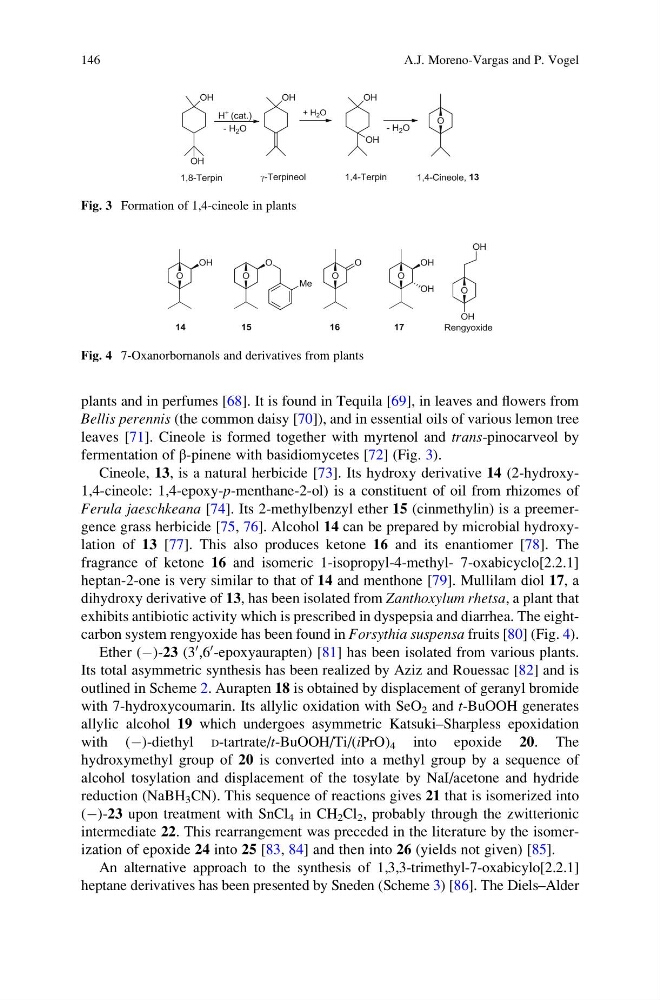
fermentation of β-pinene with basidiomycetes [72] (Fig. 3).
Cineole, 13, is a natural herbicide [73]. Its hydroxy derivative 14 (2-hydroxy1,4-cineole: 1,4-epoxy-p-menthane-2-ol) is a constituent of oil from rhizomes of
Ferula jaeschkeana [74]. Its 2-methylbenzyl ether 15 (cinmethylin) is a preemergence grass herbicide [75, 76]. Alcohol 14 can be prepared by microbial hydroxylation of 13 [77]. This also produces ketone 16 and its enantiomer [78]. The
fragrance of ketone 16 and isomeric 1-isopropyl-4-methyl- 7-oxabicyclo[2.2.1]
heptan-2-one is very similar to that of 14 and menthone [79]. Mullilam diol 17, a
dihydroxy derivative of 13, has been isolated from Zanthoxylum rhetsa, a plant that
exhibits antibiotic activity which is prescribed in dyspepsia and diarrhea. The eightcarbon system rengyoxide has been found in Forsythia suspensa fruits [80] (Fig. 4).
Ether (À)-23 (3
0 ,6
0 -epoxyaurapten) [81] has been isolated from various plants.
Its total asymmetric synthesis has been realized by Aziz and Rouessac [82] and is
outlined in Scheme 2. Aurapten 18 is obtained by displacement of geranyl bromide
with 7-hydroxycoumarin. Its allylic oxidation with SeO 2 and t-BuOOH generates
allylic alcohol 19 which undergoes asymmetric Katsuki–Sharpless epoxidation
with (À)-diethyl D-tartrate/t-BuOOH/Ti/(iPrO) 4 into epoxide 20. The
hydroxymethyl group of 20 is converted into a methyl group by a sequence of
alcohol tosylation and displacement of the tosylate by NaI/acetone and hydride
reduction (NaBH 3 CN). This sequence of reactions gives 21 that is isomerized into
(À)-23 upon treatment with SnCl 4 in CH 2 Cl 2 , probably through the zwitterionic
intermediate 22. This rearrangement was preceded in the literature by the isomerization of epoxide 24 into 25 [83, 84] and then into 26 (yields not given) [85].
An alternative approach to the synthesis of 1,3,3-trimethyl-7-oxabicylo[2.2.1]
heptane derivatives has been presented by Sneden (Scheme 3) [86]. The Diels–Alder
Fig. 3 Formation of 1,4-cineole in plants
Fig. 4 7-Oxanorbornanols and derivatives from plants
146
A.J. Moreno-Vargas and P. Vogel
Bellis perennis (the common daisy [70]), and in essential oils of various lemon tree
leaves [71]. Cineole is formed together with myrtenol and trans-pinocarveol by
fermentation of β-pinene with basidiomycetes [72] (Fig. 3).
Cineole, 13, is a natural herbicide [73]. Its hydroxy derivative 14 (2-hydroxy1,4-cineole: 1,4-epoxy-p-menthane-2-ol) is a constituent of oil from rhizomes of
Ferula jaeschkeana [74]. Its 2-methylbenzyl ether 15 (cinmethylin) is a preemergence grass herbicide [75, 76]. Alcohol 14 can be prepared by microbial hydroxylation of 13 [77]. This also produces ketone 16 and its enantiomer [78]. The
fragrance of ketone 16 and isomeric 1-isopropyl-4-methyl- 7-oxabicyclo[2.2.1]
heptan-2-one is very similar to that of 14 and menthone [79]. Mullilam diol 17, a
dihydroxy derivative of 13, has been isolated from Zanthoxylum rhetsa, a plant that
exhibits antibiotic activity which is prescribed in dyspepsia and diarrhea. The eightcarbon system rengyoxide has been found in Forsythia suspensa fruits [80] (Fig. 4).
Ether (À)-23 (3
0 ,6
0 -epoxyaurapten) [81] has been isolated from various plants.
Its total asymmetric synthesis has been realized by Aziz and Rouessac [82] and is
outlined in Scheme 2. Aurapten 18 is obtained by displacement of geranyl bromide
with 7-hydroxycoumarin. Its allylic oxidation with SeO 2 and t-BuOOH generates
allylic alcohol 19 which undergoes asymmetric Katsuki–Sharpless epoxidation
with (À)-diethyl D-tartrate/t-BuOOH/Ti/(iPrO) 4 into epoxide 20. The
hydroxymethyl group of 20 is converted into a methyl group by a sequence of
alcohol tosylation and displacement of the tosylate by NaI/acetone and hydride
reduction (NaBH 3 CN). This sequence of reactions gives 21 that is isomerized into
(À)-23 upon treatment with SnCl 4 in CH 2 Cl 2 , probably through the zwitterionic
intermediate 22. This rearrangement was preceded in the literature by the isomerization of epoxide 24 into 25 [83, 84] and then into 26 (yields not given) [85].
An alternative approach to the synthesis of 1,3,3-trimethyl-7-oxabicylo[2.2.1]
heptane derivatives has been presented by Sneden (Scheme 3) [86]. The Diels–Alder
Fig. 3 Formation of 1,4-cineole in plants
Fig. 4 7-Oxanorbornanols and derivatives from plants
146
A.J. Moreno-Vargas and P. Vogel