

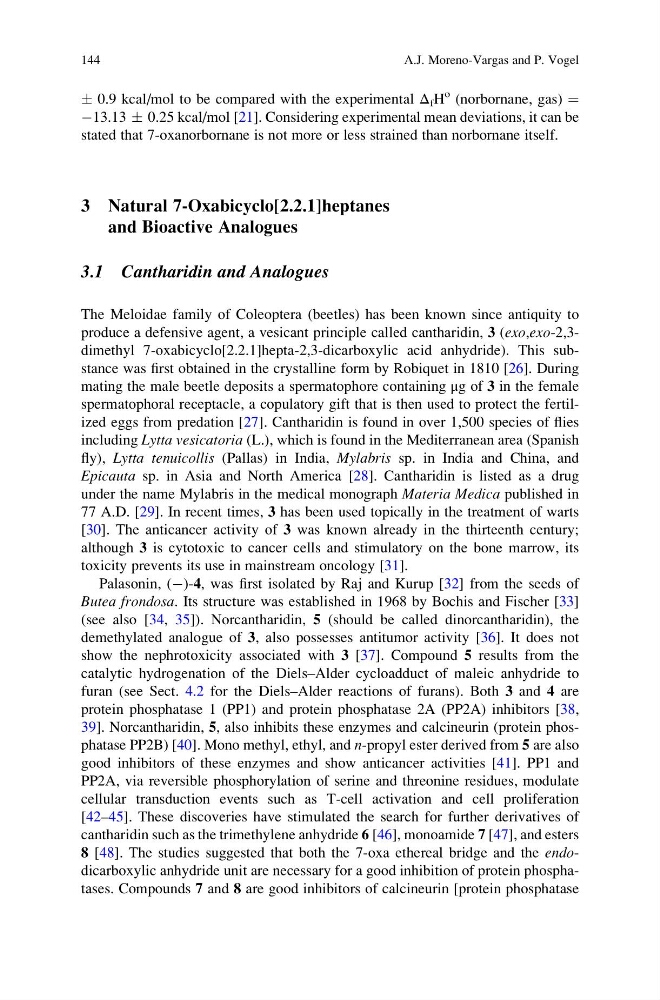
Æ 0.9 kcal/mol to be compared with the experimental Δ f H
o (norbornane, gas) ¼
À13.13 Æ 0.25 kcal/mol [21]. Considering experimental mean deviations, it can be
stated that 7-oxanorbornane is not more or less strained than norbornane itself.
3 Natural 7-Oxabicyclo[2.2.1]heptanes
and Bioactive Analogues
3.1 Cantharidin and Analogues
The Meloidae family of Coleoptera (beetles) has been known since antiquity to
produce a defensive agent, a vesicant principle called cantharidin, 3 (exo,exo-2,3dimethyl 7-oxabicyclo[2.2.1]hepta-2,3-dicarboxylic acid anhydride). This substance was first obtained in the crystalline form by Robiquet in 1810 [26]. During
mating the male beetle deposits a spermatophore containing μg of 3 in the female
spermatophoral receptacle, a copulatory gift that is then used to protect the fertilized eggs from predation [27]. Cantharidin is found in over 1,500 species of flies
including Lytta vesicatoria (L.), which is found in the Mediterranean area (Spanish
fly), Lytta tenuicollis (Pallas) in India, Mylabris sp. in India and China, and
Epicauta sp. in Asia and North America [28]. Cantharidin is listed as a drug
under the name Mylabris in the medical monograph Materia Medica published in
77 A.D. [29]. In recent times, 3 has been used topically in the treatment of warts
[30]. The anticancer activity of 3 was known already in the thirteenth century;
although 3 is cytotoxic to cancer cells and stimulatory on the bone marrow, its
toxicity prevents its use in mainstream oncology [31].
Palasonin, (À)-4, was first isolated by Raj and Kurup [32] from the seeds of
Butea frondosa. Its structure was established in 1968 by Bochis and Fischer [33]
(see also [34, 35]). Norcantharidin, 5 (should be called dinorcantharidin), the
demethylated analogue of 3, also possesses antitumor activity [36]. It does not
show the nephrotoxicity associated with 3 [37]. Compound 5 results from the
catalytic hydrogenation of the Diels–Alder cycloadduct of maleic anhydride to
furan (see Sect. 4.2 for the Diels–Alder reactions of furans). Both 3 and 4 are
protein phosphatase 1 (PP1) and protein phosphatase 2A (PP2A) inhibitors [38,
39]. Norcantharidin, 5, also inhibits these enzymes and calcineurin (protein phosphatase PP2B) [40]. Mono methyl, ethyl, and n-propyl ester derived from 5 are also
good inhibitors of these enzymes and show anticancer activities [41]. PP1 and
PP2A, via reversible phosphorylation of serine and threonine residues, modulate
cellular transduction events such as T-cell activation and cell proliferation
[42–45]. These discoveries have stimulated the search for further derivatives of
cantharidin such as the trimethylene anhydride 6 [46], monoamide 7 [47], and esters
8 [48]. The studies suggested that both the 7-oxa ethereal bridge and the endodicarboxylic anhydride unit are necessary for a good inhibition of protein phosphatases. Compounds 7 and 8 are good inhibitors of calcineurin [protein phosphatase
144
A.J. Moreno-Vargas and P. Vogel
o (norbornane, gas) ¼
À13.13 Æ 0.25 kcal/mol [21]. Considering experimental mean deviations, it can be
stated that 7-oxanorbornane is not more or less strained than norbornane itself.
3 Natural 7-Oxabicyclo[2.2.1]heptanes
and Bioactive Analogues
3.1 Cantharidin and Analogues
The Meloidae family of Coleoptera (beetles) has been known since antiquity to
produce a defensive agent, a vesicant principle called cantharidin, 3 (exo,exo-2,3dimethyl 7-oxabicyclo[2.2.1]hepta-2,3-dicarboxylic acid anhydride). This substance was first obtained in the crystalline form by Robiquet in 1810 [26]. During
mating the male beetle deposits a spermatophore containing μg of 3 in the female
spermatophoral receptacle, a copulatory gift that is then used to protect the fertilized eggs from predation [27]. Cantharidin is found in over 1,500 species of flies
including Lytta vesicatoria (L.), which is found in the Mediterranean area (Spanish
fly), Lytta tenuicollis (Pallas) in India, Mylabris sp. in India and China, and
Epicauta sp. in Asia and North America [28]. Cantharidin is listed as a drug
under the name Mylabris in the medical monograph Materia Medica published in
77 A.D. [29]. In recent times, 3 has been used topically in the treatment of warts
[30]. The anticancer activity of 3 was known already in the thirteenth century;
although 3 is cytotoxic to cancer cells and stimulatory on the bone marrow, its
toxicity prevents its use in mainstream oncology [31].
Palasonin, (À)-4, was first isolated by Raj and Kurup [32] from the seeds of
Butea frondosa. Its structure was established in 1968 by Bochis and Fischer [33]
(see also [34, 35]). Norcantharidin, 5 (should be called dinorcantharidin), the
demethylated analogue of 3, also possesses antitumor activity [36]. It does not
show the nephrotoxicity associated with 3 [37]. Compound 5 results from the
catalytic hydrogenation of the Diels–Alder cycloadduct of maleic anhydride to
furan (see Sect. 4.2 for the Diels–Alder reactions of furans). Both 3 and 4 are
protein phosphatase 1 (PP1) and protein phosphatase 2A (PP2A) inhibitors [38,
39]. Norcantharidin, 5, also inhibits these enzymes and calcineurin (protein phosphatase PP2B) [40]. Mono methyl, ethyl, and n-propyl ester derived from 5 are also
good inhibitors of these enzymes and show anticancer activities [41]. PP1 and
PP2A, via reversible phosphorylation of serine and threonine residues, modulate
cellular transduction events such as T-cell activation and cell proliferation
[42–45]. These discoveries have stimulated the search for further derivatives of
cantharidin such as the trimethylene anhydride 6 [46], monoamide 7 [47], and esters
8 [48]. The studies suggested that both the 7-oxa ethereal bridge and the endodicarboxylic anhydride unit are necessary for a good inhibition of protein phosphatases. Compounds 7 and 8 are good inhibitors of calcineurin [protein phosphatase
144
A.J. Moreno-Vargas and P. Vogel