

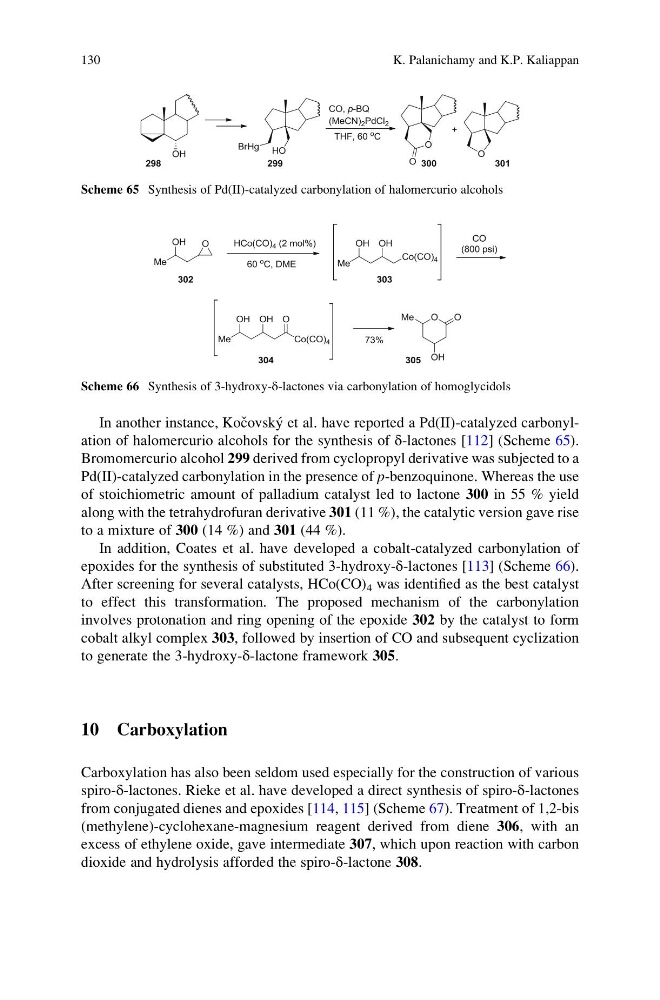
In another instance, Koc ˇovsky ´ et al. have reported a Pd(II)-catalyzed carbonylation of halomercurio alcohols for the synthesis of δ-lactones [112] (Scheme 65).
Bromomercurio alcohol 299 derived from cyclopropyl derivative was subjected to a
Pd(II)-catalyzed carbonylation in the presence of p-benzoquinone. Whereas the use
of stoichiometric amount of palladium catalyst led to lactone 300 in 55 % yield
along with the tetrahydrofuran derivative 301 (11 %), the catalytic version gave rise
to a mixture of 300 (14 %) and 301 (44 %).
In addition, Coates et al. have developed a cobalt-catalyzed carbonylation of
epoxides for the synthesis of substituted 3-hydroxy-δ-lactones [113] (Scheme 66).
After screening for several catalysts, HCo(CO) 4 was identified as the best catalyst
to effect this transformation. The proposed mechanism of the carbonylation
involves protonation and ring opening of the epoxide 302 by the catalyst to form
cobalt alkyl complex 303, followed by insertion of CO and subsequent cyclization
to generate the 3-hydroxy-δ-lactone framework 305.
10 Carboxylation
Carboxylation has also been seldom used especially for the construction of various
spiro-δ-lactones. Rieke et al. have developed a direct synthesis of spiro-δ-lactones
from conjugated dienes and epoxides [114, 115] (Scheme 67). Treatment of 1,2-bis
(methylene)-cyclohexane-magnesium reagent derived from diene 306, with an
excess of ethylene oxide, gave intermediate 307, which upon reaction with carbon
dioxide and hydrolysis afforded the spiro-δ-lactone 308.
Scheme 65 Synthesis of Pd(II)-catalyzed carbonylation of halomercurio alcohols
Scheme 66 Synthesis of 3-hydroxy-δ-lactones via carbonylation of homoglycidols
130
K. Palanichamy and K.P. Kaliappan
Bromomercurio alcohol 299 derived from cyclopropyl derivative was subjected to a
Pd(II)-catalyzed carbonylation in the presence of p-benzoquinone. Whereas the use
of stoichiometric amount of palladium catalyst led to lactone 300 in 55 % yield
along with the tetrahydrofuran derivative 301 (11 %), the catalytic version gave rise
to a mixture of 300 (14 %) and 301 (44 %).
In addition, Coates et al. have developed a cobalt-catalyzed carbonylation of
epoxides for the synthesis of substituted 3-hydroxy-δ-lactones [113] (Scheme 66).
After screening for several catalysts, HCo(CO) 4 was identified as the best catalyst
to effect this transformation. The proposed mechanism of the carbonylation
involves protonation and ring opening of the epoxide 302 by the catalyst to form
cobalt alkyl complex 303, followed by insertion of CO and subsequent cyclization
to generate the 3-hydroxy-δ-lactone framework 305.
10 Carboxylation
Carboxylation has also been seldom used especially for the construction of various
spiro-δ-lactones. Rieke et al. have developed a direct synthesis of spiro-δ-lactones
from conjugated dienes and epoxides [114, 115] (Scheme 67). Treatment of 1,2-bis
(methylene)-cyclohexane-magnesium reagent derived from diene 306, with an
excess of ethylene oxide, gave intermediate 307, which upon reaction with carbon
dioxide and hydrolysis afforded the spiro-δ-lactone 308.
Scheme 65 Synthesis of Pd(II)-catalyzed carbonylation of halomercurio alcohols
Scheme 66 Synthesis of 3-hydroxy-δ-lactones via carbonylation of homoglycidols
130
K. Palanichamy and K.P. Kaliappan