

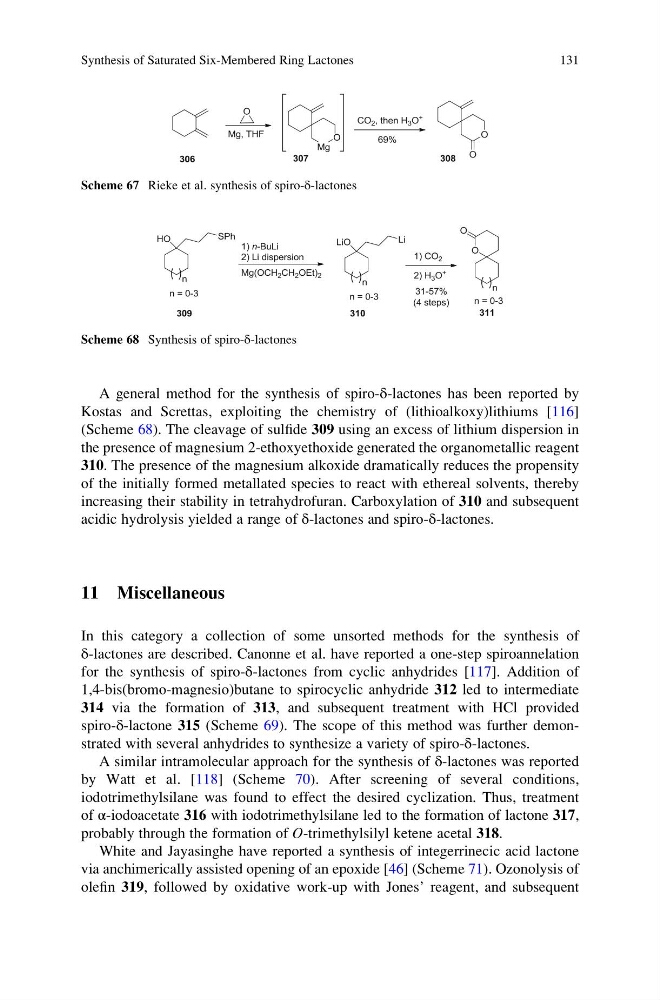
A general method for the synthesis of spiro-δ-lactones has been reported by
Kostas and Screttas, exploiting the chemistry of (lithioalkoxy)lithiums [116]
(Scheme 68). The cleavage of sulfide 309 using an excess of lithium dispersion in
the presence of magnesium 2-ethoxyethoxide generated the organometallic reagent
310. The presence of the magnesium alkoxide dramatically reduces the propensity
of the initially formed metallated species to react with ethereal solvents, thereby
increasing their stability in tetrahydrofuran. Carboxylation of 310 and subsequent
acidic hydrolysis yielded a range of δ-lactones and spiro-δ-lactones.
11 Miscellaneous
In this category a collection of some unsorted methods for the synthesis of
δ-lactones are described. Canonne et al. have reported a one-step spiroannelation
for the synthesis of spiro-δ-lactones from cyclic anhydrides [117]. Addition of
1,4-bis(bromo-magnesio)butane to spirocyclic anhydride 312 led to intermediate
314 via the formation of 313, and subsequent treatment with HCl provided
spiro-δ-lactone 315 (Scheme 69). The scope of this method was further demonstrated with several anhydrides to synthesize a variety of spiro-δ-lactones.
A similar intramolecular approach for the synthesis of δ-lactones was reported
by Watt et al. [118] (Scheme 70). After screening of several conditions,
iodotrimethylsilane was found to effect the desired cyclization. Thus, treatment
of α-iodoacetate 316 with iodotrimethylsilane led to the formation of lactone 317,
probably through the formation of O-trimethylsilyl ketene acetal 318.
White and Jayasinghe have reported a synthesis of integerrinecic acid lactone
via anchimerically assisted opening of an epoxide [46] (Scheme 71). Ozonolysis of
olefin 319, followed by oxidative work-up with Jones’ reagent, and subsequent
Scheme 67 Rieke et al. synthesis of spiro-δ-lactones
Scheme 68 Synthesis of spiro-δ-lactones
Synthesis of Saturated Six-Membered Ring Lactones
131
Kostas and Screttas, exploiting the chemistry of (lithioalkoxy)lithiums [116]
(Scheme 68). The cleavage of sulfide 309 using an excess of lithium dispersion in
the presence of magnesium 2-ethoxyethoxide generated the organometallic reagent
310. The presence of the magnesium alkoxide dramatically reduces the propensity
of the initially formed metallated species to react with ethereal solvents, thereby
increasing their stability in tetrahydrofuran. Carboxylation of 310 and subsequent
acidic hydrolysis yielded a range of δ-lactones and spiro-δ-lactones.
11 Miscellaneous
In this category a collection of some unsorted methods for the synthesis of
δ-lactones are described. Canonne et al. have reported a one-step spiroannelation
for the synthesis of spiro-δ-lactones from cyclic anhydrides [117]. Addition of
1,4-bis(bromo-magnesio)butane to spirocyclic anhydride 312 led to intermediate
314 via the formation of 313, and subsequent treatment with HCl provided
spiro-δ-lactone 315 (Scheme 69). The scope of this method was further demonstrated with several anhydrides to synthesize a variety of spiro-δ-lactones.
A similar intramolecular approach for the synthesis of δ-lactones was reported
by Watt et al. [118] (Scheme 70). After screening of several conditions,
iodotrimethylsilane was found to effect the desired cyclization. Thus, treatment
of α-iodoacetate 316 with iodotrimethylsilane led to the formation of lactone 317,
probably through the formation of O-trimethylsilyl ketene acetal 318.
White and Jayasinghe have reported a synthesis of integerrinecic acid lactone
via anchimerically assisted opening of an epoxide [46] (Scheme 71). Ozonolysis of
olefin 319, followed by oxidative work-up with Jones’ reagent, and subsequent
Scheme 67 Rieke et al. synthesis of spiro-δ-lactones
Scheme 68 Synthesis of spiro-δ-lactones
Synthesis of Saturated Six-Membered Ring Lactones
131