

carbonate gave δ-lactone 287. However, the same reaction in acetonitrile in the
presence of sodium acetate resulted in the formation of the endocyclic lactone 288.
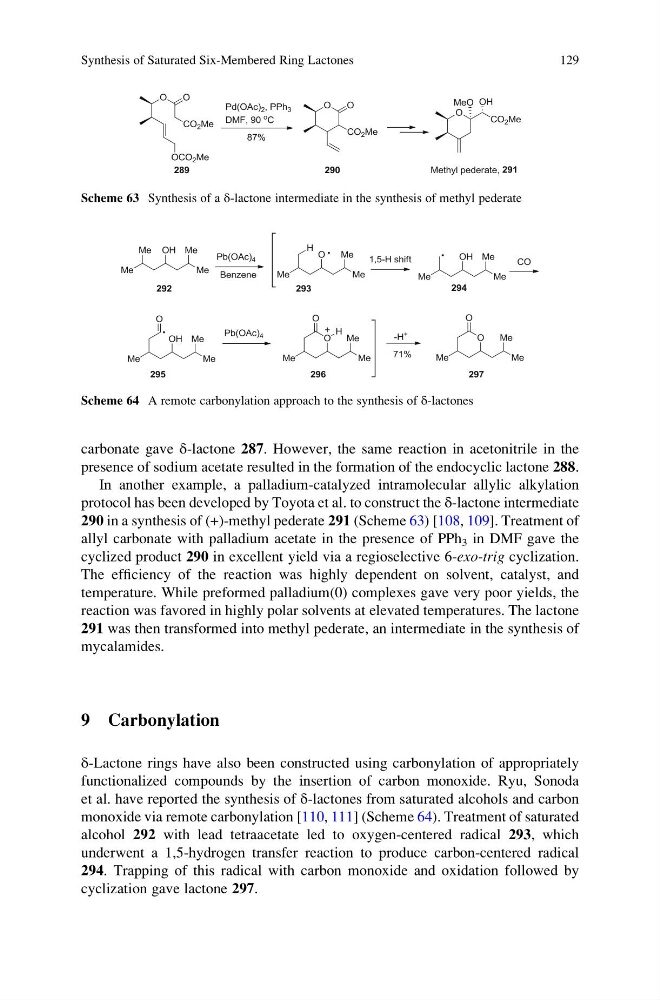
In another example, a palladium-catalyzed intramolecular allylic alkylation
protocol has been developed by Toyota et al. to construct the δ-lactone intermediate
290 in a synthesis of (+)-methyl pederate 291 (Scheme 63) [108, 109]. Treatment of
allyl carbonate with palladium acetate in the presence of PPh 3 in DMF gave the
cyclized product 290 in excellent yield via a regioselective 6-exo-trig cyclization.
The efficiency of the reaction was highly dependent on solvent, catalyst, and
temperature. While preformed palladium(0) complexes gave very poor yields, the
reaction was favored in highly polar solvents at elevated temperatures. The lactone
291 was then transformed into methyl pederate, an intermediate in the synthesis of
mycalamides.
9 Carbonylation
δ-Lactone rings have also been constructed using carbonylation of appropriately
functionalized compounds by the insertion of carbon monoxide. Ryu, Sonoda
et al. have reported the synthesis of δ-lactones from saturated alcohols and carbon
monoxide via remote carbonylation [110, 111] (Scheme 64). Treatment of saturated
alcohol 292 with lead tetraacetate led to oxygen-centered radical 293, which
underwent a 1,5-hydrogen transfer reaction to produce carbon-centered radical
294. Trapping of this radical with carbon monoxide and oxidation followed by
cyclization gave lactone 297.
Scheme 63 Synthesis of a δ-lactone intermediate in the synthesis of methyl pederate
Scheme 64 A remote carbonylation approach to the synthesis of δ-lactones
Synthesis of Saturated Six-Membered Ring Lactones
129
presence of sodium acetate resulted in the formation of the endocyclic lactone 288.
In another example, a palladium-catalyzed intramolecular allylic alkylation
protocol has been developed by Toyota et al. to construct the δ-lactone intermediate
290 in a synthesis of (+)-methyl pederate 291 (Scheme 63) [108, 109]. Treatment of
allyl carbonate with palladium acetate in the presence of PPh 3 in DMF gave the
cyclized product 290 in excellent yield via a regioselective 6-exo-trig cyclization.
The efficiency of the reaction was highly dependent on solvent, catalyst, and
temperature. While preformed palladium(0) complexes gave very poor yields, the
reaction was favored in highly polar solvents at elevated temperatures. The lactone
291 was then transformed into methyl pederate, an intermediate in the synthesis of
mycalamides.
9 Carbonylation
δ-Lactone rings have also been constructed using carbonylation of appropriately
functionalized compounds by the insertion of carbon monoxide. Ryu, Sonoda
et al. have reported the synthesis of δ-lactones from saturated alcohols and carbon
monoxide via remote carbonylation [110, 111] (Scheme 64). Treatment of saturated
alcohol 292 with lead tetraacetate led to oxygen-centered radical 293, which
underwent a 1,5-hydrogen transfer reaction to produce carbon-centered radical
294. Trapping of this radical with carbon monoxide and oxidation followed by
cyclization gave lactone 297.
Scheme 63 Synthesis of a δ-lactone intermediate in the synthesis of methyl pederate
Scheme 64 A remote carbonylation approach to the synthesis of δ-lactones
Synthesis of Saturated Six-Membered Ring Lactones
129