

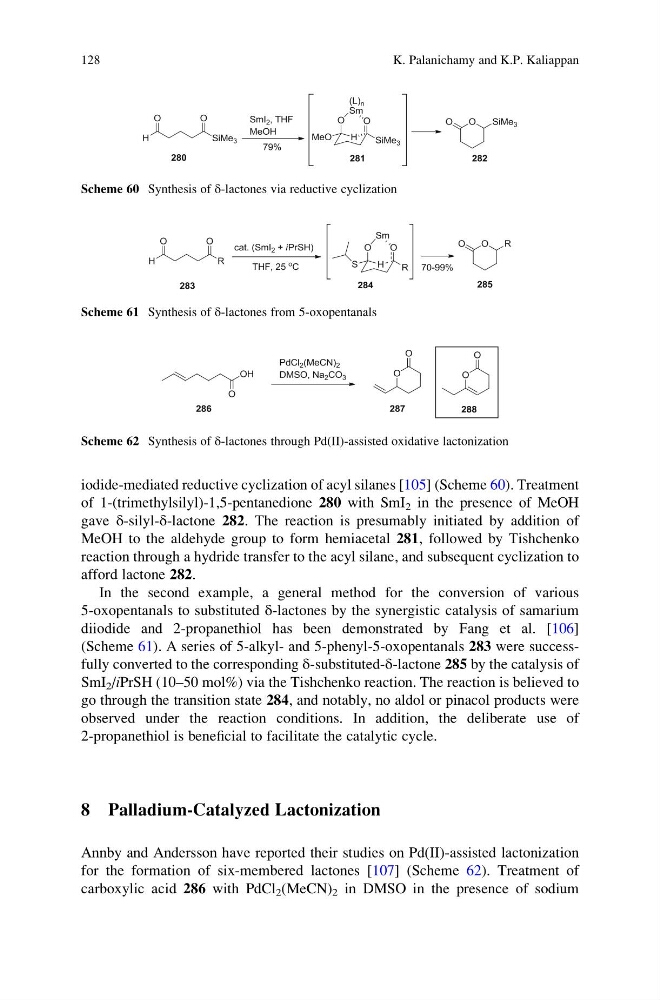
iodide-mediated reductive cyclization of acyl silanes [105] (Scheme 60). Treatment
of 1-(trimethylsilyl)-1,5-pentanedione 280 with SmI 2 in the presence of MeOH
gave δ-silyl-δ-lactone 282. The reaction is presumably initiated by addition of
MeOH to the aldehyde group to form hemiacetal 281, followed by Tishchenko
reaction through a hydride transfer to the acyl silane, and subsequent cyclization to
afford lactone 282.
In the second example, a general method for the conversion of various
5-oxopentanals to substituted δ-lactones by the synergistic catalysis of samarium
diiodide and 2-propanethiol has been demonstrated by Fang et al. [106]
(Scheme 61). A series of 5-alkyl- and 5-phenyl-5-oxopentanals 283 were successfully converted to the corresponding δ-substituted-δ-lactone 285 by the catalysis of
SmI 2 /iPrSH (10–50 mol%) via the Tishchenko reaction. The reaction is believed to
go through the transition state 284, and notably, no aldol or pinacol products were
observed under the reaction conditions. In addition, the deliberate use of
2-propanethiol is beneficial to facilitate the catalytic cycle.
8 Palladium-Catalyzed Lactonization
Annby and Andersson have reported their studies on Pd(II)-assisted lactonization
for the formation of six-membered lactones [107] (Scheme 62). Treatment of
carboxylic acid 286 with PdCl 2 (MeCN) 2 in DMSO in the presence of sodium
Scheme 60 Synthesis of δ-lactones via reductive cyclization
Scheme 61 Synthesis of δ-lactones from 5-oxopentanals
Scheme 62 Synthesis of δ-lactones through Pd(II)-assisted oxidative lactonization
128
K. Palanichamy and K.P. Kaliappan
of 1-(trimethylsilyl)-1,5-pentanedione 280 with SmI 2 in the presence of MeOH
gave δ-silyl-δ-lactone 282. The reaction is presumably initiated by addition of
MeOH to the aldehyde group to form hemiacetal 281, followed by Tishchenko
reaction through a hydride transfer to the acyl silane, and subsequent cyclization to
afford lactone 282.
In the second example, a general method for the conversion of various
5-oxopentanals to substituted δ-lactones by the synergistic catalysis of samarium
diiodide and 2-propanethiol has been demonstrated by Fang et al. [106]
(Scheme 61). A series of 5-alkyl- and 5-phenyl-5-oxopentanals 283 were successfully converted to the corresponding δ-substituted-δ-lactone 285 by the catalysis of
SmI 2 /iPrSH (10–50 mol%) via the Tishchenko reaction. The reaction is believed to
go through the transition state 284, and notably, no aldol or pinacol products were
observed under the reaction conditions. In addition, the deliberate use of
2-propanethiol is beneficial to facilitate the catalytic cycle.
8 Palladium-Catalyzed Lactonization
Annby and Andersson have reported their studies on Pd(II)-assisted lactonization
for the formation of six-membered lactones [107] (Scheme 62). Treatment of
carboxylic acid 286 with PdCl 2 (MeCN) 2 in DMSO in the presence of sodium
Scheme 60 Synthesis of δ-lactones via reductive cyclization
Scheme 61 Synthesis of δ-lactones from 5-oxopentanals
Scheme 62 Synthesis of δ-lactones through Pd(II)-assisted oxidative lactonization
128
K. Palanichamy and K.P. Kaliappan