

6 Radical Cyclization
Described in this section are a couple of reports on the synthesis of δ-lactones
wherein the ring closure has been achieved through a radical cyclization. Bachi and
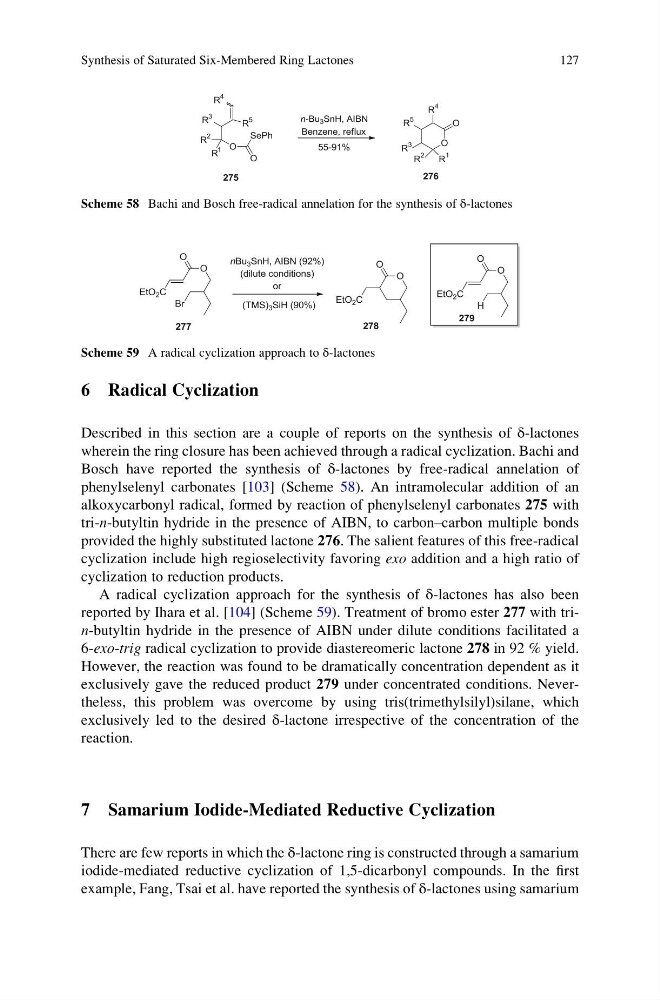
Bosch have reported the synthesis of δ-lactones by free-radical annelation of
phenylselenyl carbonates [103] (Scheme 58). An intramolecular addition of an
alkoxycarbonyl radical, formed by reaction of phenylselenyl carbonates 275 with
tri-n-butyltin hydride in the presence of AIBN, to carbon–carbon multiple bonds
provided the highly substituted lactone 276. The salient features of this free-radical
cyclization include high regioselectivity favoring exo addition and a high ratio of
cyclization to reduction products.
A radical cyclization approach for the synthesis of δ-lactones has also been
reported by Ihara et al. [104] (Scheme 59). Treatment of bromo ester 277 with trin-butyltin hydride in the presence of AIBN under dilute conditions facilitated a
6-exo-trig radical cyclization to provide diastereomeric lactone 278 in 92 % yield.
However, the reaction was found to be dramatically concentration dependent as it
exclusively gave the reduced product 279 under concentrated conditions. Nevertheless, this problem was overcome by using tris(trimethylsilyl)silane, which
exclusively led to the desired δ-lactone irrespective of the concentration of the
reaction.
7 Samarium Iodide-Mediated Reductive Cyclization
There are few reports in which the δ-lactone ring is constructed through a samarium
iodide-mediated reductive cyclization of 1,5-dicarbonyl compounds. In the first
example, Fang, Tsai et al. have reported the synthesis of δ-lactones using samarium
n
Scheme 58 Bachi and Bosch free-radical annelation for the synthesis of δ-lactones
Scheme 59 A radical cyclization approach to δ-lactones
Synthesis of Saturated Six-Membered Ring Lactones
127
Described in this section are a couple of reports on the synthesis of δ-lactones
wherein the ring closure has been achieved through a radical cyclization. Bachi and
Bosch have reported the synthesis of δ-lactones by free-radical annelation of
phenylselenyl carbonates [103] (Scheme 58). An intramolecular addition of an
alkoxycarbonyl radical, formed by reaction of phenylselenyl carbonates 275 with
tri-n-butyltin hydride in the presence of AIBN, to carbon–carbon multiple bonds
provided the highly substituted lactone 276. The salient features of this free-radical
cyclization include high regioselectivity favoring exo addition and a high ratio of
cyclization to reduction products.
A radical cyclization approach for the synthesis of δ-lactones has also been
reported by Ihara et al. [104] (Scheme 59). Treatment of bromo ester 277 with trin-butyltin hydride in the presence of AIBN under dilute conditions facilitated a
6-exo-trig radical cyclization to provide diastereomeric lactone 278 in 92 % yield.
However, the reaction was found to be dramatically concentration dependent as it
exclusively gave the reduced product 279 under concentrated conditions. Nevertheless, this problem was overcome by using tris(trimethylsilyl)silane, which
exclusively led to the desired δ-lactone irrespective of the concentration of the
reaction.
7 Samarium Iodide-Mediated Reductive Cyclization
There are few reports in which the δ-lactone ring is constructed through a samarium
iodide-mediated reductive cyclization of 1,5-dicarbonyl compounds. In the first
example, Fang, Tsai et al. have reported the synthesis of δ-lactones using samarium
n
Scheme 58 Bachi and Bosch free-radical annelation for the synthesis of δ-lactones
Scheme 59 A radical cyclization approach to δ-lactones
Synthesis of Saturated Six-Membered Ring Lactones
127