

5 Intramolecular Nucleophilic Displacement
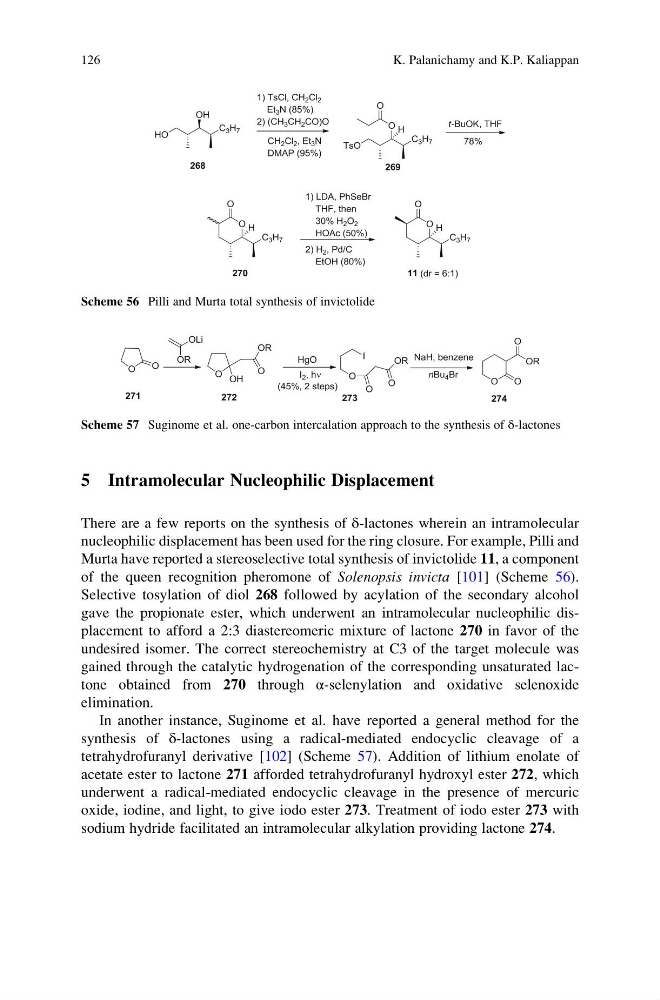
There are a few reports on the synthesis of δ-lactones wherein an intramolecular
nucleophilic displacement has been used for the ring closure. For example, Pilli and
Murta have reported a stereoselective total synthesis of invictolide 11, a component
of the queen recognition pheromone of Solenopsis invicta [101] (Scheme 56).
Selective tosylation of diol 268 followed by acylation of the secondary alcohol
gave the propionate ester, which underwent an intramolecular nucleophilic displacement to afford a 2:3 diastereomeric mixture of lactone 270 in favor of the
undesired isomer. The correct stereochemistry at C3 of the target molecule was
gained through the catalytic hydrogenation of the corresponding unsaturated lactone obtained from 270 through α-selenylation and oxidative selenoxide
elimination.
In another instance, Suginome et al. have reported a general method for the
synthesis of δ-lactones using a radical-mediated endocyclic cleavage of a
tetrahydrofuranyl derivative [102] (Scheme 57). Addition of lithium enolate of
acetate ester to lactone 271 afforded tetrahydrofuranyl hydroxyl ester 272, which
underwent a radical-mediated endocyclic cleavage in the presence of mercuric
oxide, iodine, and light, to give iodo ester 273. Treatment of iodo ester 273 with
sodium hydride facilitated an intramolecular alkylation providing lactone 274.
Scheme 56 Pilli and Murta total synthesis of invictolide
Scheme 57 Suginome et al. one-carbon intercalation approach to the synthesis of δ-lactones
126
K. Palanichamy and K.P. Kaliappan
There are a few reports on the synthesis of δ-lactones wherein an intramolecular
nucleophilic displacement has been used for the ring closure. For example, Pilli and
Murta have reported a stereoselective total synthesis of invictolide 11, a component
of the queen recognition pheromone of Solenopsis invicta [101] (Scheme 56).
Selective tosylation of diol 268 followed by acylation of the secondary alcohol
gave the propionate ester, which underwent an intramolecular nucleophilic displacement to afford a 2:3 diastereomeric mixture of lactone 270 in favor of the
undesired isomer. The correct stereochemistry at C3 of the target molecule was
gained through the catalytic hydrogenation of the corresponding unsaturated lactone obtained from 270 through α-selenylation and oxidative selenoxide
elimination.
In another instance, Suginome et al. have reported a general method for the
synthesis of δ-lactones using a radical-mediated endocyclic cleavage of a
tetrahydrofuranyl derivative [102] (Scheme 57). Addition of lithium enolate of
acetate ester to lactone 271 afforded tetrahydrofuranyl hydroxyl ester 272, which
underwent a radical-mediated endocyclic cleavage in the presence of mercuric
oxide, iodine, and light, to give iodo ester 273. Treatment of iodo ester 273 with
sodium hydride facilitated an intramolecular alkylation providing lactone 274.
Scheme 56 Pilli and Murta total synthesis of invictolide
Scheme 57 Suginome et al. one-carbon intercalation approach to the synthesis of δ-lactones
126
K. Palanichamy and K.P. Kaliappan