

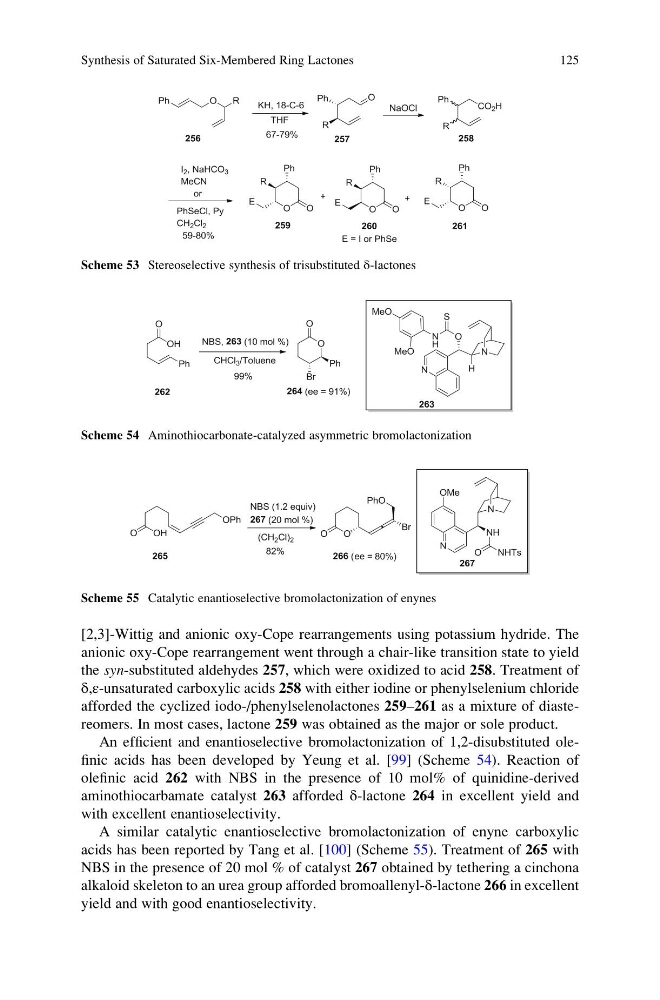
[2,3]-Wittig and anionic oxy-Cope rearrangements using potassium hydride. The
anionic oxy-Cope rearrangement went through a chair-like transition state to yield
the syn-substituted aldehydes 257, which were oxidized to acid 258. Treatment of
δ,ε-unsaturated carboxylic acids 258 with either iodine or phenylselenium chloride
afforded the cyclized iodo-/phenylselenolactones 259–261 as a mixture of diastereomers. In most cases, lactone 259 was obtained as the major or sole product.
An efficient and enantioselective bromolactonization of 1,2-disubstituted olefinic acids has been developed by Yeung et al. [99] (Scheme 54). Reaction of
olefinic acid 262 with NBS in the presence of 10 mol% of quinidine-derived
aminothiocarbamate catalyst 263 afforded δ-lactone 264 in excellent yield and
with excellent enantioselectivity.
A similar catalytic enantioselective bromolactonization of enyne carboxylic
acids has been reported by Tang et al. [100] (Scheme 55). Treatment of 265 with
NBS in the presence of 20 mol % of catalyst 267 obtained by tethering a cinchona
alkaloid skeleton to an urea group afforded bromoallenyl-δ-lactone 266 in excellent
yield and with good enantioselectivity.
Scheme 53 Stereoselective synthesis of trisubstituted δ-lactones
Scheme 54 Aminothiocarbonate-catalyzed asymmetric bromolactonization
Scheme 55 Catalytic enantioselective bromolactonization of enynes
Synthesis of Saturated Six-Membered Ring Lactones
125
anionic oxy-Cope rearrangement went through a chair-like transition state to yield
the syn-substituted aldehydes 257, which were oxidized to acid 258. Treatment of
δ,ε-unsaturated carboxylic acids 258 with either iodine or phenylselenium chloride
afforded the cyclized iodo-/phenylselenolactones 259–261 as a mixture of diastereomers. In most cases, lactone 259 was obtained as the major or sole product.
An efficient and enantioselective bromolactonization of 1,2-disubstituted olefinic acids has been developed by Yeung et al. [99] (Scheme 54). Reaction of
olefinic acid 262 with NBS in the presence of 10 mol% of quinidine-derived
aminothiocarbamate catalyst 263 afforded δ-lactone 264 in excellent yield and
with excellent enantioselectivity.
A similar catalytic enantioselective bromolactonization of enyne carboxylic
acids has been reported by Tang et al. [100] (Scheme 55). Treatment of 265 with
NBS in the presence of 20 mol % of catalyst 267 obtained by tethering a cinchona
alkaloid skeleton to an urea group afforded bromoallenyl-δ-lactone 266 in excellent
yield and with good enantioselectivity.
Scheme 53 Stereoselective synthesis of trisubstituted δ-lactones
Scheme 54 Aminothiocarbonate-catalyzed asymmetric bromolactonization
Scheme 55 Catalytic enantioselective bromolactonization of enynes
Synthesis of Saturated Six-Membered Ring Lactones
125