

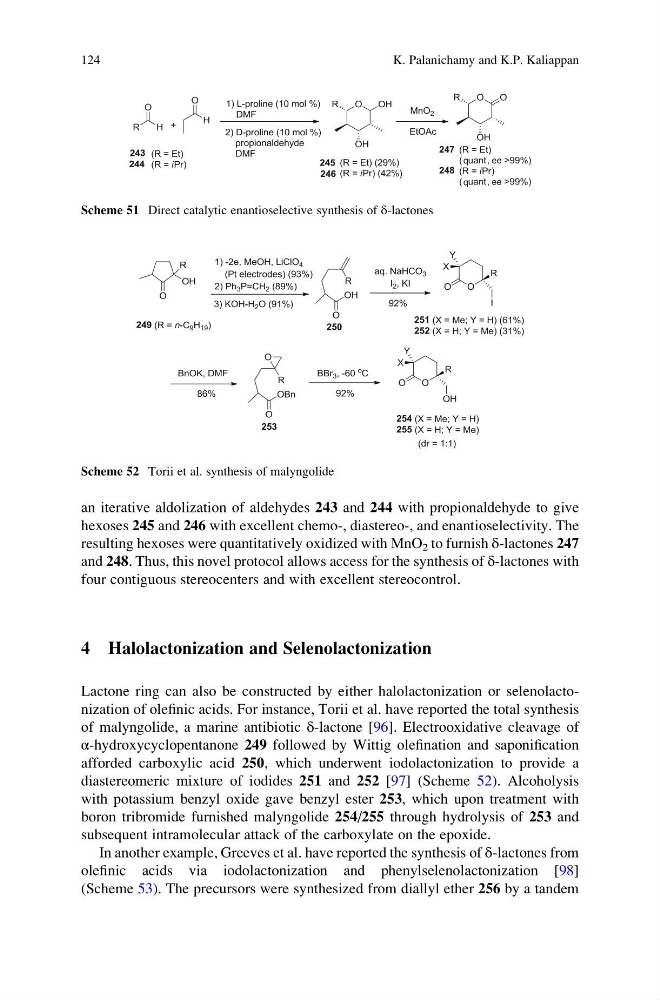
an iterative aldolization of aldehydes 243 and 244 with propionaldehyde to give
hexoses 245 and 246 with excellent chemo-, diastereo-, and enantioselectivity. The
resulting hexoses were quantitatively oxidized with MnO 2 to furnish δ-lactones 247
and 248. Thus, this novel protocol allows access for the synthesis of δ-lactones with
four contiguous stereocenters and with excellent stereocontrol.
4 Halolactonization and Selenolactonization
Lactone ring can also be constructed by either halolactonization or selenolactonization of olefinic acids. For instance, Torii et al. have reported the total synthesis
of malyngolide, a marine antibiotic δ-lactone [96]. Electrooxidative cleavage of
α-hydroxycyclopentanone 249 followed by Wittig olefination and saponification
afforded carboxylic acid 250, which underwent iodolactonization to provide a
diastereomeric mixture of iodides 251 and 252 [97] (Scheme 52). Alcoholysis
with potassium benzyl oxide gave benzyl ester 253, which upon treatment with
boron tribromide furnished malyngolide 254/255 through hydrolysis of 253 and
subsequent intramolecular attack of the carboxylate on the epoxide.
In another example, Greeves et al. have reported the synthesis of δ-lactones from
olefinic acids via iodolactonization and phenylselenolactonization [98]
(Scheme 53). The precursors were synthesized from diallyl ether 256 by a tandem
ee
ee
q
q
Scheme 51 Direct catalytic enantioselective synthesis of δ-lactones
Scheme 52 Torii et al. synthesis of malyngolide
124
K. Palanichamy and K.P. Kaliappan
hexoses 245 and 246 with excellent chemo-, diastereo-, and enantioselectivity. The
resulting hexoses were quantitatively oxidized with MnO 2 to furnish δ-lactones 247
and 248. Thus, this novel protocol allows access for the synthesis of δ-lactones with
four contiguous stereocenters and with excellent stereocontrol.
4 Halolactonization and Selenolactonization
Lactone ring can also be constructed by either halolactonization or selenolactonization of olefinic acids. For instance, Torii et al. have reported the total synthesis
of malyngolide, a marine antibiotic δ-lactone [96]. Electrooxidative cleavage of
α-hydroxycyclopentanone 249 followed by Wittig olefination and saponification
afforded carboxylic acid 250, which underwent iodolactonization to provide a
diastereomeric mixture of iodides 251 and 252 [97] (Scheme 52). Alcoholysis
with potassium benzyl oxide gave benzyl ester 253, which upon treatment with
boron tribromide furnished malyngolide 254/255 through hydrolysis of 253 and
subsequent intramolecular attack of the carboxylate on the epoxide.
In another example, Greeves et al. have reported the synthesis of δ-lactones from
olefinic acids via iodolactonization and phenylselenolactonization [98]
(Scheme 53). The precursors were synthesized from diallyl ether 256 by a tandem
ee
ee
q
q
Scheme 51 Direct catalytic enantioselective synthesis of δ-lactones
Scheme 52 Torii et al. synthesis of malyngolide
124
K. Palanichamy and K.P. Kaliappan