

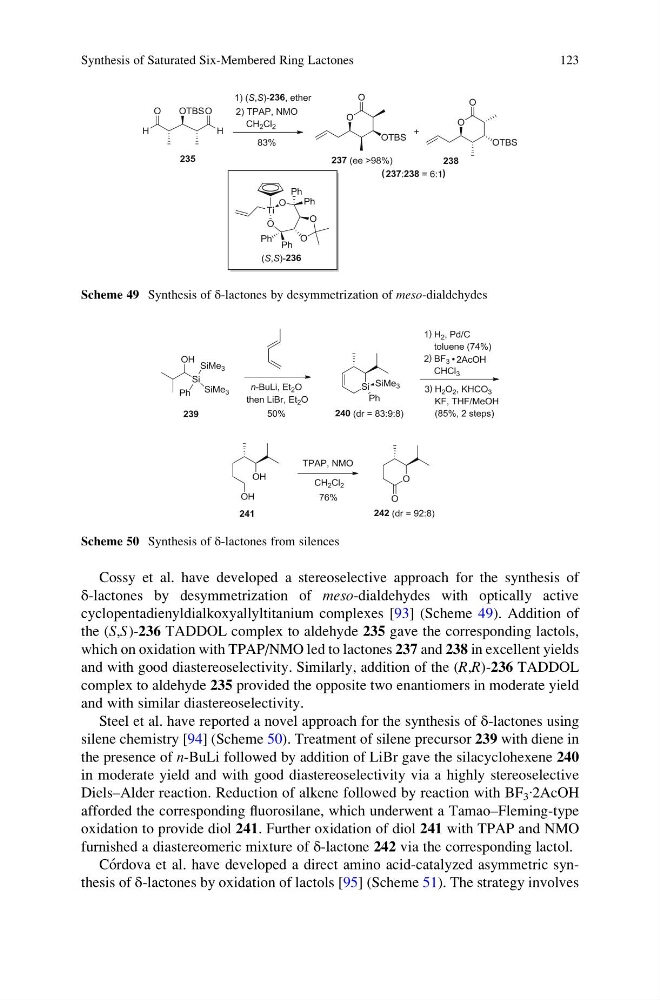
Cossy et al. have developed a stereoselective approach for the synthesis of
δ-lactones by desymmetrization of meso-dialdehydes with optically active
cyclopentadienyldialkoxyallyltitanium complexes [93] (Scheme 49). Addition of
the (S,S)-236 TADDOL complex to aldehyde 235 gave the corresponding lactols,
which on oxidation with TPAP/NMO led to lactones 237 and 238 in excellent yields
and with good diastereoselectivity. Similarly, addition of the (R,R)-236 TADDOL
complex to aldehyde 235 provided the opposite two enantiomers in moderate yield
and with similar diastereoselectivity.
Steel et al. have reported a novel approach for the synthesis of δ-lactones using
silene chemistry [94] (Scheme 50). Treatment of silene precursor 239 with diene in
the presence of n-BuLi followed by addition of LiBr gave the silacyclohexene 240
in moderate yield and with good diastereoselectivity via a highly stereoselective
Diels–Alder reaction. Reduction of alkene followed by reaction with BF 3 ∙2AcOH
afforded the corresponding fluorosilane, which underwent a Tamao–Fleming-type
oxidation to provide diol 241. Further oxidation of diol 241 with TPAP and NMO
furnished a diastereomeric mixture of δ-lactone 242 via the corresponding lactol.
Co ´rdova et al. have developed a direct amino acid-catalyzed asymmetric synthesis of δ-lactones by oxidation of lactols [95] (Scheme 51). The strategy involves
Scheme 49 Synthesis of δ-lactones by desymmetrization of meso-dialdehydes
Scheme 50 Synthesis of δ-lactones from silences
Synthesis of Saturated Six-Membered Ring Lactones
123
δ-lactones by desymmetrization of meso-dialdehydes with optically active
cyclopentadienyldialkoxyallyltitanium complexes [93] (Scheme 49). Addition of
the (S,S)-236 TADDOL complex to aldehyde 235 gave the corresponding lactols,
which on oxidation with TPAP/NMO led to lactones 237 and 238 in excellent yields
and with good diastereoselectivity. Similarly, addition of the (R,R)-236 TADDOL
complex to aldehyde 235 provided the opposite two enantiomers in moderate yield
and with similar diastereoselectivity.
Steel et al. have reported a novel approach for the synthesis of δ-lactones using
silene chemistry [94] (Scheme 50). Treatment of silene precursor 239 with diene in
the presence of n-BuLi followed by addition of LiBr gave the silacyclohexene 240
in moderate yield and with good diastereoselectivity via a highly stereoselective
Diels–Alder reaction. Reduction of alkene followed by reaction with BF 3 ∙2AcOH
afforded the corresponding fluorosilane, which underwent a Tamao–Fleming-type
oxidation to provide diol 241. Further oxidation of diol 241 with TPAP and NMO
furnished a diastereomeric mixture of δ-lactone 242 via the corresponding lactol.
Co ´rdova et al. have developed a direct amino acid-catalyzed asymmetric synthesis of δ-lactones by oxidation of lactols [95] (Scheme 51). The strategy involves
Scheme 49 Synthesis of δ-lactones by desymmetrization of meso-dialdehydes
Scheme 50 Synthesis of δ-lactones from silences
Synthesis of Saturated Six-Membered Ring Lactones
123