

intramolecularly by the alcohol moiety to form the hemiacetal 194. Equilibration of
the hemiacetal with oxone leads to the hemiperoxymonosulfate acetal 195, which
undergoes a Baeyer–Villiger-like rearrangement to provide δ-lactone 197.
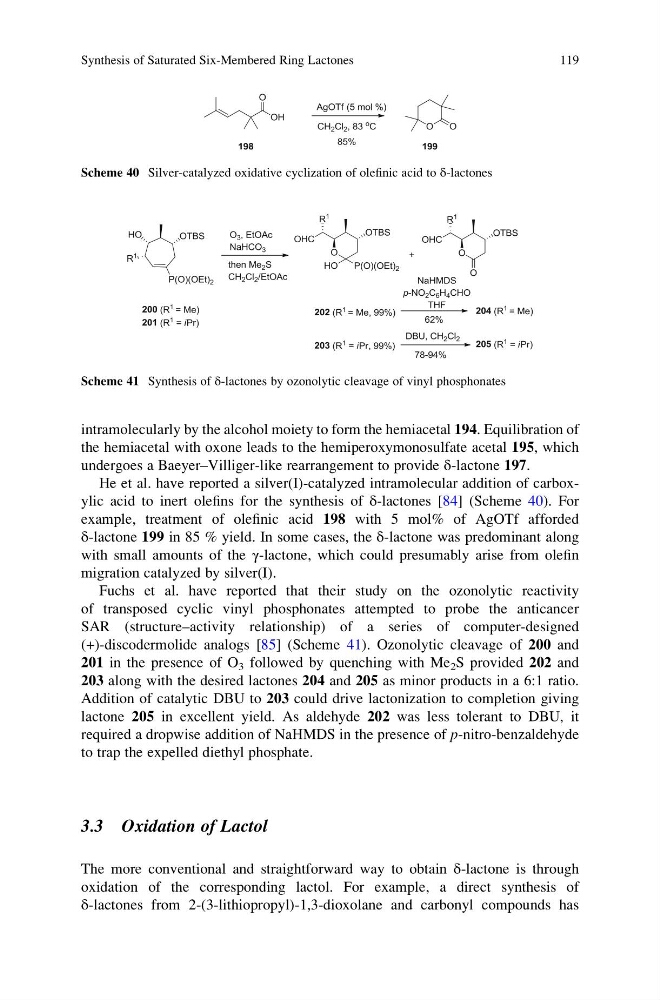
He et al. have reported a silver(I)-catalyzed intramolecular addition of carboxylic acid to inert olefins for the synthesis of δ-lactones [84] (Scheme 40). For
example, treatment of olefinic acid 198 with 5 mol% of AgOTf afforded
δ-lactone 199 in 85 % yield. In some cases, the δ-lactone was predominant along
with small amounts of the γ-lactone, which could presumably arise from olefin
migration catalyzed by silver(I).
Fuchs et al. have reported that their study on the ozonolytic reactivity
of transposed cyclic vinyl phosphonates attempted to probe the anticancer
SAR (structure–activity relationship) of a series of computer-designed
(+)-discodermolide analogs [85] (Scheme 41). Ozonolytic cleavage of 200 and
201 in the presence of O 3 followed by quenching with Me 2 S provided 202 and
203 along with the desired lactones 204 and 205 as minor products in a 6:1 ratio.
Addition of catalytic DBU to 203 could drive lactonization to completion giving
lactone 205 in excellent yield. As aldehyde 202 was less tolerant to DBU, it
required a dropwise addition of NaHMDS in the presence of p-nitro-benzaldehyde
to trap the expelled diethyl phosphate.
3.3 Oxidation of Lactol
The more conventional and straightforward way to obtain δ-lactone is through
oxidation of the corresponding lactol. For example, a direct synthesis of
δ-lactones from 2-(3-lithiopropyl)-1,3-dioxolane and carbonyl compounds has
Scheme 40 Silver-catalyzed oxidative cyclization of olefinic acid to δ-lactones
Scheme 41 Synthesis of δ-lactones by ozonolytic cleavage of vinyl phosphonates
Synthesis of Saturated Six-Membered Ring Lactones
119
the hemiacetal with oxone leads to the hemiperoxymonosulfate acetal 195, which
undergoes a Baeyer–Villiger-like rearrangement to provide δ-lactone 197.
He et al. have reported a silver(I)-catalyzed intramolecular addition of carboxylic acid to inert olefins for the synthesis of δ-lactones [84] (Scheme 40). For
example, treatment of olefinic acid 198 with 5 mol% of AgOTf afforded
δ-lactone 199 in 85 % yield. In some cases, the δ-lactone was predominant along
with small amounts of the γ-lactone, which could presumably arise from olefin
migration catalyzed by silver(I).
Fuchs et al. have reported that their study on the ozonolytic reactivity
of transposed cyclic vinyl phosphonates attempted to probe the anticancer
SAR (structure–activity relationship) of a series of computer-designed
(+)-discodermolide analogs [85] (Scheme 41). Ozonolytic cleavage of 200 and
201 in the presence of O 3 followed by quenching with Me 2 S provided 202 and
203 along with the desired lactones 204 and 205 as minor products in a 6:1 ratio.
Addition of catalytic DBU to 203 could drive lactonization to completion giving
lactone 205 in excellent yield. As aldehyde 202 was less tolerant to DBU, it
required a dropwise addition of NaHMDS in the presence of p-nitro-benzaldehyde
to trap the expelled diethyl phosphate.
3.3 Oxidation of Lactol
The more conventional and straightforward way to obtain δ-lactone is through
oxidation of the corresponding lactol. For example, a direct synthesis of
δ-lactones from 2-(3-lithiopropyl)-1,3-dioxolane and carbonyl compounds has
Scheme 40 Silver-catalyzed oxidative cyclization of olefinic acid to δ-lactones
Scheme 41 Synthesis of δ-lactones by ozonolytic cleavage of vinyl phosphonates
Synthesis of Saturated Six-Membered Ring Lactones
119