

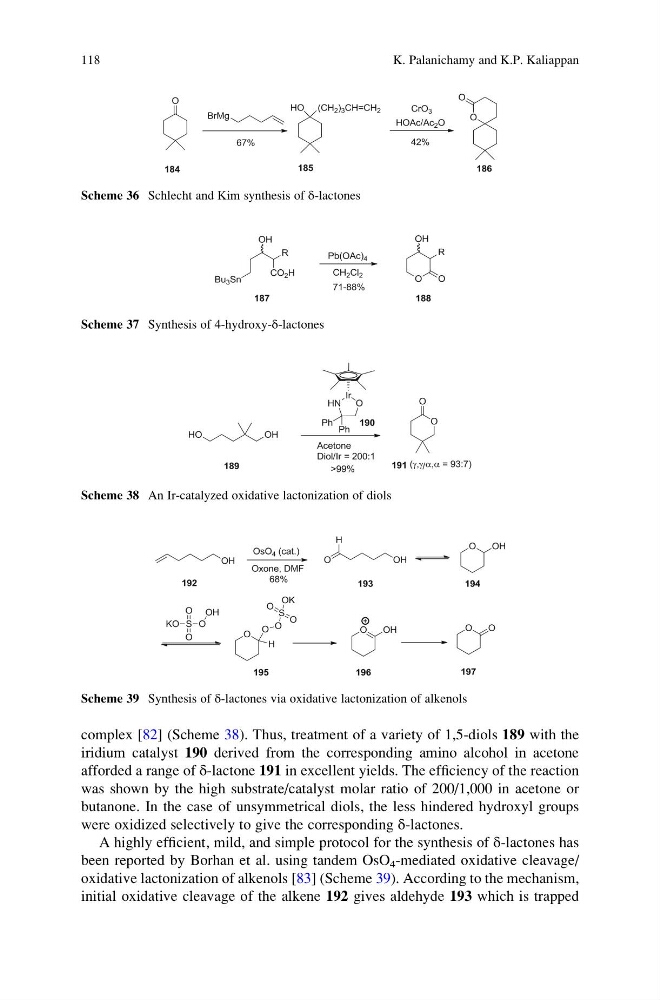
complex [82] (Scheme 38). Thus, treatment of a variety of 1,5-diols 189 with the
iridium catalyst 190 derived from the corresponding amino alcohol in acetone
afforded a range of δ-lactone 191 in excellent yields. The efficiency of the reaction
was shown by the high substrate/catalyst molar ratio of 200/1,000 in acetone or
butanone. In the case of unsymmetrical diols, the less hindered hydroxyl groups
were oxidized selectively to give the corresponding δ-lactones.
A highly efficient, mild, and simple protocol for the synthesis of δ-lactones has
been reported by Borhan et al. using tandem OsO 4 -mediated oxidative cleavage/
oxidative lactonization of alkenols [83] (Scheme 39). According to the mechanism,
initial oxidative cleavage of the alkene 192 gives aldehyde 193 which is trapped
Scheme 36 Schlecht and Kim synthesis of δ-lactones
Scheme 37 Synthesis of 4-hydroxy-δ-lactones
Scheme 38 An Ir-catalyzed oxidative lactonization of diols
Scheme 39 Synthesis of δ-lactones via oxidative lactonization of alkenols
118
K. Palanichamy and K.P. Kaliappan
iridium catalyst 190 derived from the corresponding amino alcohol in acetone
afforded a range of δ-lactone 191 in excellent yields. The efficiency of the reaction
was shown by the high substrate/catalyst molar ratio of 200/1,000 in acetone or
butanone. In the case of unsymmetrical diols, the less hindered hydroxyl groups
were oxidized selectively to give the corresponding δ-lactones.
A highly efficient, mild, and simple protocol for the synthesis of δ-lactones has
been reported by Borhan et al. using tandem OsO 4 -mediated oxidative cleavage/
oxidative lactonization of alkenols [83] (Scheme 39). According to the mechanism,
initial oxidative cleavage of the alkene 192 gives aldehyde 193 which is trapped
Scheme 36 Schlecht and Kim synthesis of δ-lactones
Scheme 37 Synthesis of 4-hydroxy-δ-lactones
Scheme 38 An Ir-catalyzed oxidative lactonization of diols
Scheme 39 Synthesis of δ-lactones via oxidative lactonization of alkenols
118
K. Palanichamy and K.P. Kaliappan