

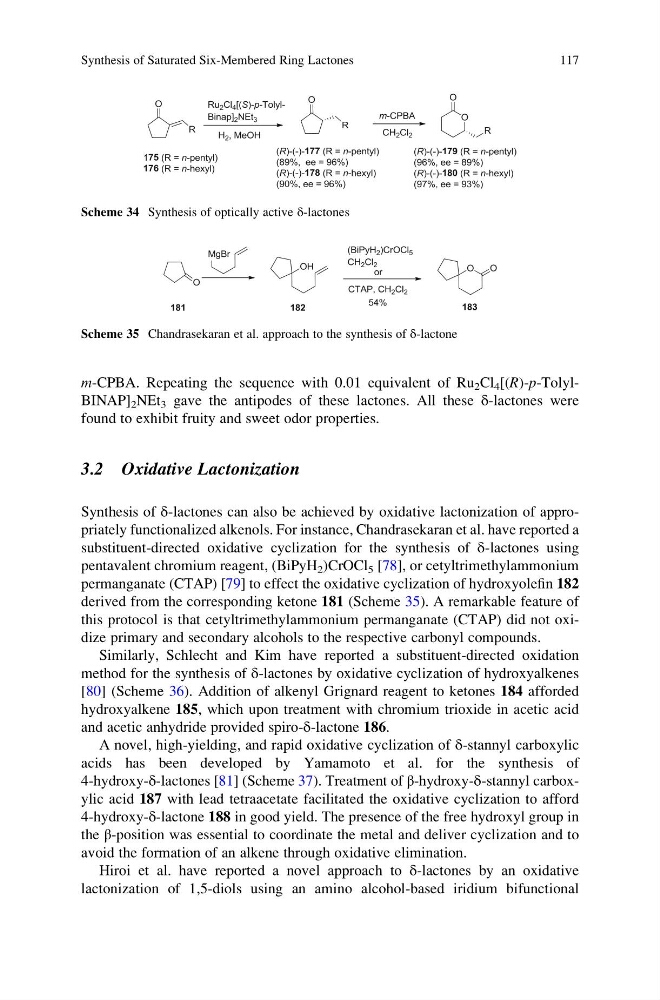
m-CPBA. Repeating the sequence with 0.01 equivalent of Ru 2 Cl 4 [(R)-p-TolylBINAP] 2 NEt 3 gave the antipodes of these lactones. All these δ-lactones were
found to exhibit fruity and sweet odor properties.
3.2 Oxidative Lactonization
Synthesis of δ-lactones can also be achieved by oxidative lactonization of appropriately functionalized alkenols. For instance, Chandrasekaran et al. have reported a
substituent-directed oxidative cyclization for the synthesis of δ-lactones using
pentavalent chromium reagent, (BiPyH 2 )CrOCl 5 [78], or cetyltrimethylammonium
permanganate (CTAP) [79] to effect the oxidative cyclization of hydroxyolefin 182
derived from the corresponding ketone 181 (Scheme 35). A remarkable feature of
this protocol is that cetyltrimethylammonium permanganate (CTAP) did not oxidize primary and secondary alcohols to the respective carbonyl compounds.
Similarly, Schlecht and Kim have reported a substituent-directed oxidation
method for the synthesis of δ-lactones by oxidative cyclization of hydroxyalkenes
[80] (Scheme 36). Addition of alkenyl Grignard reagent to ketones 184 afforded
hydroxyalkene 185, which upon treatment with chromium trioxide in acetic acid
and acetic anhydride provided spiro-δ-lactone 186.
A novel, high-yielding, and rapid oxidative cyclization of δ-stannyl carboxylic
acids has been developed by Yamamoto et al. for the synthesis of
4-hydroxy-δ-lactones [81] (Scheme 37). Treatment of β-hydroxy-δ-stannyl carboxylic acid 187 with lead tetraacetate facilitated the oxidative cyclization to afford
4-hydroxy-δ-lactone 188 in good yield. The presence of the free hydroxyl group in
the β-position was essential to coordinate the metal and deliver cyclization and to
avoid the formation of an alkene through oxidative elimination.
Hiroi et al. have reported a novel approach to δ-lactones by an oxidative
lactonization of 1,5-diols using an amino alcohol-based iridium bifunctional
Scheme 34 Synthesis of optically active δ-lactones
Scheme 35 Chandrasekaran et al. approach to the synthesis of δ-lactone
Synthesis of Saturated Six-Membered Ring Lactones
117
found to exhibit fruity and sweet odor properties.
3.2 Oxidative Lactonization
Synthesis of δ-lactones can also be achieved by oxidative lactonization of appropriately functionalized alkenols. For instance, Chandrasekaran et al. have reported a
substituent-directed oxidative cyclization for the synthesis of δ-lactones using
pentavalent chromium reagent, (BiPyH 2 )CrOCl 5 [78], or cetyltrimethylammonium
permanganate (CTAP) [79] to effect the oxidative cyclization of hydroxyolefin 182
derived from the corresponding ketone 181 (Scheme 35). A remarkable feature of
this protocol is that cetyltrimethylammonium permanganate (CTAP) did not oxidize primary and secondary alcohols to the respective carbonyl compounds.
Similarly, Schlecht and Kim have reported a substituent-directed oxidation
method for the synthesis of δ-lactones by oxidative cyclization of hydroxyalkenes
[80] (Scheme 36). Addition of alkenyl Grignard reagent to ketones 184 afforded
hydroxyalkene 185, which upon treatment with chromium trioxide in acetic acid
and acetic anhydride provided spiro-δ-lactone 186.
A novel, high-yielding, and rapid oxidative cyclization of δ-stannyl carboxylic
acids has been developed by Yamamoto et al. for the synthesis of
4-hydroxy-δ-lactones [81] (Scheme 37). Treatment of β-hydroxy-δ-stannyl carboxylic acid 187 with lead tetraacetate facilitated the oxidative cyclization to afford
4-hydroxy-δ-lactone 188 in good yield. The presence of the free hydroxyl group in
the β-position was essential to coordinate the metal and deliver cyclization and to
avoid the formation of an alkene through oxidative elimination.
Hiroi et al. have reported a novel approach to δ-lactones by an oxidative
lactonization of 1,5-diols using an amino alcohol-based iridium bifunctional
Scheme 34 Synthesis of optically active δ-lactones
Scheme 35 Chandrasekaran et al. approach to the synthesis of δ-lactone
Synthesis of Saturated Six-Membered Ring Lactones
117