

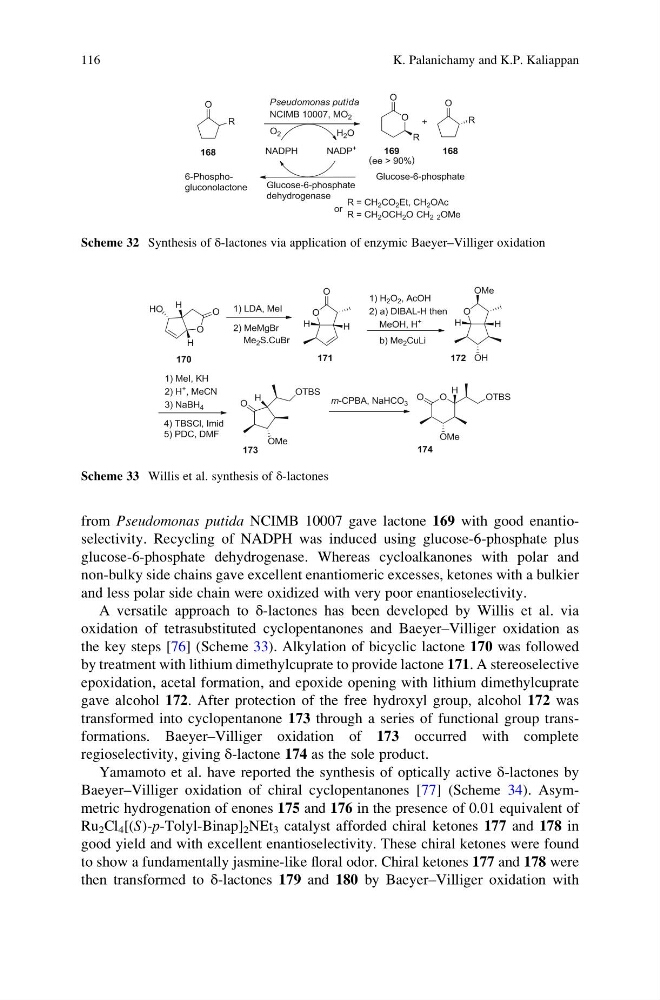
from Pseudomonas putida NCIMB 10007 gave lactone 169 with good enantioselectivity. Recycling of NADPH was induced using glucose-6-phosphate plus
glucose-6-phosphate dehydrogenase. Whereas cycloalkanones with polar and
non-bulky side chains gave excellent enantiomeric excesses, ketones with a bulkier
and less polar side chain were oxidized with very poor enantioselectivity.
A versatile approach to δ-lactones has been developed by Willis et al. via
oxidation of tetrasubstituted cyclopentanones and Baeyer–Villiger oxidation as
the key steps [76] (Scheme 33). Alkylation of bicyclic lactone 170 was followed
by treatment with lithium dimethylcuprate to provide lactone 171. A stereoselective
epoxidation, acetal formation, and epoxide opening with lithium dimethylcuprate
gave alcohol 172. After protection of the free hydroxyl group, alcohol 172 was
transformed into cyclopentanone 173 through a series of functional group transformations. Baeyer–Villiger oxidation of 173 occurred with complete
regioselectivity, giving δ-lactone 174 as the sole product.
Yamamoto et al. have reported the synthesis of optically active δ-lactones by
Baeyer–Villiger oxidation of chiral cyclopentanones [77] (Scheme 34). Asymmetric hydrogenation of enones 175 and 176 in the presence of 0.01 equivalent of
Ru 2 Cl 4 [(S)-p-Tolyl-Binap] 2 NEt 3 catalyst afforded chiral ketones 177 and 178 in
good yield and with excellent enantioselectivity. These chiral ketones were found
to show a fundamentally jasmine-like floral odor. Chiral ketones 177 and 178 were
then transformed to δ-lactones 179 and 180 by Baeyer–Villiger oxidation with
Scheme 32 Synthesis of δ-lactones via application of enzymic Baeyer–Villiger oxidation
Scheme 33 Willis et al. synthesis of δ-lactones
116
K. Palanichamy and K.P. Kaliappan
glucose-6-phosphate dehydrogenase. Whereas cycloalkanones with polar and
non-bulky side chains gave excellent enantiomeric excesses, ketones with a bulkier
and less polar side chain were oxidized with very poor enantioselectivity.
A versatile approach to δ-lactones has been developed by Willis et al. via
oxidation of tetrasubstituted cyclopentanones and Baeyer–Villiger oxidation as
the key steps [76] (Scheme 33). Alkylation of bicyclic lactone 170 was followed
by treatment with lithium dimethylcuprate to provide lactone 171. A stereoselective
epoxidation, acetal formation, and epoxide opening with lithium dimethylcuprate
gave alcohol 172. After protection of the free hydroxyl group, alcohol 172 was
transformed into cyclopentanone 173 through a series of functional group transformations. Baeyer–Villiger oxidation of 173 occurred with complete
regioselectivity, giving δ-lactone 174 as the sole product.
Yamamoto et al. have reported the synthesis of optically active δ-lactones by
Baeyer–Villiger oxidation of chiral cyclopentanones [77] (Scheme 34). Asymmetric hydrogenation of enones 175 and 176 in the presence of 0.01 equivalent of
Ru 2 Cl 4 [(S)-p-Tolyl-Binap] 2 NEt 3 catalyst afforded chiral ketones 177 and 178 in
good yield and with excellent enantioselectivity. These chiral ketones were found
to show a fundamentally jasmine-like floral odor. Chiral ketones 177 and 178 were
then transformed to δ-lactones 179 and 180 by Baeyer–Villiger oxidation with
Scheme 32 Synthesis of δ-lactones via application of enzymic Baeyer–Villiger oxidation
Scheme 33 Willis et al. synthesis of δ-lactones
116
K. Palanichamy and K.P. Kaliappan