

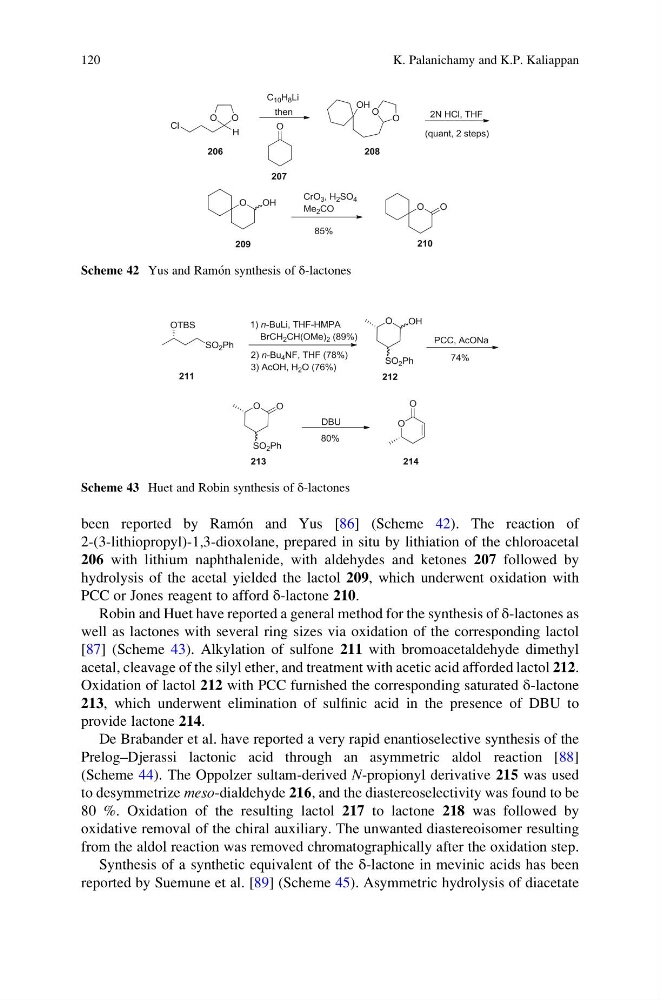
been reported by Ramo ´n and Yus [86] (Scheme 42). The reaction of
2-(3-lithiopropyl)-1,3-dioxolane, prepared in situ by lithiation of the chloroacetal
206 with lithium naphthalenide, with aldehydes and ketones 207 followed by
hydrolysis of the acetal yielded the lactol 209, which underwent oxidation with
PCC or Jones reagent to afford δ-lactone 210.
Robin and Huet have reported a general method for the synthesis of δ-lactones as
well as lactones with several ring sizes via oxidation of the corresponding lactol
[87] (Scheme 43). Alkylation of sulfone 211 with bromoacetaldehyde dimethyl
acetal, cleavage of the silyl ether, and treatment with acetic acid afforded lactol 212.
Oxidation of lactol 212 with PCC furnished the corresponding saturated δ-lactone
213, which underwent elimination of sulfinic acid in the presence of DBU to
provide lactone 214.
De Brabander et al. have reported a very rapid enantioselective synthesis of the
Prelog–Djerassi lactonic acid through an asymmetric aldol reaction [88]
(Scheme 44). The Oppolzer sultam-derived N-propionyl derivative 215 was used
to desymmetrize meso-dialdehyde 216, and the diastereoselectivity was found to be
80 %. Oxidation of the resulting lactol 217 to lactone 218 was followed by
oxidative removal of the chiral auxiliary. The unwanted diastereoisomer resulting
from the aldol reaction was removed chromatographically after the oxidation step.
Synthesis of a synthetic equivalent of the δ-lactone in mevinic acids has been
reported by Suemune et al. [89] (Scheme 45). Asymmetric hydrolysis of diacetate
Scheme 42 Yus and Ramo ´n synthesis of δ-lactones
Scheme 43 Huet and Robin synthesis of δ-lactones
120
K. Palanichamy and K.P. Kaliappan
2-(3-lithiopropyl)-1,3-dioxolane, prepared in situ by lithiation of the chloroacetal
206 with lithium naphthalenide, with aldehydes and ketones 207 followed by
hydrolysis of the acetal yielded the lactol 209, which underwent oxidation with
PCC or Jones reagent to afford δ-lactone 210.
Robin and Huet have reported a general method for the synthesis of δ-lactones as
well as lactones with several ring sizes via oxidation of the corresponding lactol
[87] (Scheme 43). Alkylation of sulfone 211 with bromoacetaldehyde dimethyl
acetal, cleavage of the silyl ether, and treatment with acetic acid afforded lactol 212.
Oxidation of lactol 212 with PCC furnished the corresponding saturated δ-lactone
213, which underwent elimination of sulfinic acid in the presence of DBU to
provide lactone 214.
De Brabander et al. have reported a very rapid enantioselective synthesis of the
Prelog–Djerassi lactonic acid through an asymmetric aldol reaction [88]
(Scheme 44). The Oppolzer sultam-derived N-propionyl derivative 215 was used
to desymmetrize meso-dialdehyde 216, and the diastereoselectivity was found to be
80 %. Oxidation of the resulting lactol 217 to lactone 218 was followed by
oxidative removal of the chiral auxiliary. The unwanted diastereoisomer resulting
from the aldol reaction was removed chromatographically after the oxidation step.
Synthesis of a synthetic equivalent of the δ-lactone in mevinic acids has been
reported by Suemune et al. [89] (Scheme 45). Asymmetric hydrolysis of diacetate
Scheme 42 Yus and Ramo ´n synthesis of δ-lactones
Scheme 43 Huet and Robin synthesis of δ-lactones
120
K. Palanichamy and K.P. Kaliappan