

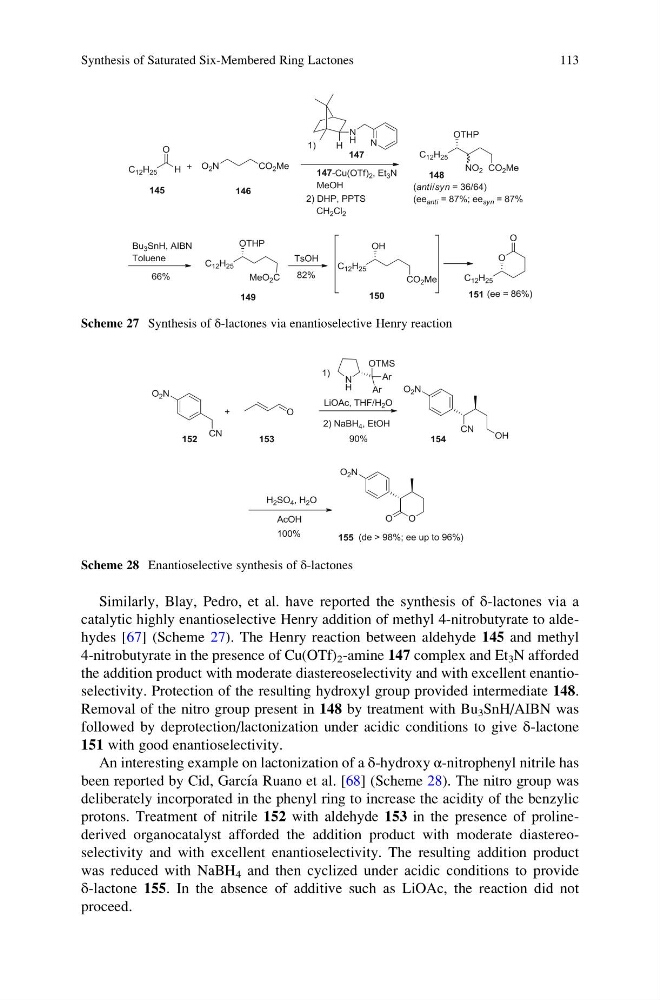
Similarly, Blay, Pedro, et al. have reported the synthesis of δ-lactones via a
catalytic highly enantioselective Henry addition of methyl 4-nitrobutyrate to aldehydes [67] (Scheme 27). The Henry reaction between aldehyde 145 and methyl
4-nitrobutyrate in the presence of Cu(OTf) 2 -amine 147 complex and Et 3 N afforded
the addition product with moderate diastereoselectivity and with excellent enantioselectivity. Protection of the resulting hydroxyl group provided intermediate 148.
Removal of the nitro group present in 148 by treatment with Bu 3 SnH/AIBN was
followed by deprotection/lactonization under acidic conditions to give δ-lactone
151 with good enantioselectivity.
An interesting example on lactonization of a δ-hydroxy α-nitrophenyl nitrile has
been reported by Cid, Garcı ´a Ruano et al. [68] (Scheme 28). The nitro group was
deliberately incorporated in the phenyl ring to increase the acidity of the benzylic
protons. Treatment of nitrile 152 with aldehyde 153 in the presence of prolinederived organocatalyst afforded the addition product with moderate diastereoselectivity and with excellent enantioselectivity. The resulting addition product
was reduced with NaBH 4 and then cyclized under acidic conditions to provide
δ-lactone 155. In the absence of additive such as LiOAc, the reaction did not
proceed.
Scheme 27 Synthesis of δ-lactones via enantioselective Henry reaction
Scheme 28 Enantioselective synthesis of δ-lactones
Synthesis of Saturated Six-Membered Ring Lactones
113
catalytic highly enantioselective Henry addition of methyl 4-nitrobutyrate to aldehydes [67] (Scheme 27). The Henry reaction between aldehyde 145 and methyl
4-nitrobutyrate in the presence of Cu(OTf) 2 -amine 147 complex and Et 3 N afforded
the addition product with moderate diastereoselectivity and with excellent enantioselectivity. Protection of the resulting hydroxyl group provided intermediate 148.
Removal of the nitro group present in 148 by treatment with Bu 3 SnH/AIBN was
followed by deprotection/lactonization under acidic conditions to give δ-lactone
151 with good enantioselectivity.
An interesting example on lactonization of a δ-hydroxy α-nitrophenyl nitrile has
been reported by Cid, Garcı ´a Ruano et al. [68] (Scheme 28). The nitro group was
deliberately incorporated in the phenyl ring to increase the acidity of the benzylic
protons. Treatment of nitrile 152 with aldehyde 153 in the presence of prolinederived organocatalyst afforded the addition product with moderate diastereoselectivity and with excellent enantioselectivity. The resulting addition product
was reduced with NaBH 4 and then cyclized under acidic conditions to provide
δ-lactone 155. In the absence of additive such as LiOAc, the reaction did not
proceed.
Scheme 27 Synthesis of δ-lactones via enantioselective Henry reaction
Scheme 28 Enantioselective synthesis of δ-lactones
Synthesis of Saturated Six-Membered Ring Lactones
113