

halogen interchange under Finkelstein conditions (NaI, acetone), produced the
iodoester, which was subjected to the crucial six-membered ring construction in
the presence of LiHMDS to provide cyclohexane derivative 135 as a single transisomer. Unmasking of the hydroxyl group followed by immediate oxidation gave
aldehyde 136 in good yield. After extensive optimization, addition of
3-titanyloxyfuran 137 to aldehyde 136 in ether at low temperature revealed
ricciocarpin A 8 in good yield and with decent diastereoselectivity (dr ¼ 5.7:1).
In a similar way, addition of reagent 139 to aldehyde 136 followed by treatment
with dilute hydrochloric acid furnished ricciocarpin B 9 as a single isomer in 78 %
yield (Scheme 25).
Yadav et al. have reported a one-pot deprotection of hydroxyl group with
concurrent lactonization of the resulting hydroxyl ester in the synthesis of
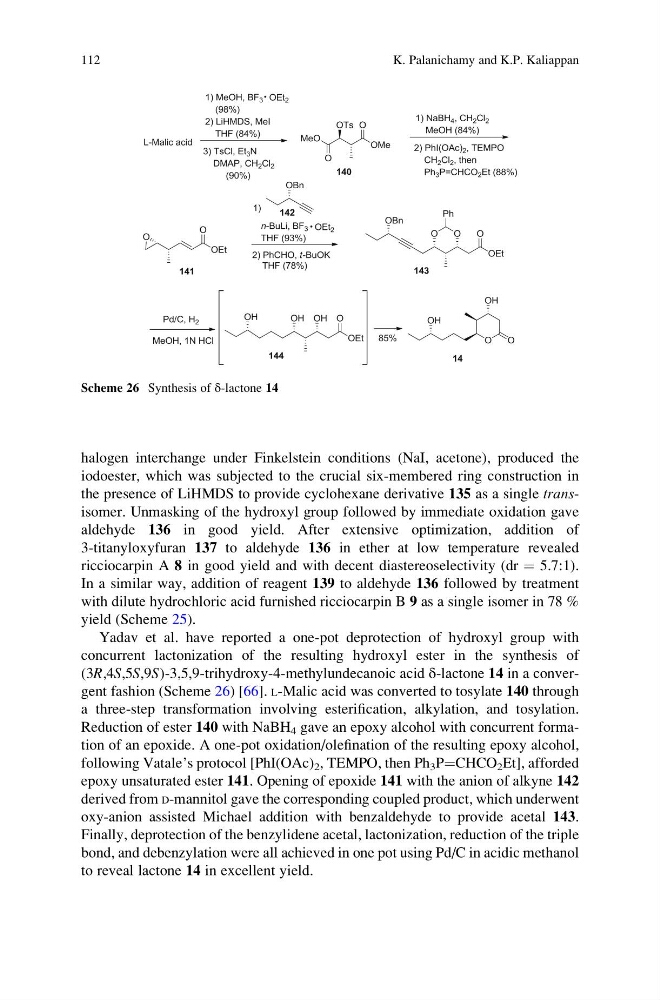
(3R,4S,5S,9S)-3,5,9-trihydroxy-4-methylundecanoic acid δ-lactone 14 in a convergent fashion (Scheme 26) [66]. L-Malic acid was converted to tosylate 140 through
a three-step transformation involving esterification, alkylation, and tosylation.
Reduction of ester 140 with NaBH 4 gave an epoxy alcohol with concurrent formation of an epoxide. A one-pot oxidation/olefination of the resulting epoxy alcohol,
following Vatale’s protocol [PhI(OAc) 2 , TEMPO, then Ph 3 P¼CHCO 2 Et], afforded
epoxy unsaturated ester 141. Opening of epoxide 141 with the anion of alkyne 142
derived from D-mannitol gave the corresponding coupled product, which underwent
oxy-anion assisted Michael addition with benzaldehyde to provide acetal 143.
Finally, deprotection of the benzylidene acetal, lactonization, reduction of the triple
bond, and debenzylation were all achieved in one pot using Pd/C in acidic methanol
to reveal lactone 14 in excellent yield.
Scheme 26 Synthesis of δ-lactone 14
112
K. Palanichamy and K.P. Kaliappan
iodoester, which was subjected to the crucial six-membered ring construction in
the presence of LiHMDS to provide cyclohexane derivative 135 as a single transisomer. Unmasking of the hydroxyl group followed by immediate oxidation gave
aldehyde 136 in good yield. After extensive optimization, addition of
3-titanyloxyfuran 137 to aldehyde 136 in ether at low temperature revealed
ricciocarpin A 8 in good yield and with decent diastereoselectivity (dr ¼ 5.7:1).
In a similar way, addition of reagent 139 to aldehyde 136 followed by treatment
with dilute hydrochloric acid furnished ricciocarpin B 9 as a single isomer in 78 %
yield (Scheme 25).
Yadav et al. have reported a one-pot deprotection of hydroxyl group with
concurrent lactonization of the resulting hydroxyl ester in the synthesis of
(3R,4S,5S,9S)-3,5,9-trihydroxy-4-methylundecanoic acid δ-lactone 14 in a convergent fashion (Scheme 26) [66]. L-Malic acid was converted to tosylate 140 through
a three-step transformation involving esterification, alkylation, and tosylation.
Reduction of ester 140 with NaBH 4 gave an epoxy alcohol with concurrent formation of an epoxide. A one-pot oxidation/olefination of the resulting epoxy alcohol,
following Vatale’s protocol [PhI(OAc) 2 , TEMPO, then Ph 3 P¼CHCO 2 Et], afforded
epoxy unsaturated ester 141. Opening of epoxide 141 with the anion of alkyne 142
derived from D-mannitol gave the corresponding coupled product, which underwent
oxy-anion assisted Michael addition with benzaldehyde to provide acetal 143.
Finally, deprotection of the benzylidene acetal, lactonization, reduction of the triple
bond, and debenzylation were all achieved in one pot using Pd/C in acidic methanol
to reveal lactone 14 in excellent yield.
Scheme 26 Synthesis of δ-lactone 14
112
K. Palanichamy and K.P. Kaliappan