

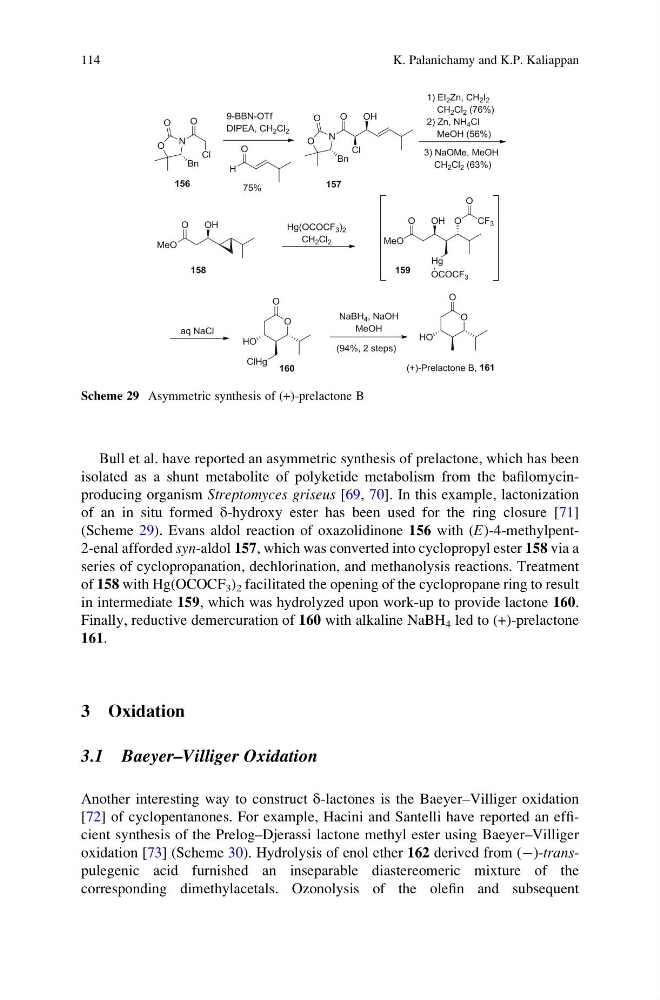
Bull et al. have reported an asymmetric synthesis of prelactone, which has been
isolated as a shunt metabolite of polyketide metabolism from the bafilomycinproducing organism Streptomyces griseus [69, 70]. In this example, lactonization
of an in situ formed δ-hydroxy ester has been used for the ring closure [71]
(Scheme 29). Evans aldol reaction of oxazolidinone 156 with (E)-4-methylpent2-enal afforded syn-aldol 157, which was converted into cyclopropyl ester 158 via a
series of cyclopropanation, dechlorination, and methanolysis reactions. Treatment
of 158 with Hg(OCOCF 3 ) 2 facilitated the opening of the cyclopropane ring to result
in intermediate 159, which was hydrolyzed upon work-up to provide lactone 160.
Finally, reductive demercuration of 160 with alkaline NaBH 4 led to (+)-prelactone
161.
3 Oxidation
3.1 Baeyer–Villiger Oxidation
Another interesting way to construct δ-lactones is the Baeyer–Villiger oxidation
[72] of cyclopentanones. For example, Hacini and Santelli have reported an efficient synthesis of the Prelog–Djerassi lactone methyl ester using Baeyer–Villiger
oxidation [73] (Scheme 30). Hydrolysis of enol ether 162 derived from (À)-transpulegenic acid furnished an inseparable diastereomeric mixture of the
corresponding dimethylacetals. Ozonolysis of the olefin and subsequent
Scheme 29 Asymmetric synthesis of (+)-prelactone B
114
K. Palanichamy and K.P. Kaliappan
isolated as a shunt metabolite of polyketide metabolism from the bafilomycinproducing organism Streptomyces griseus [69, 70]. In this example, lactonization
of an in situ formed δ-hydroxy ester has been used for the ring closure [71]
(Scheme 29). Evans aldol reaction of oxazolidinone 156 with (E)-4-methylpent2-enal afforded syn-aldol 157, which was converted into cyclopropyl ester 158 via a
series of cyclopropanation, dechlorination, and methanolysis reactions. Treatment
of 158 with Hg(OCOCF 3 ) 2 facilitated the opening of the cyclopropane ring to result
in intermediate 159, which was hydrolyzed upon work-up to provide lactone 160.
Finally, reductive demercuration of 160 with alkaline NaBH 4 led to (+)-prelactone
161.
3 Oxidation
3.1 Baeyer–Villiger Oxidation
Another interesting way to construct δ-lactones is the Baeyer–Villiger oxidation
[72] of cyclopentanones. For example, Hacini and Santelli have reported an efficient synthesis of the Prelog–Djerassi lactone methyl ester using Baeyer–Villiger
oxidation [73] (Scheme 30). Hydrolysis of enol ether 162 derived from (À)-transpulegenic acid furnished an inseparable diastereomeric mixture of the
corresponding dimethylacetals. Ozonolysis of the olefin and subsequent
Scheme 29 Asymmetric synthesis of (+)-prelactone B
114
K. Palanichamy and K.P. Kaliappan