

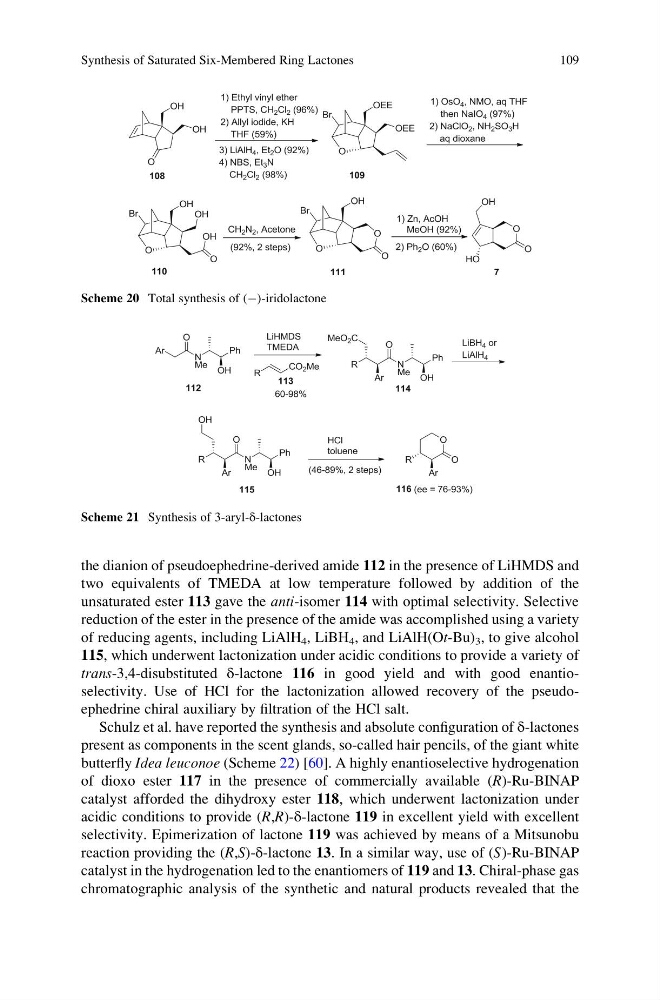
the dianion of pseudoephedrine-derived amide 112 in the presence of LiHMDS and
two equivalents of TMEDA at low temperature followed by addition of the
unsaturated ester 113 gave the anti-isomer 114 with optimal selectivity. Selective
reduction of the ester in the presence of the amide was accomplished using a variety
of reducing agents, including LiAlH 4 , LiBH 4 , and LiAlH(Ot-Bu) 3 , to give alcohol
115, which underwent lactonization under acidic conditions to provide a variety of
trans-3,4-disubstituted δ-lactone 116 in good yield and with good enantioselectivity. Use of HCl for the lactonization allowed recovery of the pseudoephedrine chiral auxiliary by filtration of the HCl salt.
Schulz et al. have reported the synthesis and absolute configuration of δ-lactones
present as components in the scent glands, so-called hair pencils, of the giant white
butterfly Idea leuconoe (Scheme 22) [60]. A highly enantioselective hydrogenation
of dioxo ester 117 in the presence of commercially available (R)-Ru-BINAP
catalyst afforded the dihydroxy ester 118, which underwent lactonization under
acidic conditions to provide (R,R)-δ-lactone 119 in excellent yield with excellent
selectivity. Epimerization of lactone 119 was achieved by means of a Mitsunobu
reaction providing the (R,S)-δ-lactone 13. In a similar way, use of (S)-Ru-BINAP
catalyst in the hydrogenation led to the enantiomers of 119 and 13. Chiral-phase gas
chromatographic analysis of the synthetic and natural products revealed that the
Scheme 20 Total synthesis of (À)-iridolactone
Scheme 21 Synthesis of 3-aryl-δ-lactones
Synthesis of Saturated Six-Membered Ring Lactones
109
two equivalents of TMEDA at low temperature followed by addition of the
unsaturated ester 113 gave the anti-isomer 114 with optimal selectivity. Selective
reduction of the ester in the presence of the amide was accomplished using a variety
of reducing agents, including LiAlH 4 , LiBH 4 , and LiAlH(Ot-Bu) 3 , to give alcohol
115, which underwent lactonization under acidic conditions to provide a variety of
trans-3,4-disubstituted δ-lactone 116 in good yield and with good enantioselectivity. Use of HCl for the lactonization allowed recovery of the pseudoephedrine chiral auxiliary by filtration of the HCl salt.
Schulz et al. have reported the synthesis and absolute configuration of δ-lactones
present as components in the scent glands, so-called hair pencils, of the giant white
butterfly Idea leuconoe (Scheme 22) [60]. A highly enantioselective hydrogenation
of dioxo ester 117 in the presence of commercially available (R)-Ru-BINAP
catalyst afforded the dihydroxy ester 118, which underwent lactonization under
acidic conditions to provide (R,R)-δ-lactone 119 in excellent yield with excellent
selectivity. Epimerization of lactone 119 was achieved by means of a Mitsunobu
reaction providing the (R,S)-δ-lactone 13. In a similar way, use of (S)-Ru-BINAP
catalyst in the hydrogenation led to the enantiomers of 119 and 13. Chiral-phase gas
chromatographic analysis of the synthetic and natural products revealed that the
Scheme 20 Total synthesis of (À)-iridolactone
Scheme 21 Synthesis of 3-aryl-δ-lactones
Synthesis of Saturated Six-Membered Ring Lactones
109