

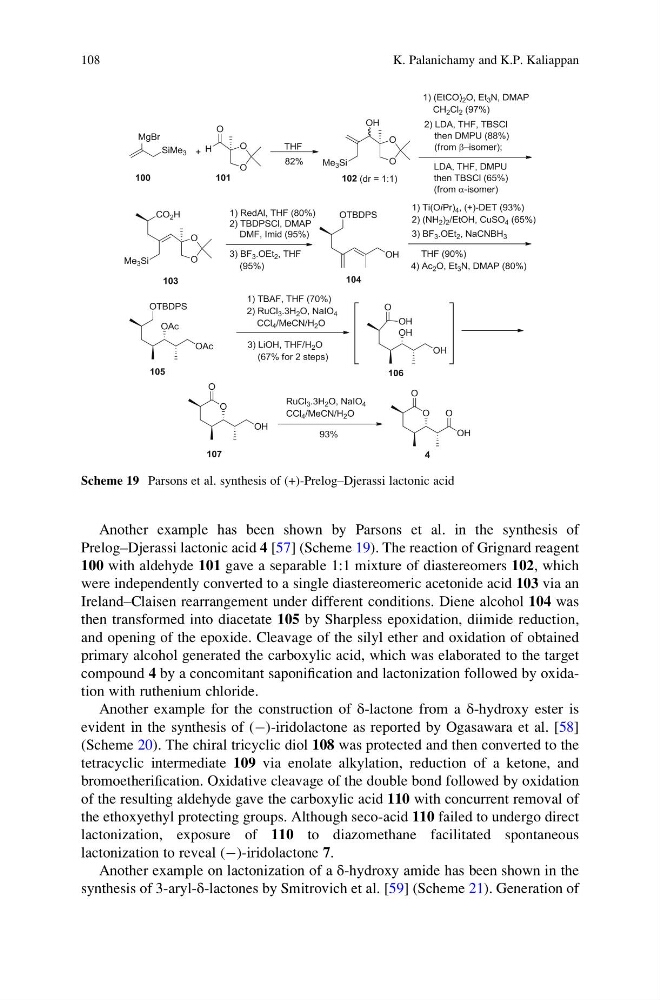
Another example has been shown by Parsons et al. in the synthesis of
Prelog–Djerassi lactonic acid 4 [57] (Scheme 19). The reaction of Grignard reagent
100 with aldehyde 101 gave a separable 1:1 mixture of diastereomers 102, which
were independently converted to a single diastereomeric acetonide acid 103 via an
Ireland–Claisen rearrangement under different conditions. Diene alcohol 104 was
then transformed into diacetate 105 by Sharpless epoxidation, diimide reduction,
and opening of the epoxide. Cleavage of the silyl ether and oxidation of obtained
primary alcohol generated the carboxylic acid, which was elaborated to the target
compound 4 by a concomitant saponification and lactonization followed by oxidation with ruthenium chloride.
Another example for the construction of δ-lactone from a δ-hydroxy ester is
evident in the synthesis of (À)-iridolactone as reported by Ogasawara et al. [58]
(Scheme 20). The chiral tricyclic diol 108 was protected and then converted to the
tetracyclic intermediate 109 via enolate alkylation, reduction of a ketone, and
bromoetherification. Oxidative cleavage of the double bond followed by oxidation
of the resulting aldehyde gave the carboxylic acid 110 with concurrent removal of
the ethoxyethyl protecting groups. Although seco-acid 110 failed to undergo direct
lactonization, exposure of 110 to diazomethane facilitated spontaneous
lactonization to reveal (À)-iridolactone 7.
Another example on lactonization of a δ-hydroxy amide has been shown in the
synthesis of 3-aryl-δ-lactones by Smitrovich et al. [59] (Scheme 21). Generation of
Scheme 19 Parsons et al. synthesis of (+)-Prelog–Djerassi lactonic acid
108
K. Palanichamy and K.P. Kaliappan
Prelog–Djerassi lactonic acid 4 [57] (Scheme 19). The reaction of Grignard reagent
100 with aldehyde 101 gave a separable 1:1 mixture of diastereomers 102, which
were independently converted to a single diastereomeric acetonide acid 103 via an
Ireland–Claisen rearrangement under different conditions. Diene alcohol 104 was
then transformed into diacetate 105 by Sharpless epoxidation, diimide reduction,
and opening of the epoxide. Cleavage of the silyl ether and oxidation of obtained
primary alcohol generated the carboxylic acid, which was elaborated to the target
compound 4 by a concomitant saponification and lactonization followed by oxidation with ruthenium chloride.
Another example for the construction of δ-lactone from a δ-hydroxy ester is
evident in the synthesis of (À)-iridolactone as reported by Ogasawara et al. [58]
(Scheme 20). The chiral tricyclic diol 108 was protected and then converted to the
tetracyclic intermediate 109 via enolate alkylation, reduction of a ketone, and
bromoetherification. Oxidative cleavage of the double bond followed by oxidation
of the resulting aldehyde gave the carboxylic acid 110 with concurrent removal of
the ethoxyethyl protecting groups. Although seco-acid 110 failed to undergo direct
lactonization, exposure of 110 to diazomethane facilitated spontaneous
lactonization to reveal (À)-iridolactone 7.
Another example on lactonization of a δ-hydroxy amide has been shown in the
synthesis of 3-aryl-δ-lactones by Smitrovich et al. [59] (Scheme 21). Generation of
Scheme 19 Parsons et al. synthesis of (+)-Prelog–Djerassi lactonic acid
108
K. Palanichamy and K.P. Kaliappan