

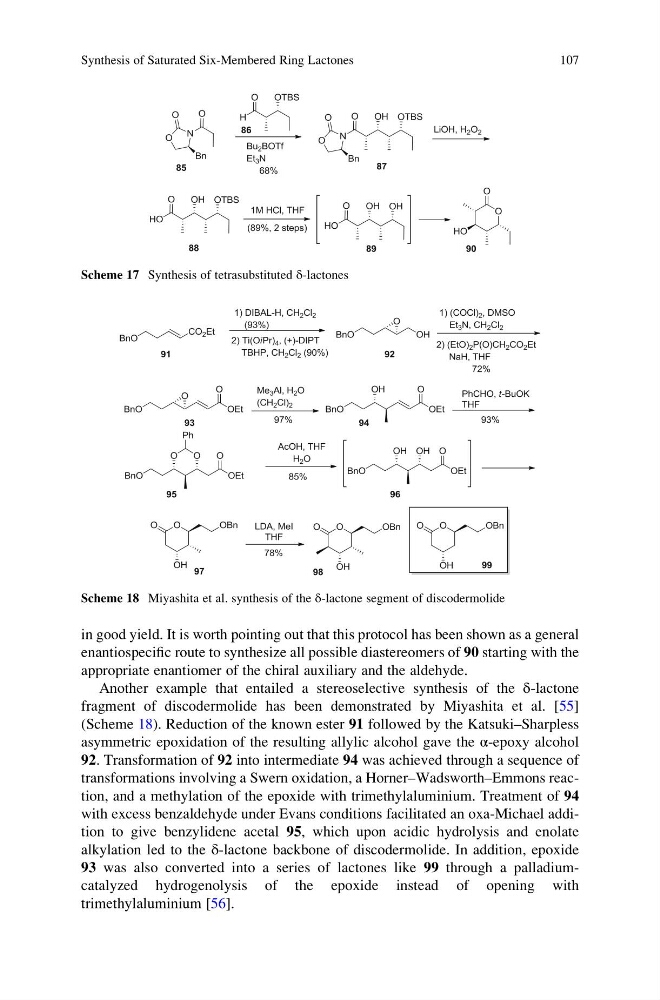
in good yield. It is worth pointing out that this protocol has been shown as a general
enantiospecific route to synthesize all possible diastereomers of 90 starting with the
appropriate enantiomer of the chiral auxiliary and the aldehyde.
Another example that entailed a stereoselective synthesis of the δ-lactone
fragment of discodermolide has been demonstrated by Miyashita et al. [55]
(Scheme 18). Reduction of the known ester 91 followed by the Katsuki–Sharpless
asymmetric epoxidation of the resulting allylic alcohol gave the α-epoxy alcohol
92. Transformation of 92 into intermediate 94 was achieved through a sequence of
transformations involving a Swern oxidation, a Horner–Wadsworth–Emmons reaction, and a methylation of the epoxide with trimethylaluminium. Treatment of 94
with excess benzaldehyde under Evans conditions facilitated an oxa-Michael addition to give benzylidene acetal 95, which upon acidic hydrolysis and enolate
alkylation led to the δ-lactone backbone of discodermolide. In addition, epoxide
93 was also converted into a series of lactones like 99 through a palladiumcatalyzed hydrogenolysis of the epoxide instead of opening with
trimethylaluminium [56].
Scheme 17 Synthesis of tetrasubstituted δ-lactones
Scheme 18 Miyashita et al. synthesis of the δ-lactone segment of discodermolide
Synthesis of Saturated Six-Membered Ring Lactones
107
enantiospecific route to synthesize all possible diastereomers of 90 starting with the
appropriate enantiomer of the chiral auxiliary and the aldehyde.
Another example that entailed a stereoselective synthesis of the δ-lactone
fragment of discodermolide has been demonstrated by Miyashita et al. [55]
(Scheme 18). Reduction of the known ester 91 followed by the Katsuki–Sharpless
asymmetric epoxidation of the resulting allylic alcohol gave the α-epoxy alcohol
92. Transformation of 92 into intermediate 94 was achieved through a sequence of
transformations involving a Swern oxidation, a Horner–Wadsworth–Emmons reaction, and a methylation of the epoxide with trimethylaluminium. Treatment of 94
with excess benzaldehyde under Evans conditions facilitated an oxa-Michael addition to give benzylidene acetal 95, which upon acidic hydrolysis and enolate
alkylation led to the δ-lactone backbone of discodermolide. In addition, epoxide
93 was also converted into a series of lactones like 99 through a palladiumcatalyzed hydrogenolysis of the epoxide instead of opening with
trimethylaluminium [56].
Scheme 17 Synthesis of tetrasubstituted δ-lactones
Scheme 18 Miyashita et al. synthesis of the δ-lactone segment of discodermolide
Synthesis of Saturated Six-Membered Ring Lactones
107