

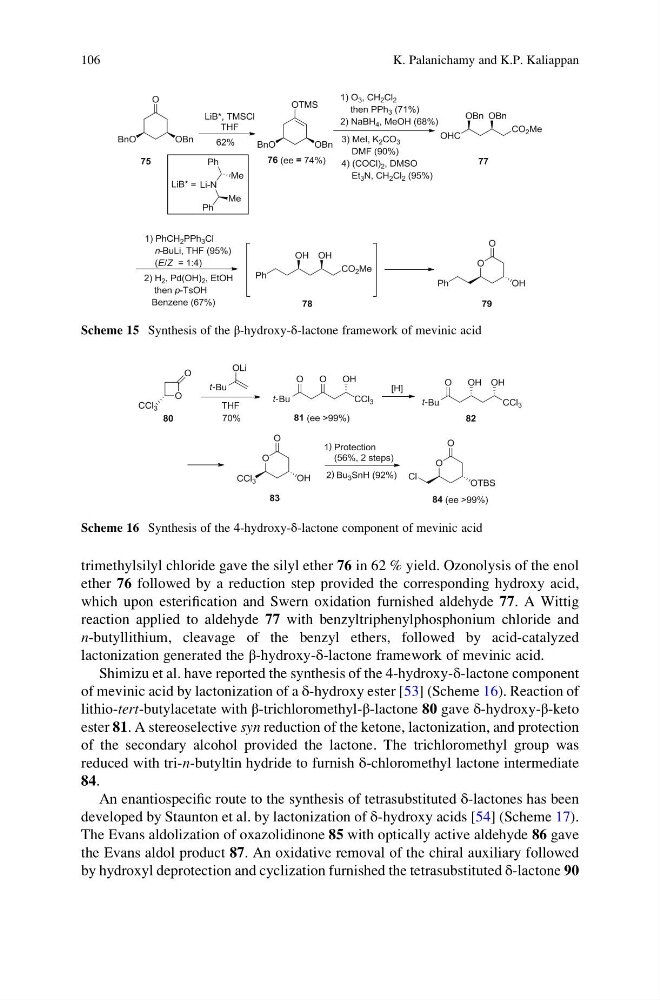
trimethylsilyl chloride gave the silyl ether 76 in 62 % yield. Ozonolysis of the enol
ether 76 followed by a reduction step provided the corresponding hydroxy acid,
which upon esterification and Swern oxidation furnished aldehyde 77. A Wittig
reaction applied to aldehyde 77 with benzyltriphenylphosphonium chloride and
n-butyllithium, cleavage of the benzyl ethers, followed by acid-catalyzed
lactonization generated the β-hydroxy-δ-lactone framework of mevinic acid.
Shimizu et al. have reported the synthesis of the 4-hydroxy-δ-lactone component
of mevinic acid by lactonization of a δ-hydroxy ester [53] (Scheme 16). Reaction of
lithio-tert-butylacetate with β-trichloromethyl-β-lactone 80 gave δ-hydroxy-β-keto
ester 81. A stereoselective syn reduction of the ketone, lactonization, and protection
of the secondary alcohol provided the lactone. The trichloromethyl group was
reduced with tri-n-butyltin hydride to furnish δ-chloromethyl lactone intermediate
84.
An enantiospecific route to the synthesis of tetrasubstituted δ-lactones has been
developed by Staunton et al. by lactonization of δ-hydroxy acids [54] (Scheme 17).
The Evans aldolization of oxazolidinone 85 with optically active aldehyde 86 gave
the Evans aldol product 87. An oxidative removal of the chiral auxiliary followed
by hydroxyl deprotection and cyclization furnished the tetrasubstituted δ-lactone 90
Scheme 15 Synthesis of the β-hydroxy-δ-lactone framework of mevinic acid
tScheme 16 Synthesis of the 4-hydroxy-δ-lactone component of mevinic acid
106
K. Palanichamy and K.P. Kaliappan
ether 76 followed by a reduction step provided the corresponding hydroxy acid,
which upon esterification and Swern oxidation furnished aldehyde 77. A Wittig
reaction applied to aldehyde 77 with benzyltriphenylphosphonium chloride and
n-butyllithium, cleavage of the benzyl ethers, followed by acid-catalyzed
lactonization generated the β-hydroxy-δ-lactone framework of mevinic acid.
Shimizu et al. have reported the synthesis of the 4-hydroxy-δ-lactone component
of mevinic acid by lactonization of a δ-hydroxy ester [53] (Scheme 16). Reaction of
lithio-tert-butylacetate with β-trichloromethyl-β-lactone 80 gave δ-hydroxy-β-keto
ester 81. A stereoselective syn reduction of the ketone, lactonization, and protection
of the secondary alcohol provided the lactone. The trichloromethyl group was
reduced with tri-n-butyltin hydride to furnish δ-chloromethyl lactone intermediate
84.
An enantiospecific route to the synthesis of tetrasubstituted δ-lactones has been
developed by Staunton et al. by lactonization of δ-hydroxy acids [54] (Scheme 17).
The Evans aldolization of oxazolidinone 85 with optically active aldehyde 86 gave
the Evans aldol product 87. An oxidative removal of the chiral auxiliary followed
by hydroxyl deprotection and cyclization furnished the tetrasubstituted δ-lactone 90
Scheme 15 Synthesis of the β-hydroxy-δ-lactone framework of mevinic acid
tScheme 16 Synthesis of the 4-hydroxy-δ-lactone component of mevinic acid
106
K. Palanichamy and K.P. Kaliappan