

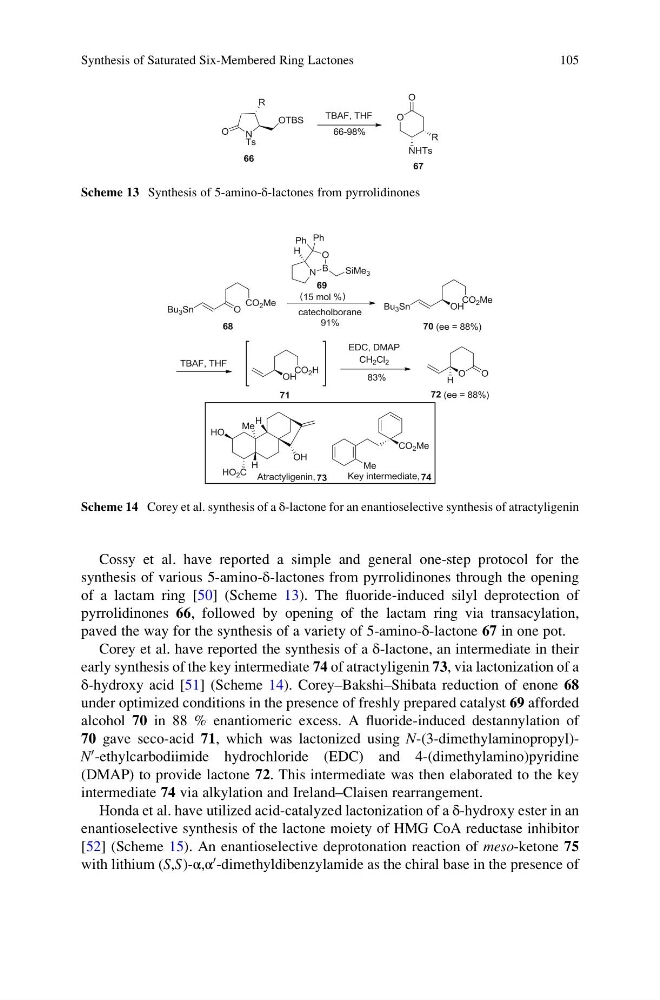
Cossy et al. have reported a simple and general one-step protocol for the
synthesis of various 5-amino-δ-lactones from pyrrolidinones through the opening
of a lactam ring [50] (Scheme 13). The fluoride-induced silyl deprotection of
pyrrolidinones 66, followed by opening of the lactam ring via transacylation,
paved the way for the synthesis of a variety of 5-amino-δ-lactone 67 in one pot.
Corey et al. have reported the synthesis of a δ-lactone, an intermediate in their
early synthesis of the key intermediate 74 of atractyligenin 73, via lactonization of a
δ-hydroxy acid [51] (Scheme 14). Corey–Bakshi–Shibata reduction of enone 68
under optimized conditions in the presence of freshly prepared catalyst 69 afforded
alcohol 70 in 88 % enantiomeric excess. A fluoride-induced destannylation of
70 gave seco-acid 71, which was lactonized using N-(3-dimethylaminopropyl)N
0 -ethylcarbodiimide hydrochloride (EDC) and 4-(dimethylamino)pyridine
(DMAP) to provide lactone 72. This intermediate was then elaborated to the key
intermediate 74 via alkylation and Ireland–Claisen rearrangement.
Honda et al. have utilized acid-catalyzed lactonization of a δ-hydroxy ester in an
enantioselective synthesis of the lactone moiety of HMG CoA reductase inhibitor
[52] (Scheme 15). An enantioselective deprotonation reaction of meso-ketone 75
with lithium (S,S)-α,α
0 -dimethyldibenzylamide as the chiral base in the presence of
Scheme 13 Synthesis of 5-amino-δ-lactones from pyrrolidinones
Scheme 14 Corey et al. synthesis of a δ-lactone for an enantioselective synthesis of atractyligenin
Synthesis of Saturated Six-Membered Ring Lactones
105
synthesis of various 5-amino-δ-lactones from pyrrolidinones through the opening
of a lactam ring [50] (Scheme 13). The fluoride-induced silyl deprotection of
pyrrolidinones 66, followed by opening of the lactam ring via transacylation,
paved the way for the synthesis of a variety of 5-amino-δ-lactone 67 in one pot.
Corey et al. have reported the synthesis of a δ-lactone, an intermediate in their
early synthesis of the key intermediate 74 of atractyligenin 73, via lactonization of a
δ-hydroxy acid [51] (Scheme 14). Corey–Bakshi–Shibata reduction of enone 68
under optimized conditions in the presence of freshly prepared catalyst 69 afforded
alcohol 70 in 88 % enantiomeric excess. A fluoride-induced destannylation of
70 gave seco-acid 71, which was lactonized using N-(3-dimethylaminopropyl)N
0 -ethylcarbodiimide hydrochloride (EDC) and 4-(dimethylamino)pyridine
(DMAP) to provide lactone 72. This intermediate was then elaborated to the key
intermediate 74 via alkylation and Ireland–Claisen rearrangement.
Honda et al. have utilized acid-catalyzed lactonization of a δ-hydroxy ester in an
enantioselective synthesis of the lactone moiety of HMG CoA reductase inhibitor
[52] (Scheme 15). An enantioselective deprotonation reaction of meso-ketone 75
with lithium (S,S)-α,α
0 -dimethyldibenzylamide as the chiral base in the presence of
Scheme 13 Synthesis of 5-amino-δ-lactones from pyrrolidinones
Scheme 14 Corey et al. synthesis of a δ-lactone for an enantioselective synthesis of atractyligenin
Synthesis of Saturated Six-Membered Ring Lactones
105