

δ-lactones occur as mixtures of all enantiomers, the (S,S)-anti-enantiomer being the
major part of this mixture.
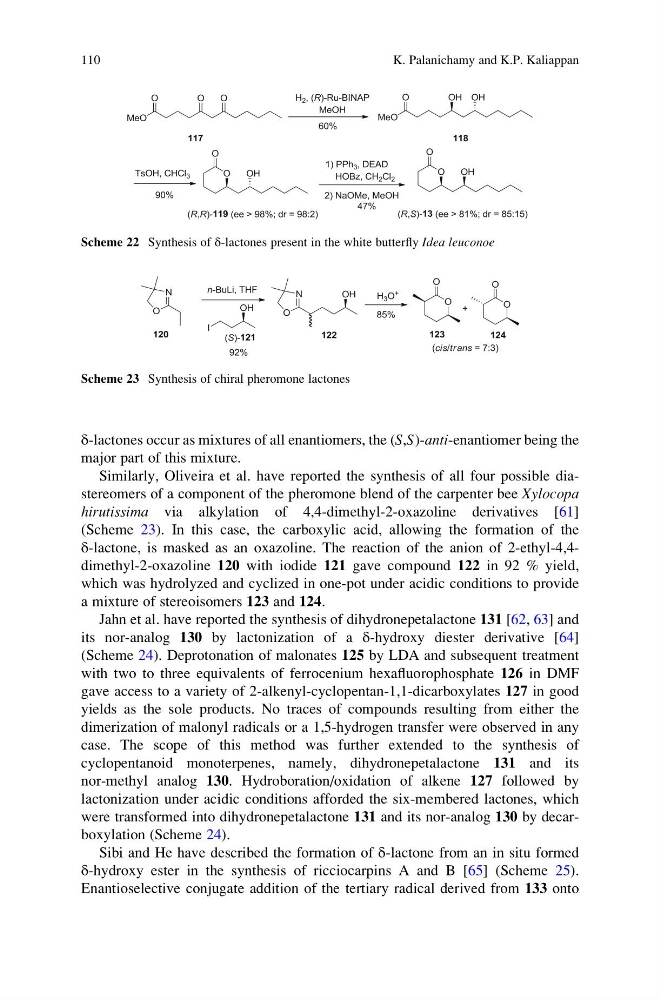
Similarly, Oliveira et al. have reported the synthesis of all four possible diastereomers of a component of the pheromone blend of the carpenter bee Xylocopa
hirutissima via alkylation of 4,4-dimethyl-2-oxazoline derivatives [61]
(Scheme 23). In this case, the carboxylic acid, allowing the formation of the
δ-lactone, is masked as an oxazoline. The reaction of the anion of 2-ethyl-4,4dimethyl-2-oxazoline 120 with iodide 121 gave compound 122 in 92 % yield,
which was hydrolyzed and cyclized in one-pot under acidic conditions to provide
a mixture of stereoisomers 123 and 124.
Jahn et al. have reported the synthesis of dihydronepetalactone 131 [62, 63] and
its nor-analog 130 by lactonization of a δ-hydroxy diester derivative [64]
(Scheme 24). Deprotonation of malonates 125 by LDA and subsequent treatment
with two to three equivalents of ferrocenium hexafluorophosphate 126 in DMF
gave access to a variety of 2-alkenyl-cyclopentan-1,1-dicarboxylates 127 in good
yields as the sole products. No traces of compounds resulting from either the
dimerization of malonyl radicals or a 1,5-hydrogen transfer were observed in any
case. The scope of this method was further extended to the synthesis of
cyclopentanoid monoterpenes, namely, dihydronepetalactone 131 and its
nor-methyl analog 130. Hydroboration/oxidation of alkene 127 followed by
lactonization under acidic conditions afforded the six-membered lactones, which
were transformed into dihydronepetalactone 131 and its nor-analog 130 by decarboxylation (Scheme 24).
Sibi and He have described the formation of δ-lactone from an in situ formed
δ-hydroxy ester in the synthesis of ricciocarpins A and B [65] (Scheme 25).
Enantioselective conjugate addition of the tertiary radical derived from 133 onto
Scheme 22 Synthesis of δ-lactones present in the white butterfly Idea leuconoe
Scheme 23 Synthesis of chiral pheromone lactones
110
K. Palanichamy and K.P. Kaliappan
major part of this mixture.
Similarly, Oliveira et al. have reported the synthesis of all four possible diastereomers of a component of the pheromone blend of the carpenter bee Xylocopa
hirutissima via alkylation of 4,4-dimethyl-2-oxazoline derivatives [61]
(Scheme 23). In this case, the carboxylic acid, allowing the formation of the
δ-lactone, is masked as an oxazoline. The reaction of the anion of 2-ethyl-4,4dimethyl-2-oxazoline 120 with iodide 121 gave compound 122 in 92 % yield,
which was hydrolyzed and cyclized in one-pot under acidic conditions to provide
a mixture of stereoisomers 123 and 124.
Jahn et al. have reported the synthesis of dihydronepetalactone 131 [62, 63] and
its nor-analog 130 by lactonization of a δ-hydroxy diester derivative [64]
(Scheme 24). Deprotonation of malonates 125 by LDA and subsequent treatment
with two to three equivalents of ferrocenium hexafluorophosphate 126 in DMF
gave access to a variety of 2-alkenyl-cyclopentan-1,1-dicarboxylates 127 in good
yields as the sole products. No traces of compounds resulting from either the
dimerization of malonyl radicals or a 1,5-hydrogen transfer were observed in any
case. The scope of this method was further extended to the synthesis of
cyclopentanoid monoterpenes, namely, dihydronepetalactone 131 and its
nor-methyl analog 130. Hydroboration/oxidation of alkene 127 followed by
lactonization under acidic conditions afforded the six-membered lactones, which
were transformed into dihydronepetalactone 131 and its nor-analog 130 by decarboxylation (Scheme 24).
Sibi and He have described the formation of δ-lactone from an in situ formed
δ-hydroxy ester in the synthesis of ricciocarpins A and B [65] (Scheme 25).
Enantioselective conjugate addition of the tertiary radical derived from 133 onto
Scheme 22 Synthesis of δ-lactones present in the white butterfly Idea leuconoe
Scheme 23 Synthesis of chiral pheromone lactones
110
K. Palanichamy and K.P. Kaliappan