

2.5.3 Epoxide Rearrangement
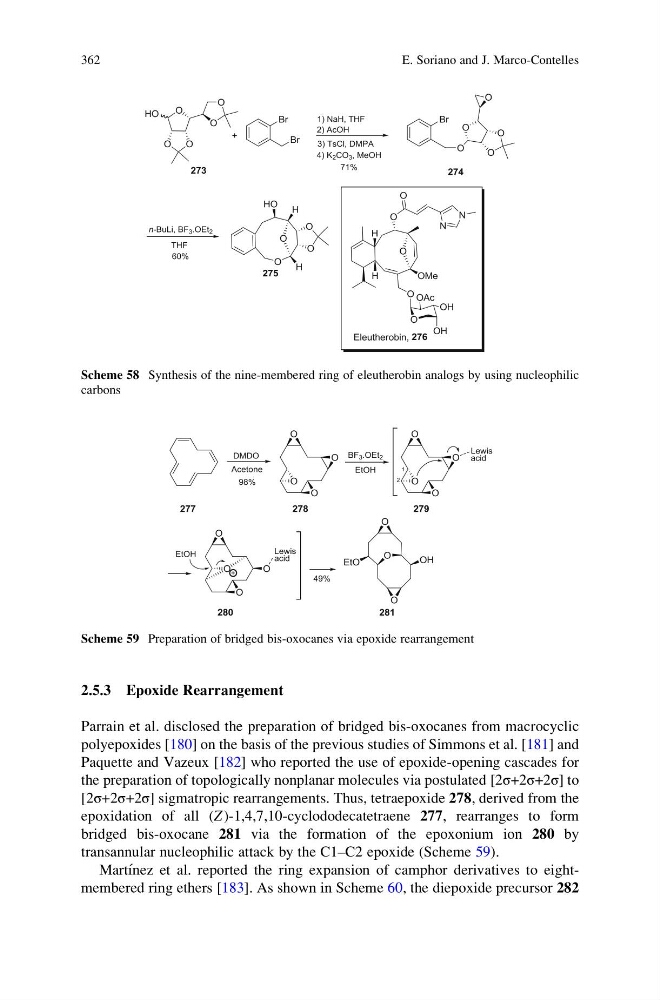
Parrain et al. disclosed the preparation of bridged bis-oxocanes from macrocyclic
polyepoxides [180] on the basis of the previous studies of Simmons et al. [181] and
Paquette and Vazeux [182] who reported the use of epoxide-opening cascades for
the preparation of topologically nonplanar molecules via postulated [2σ+2σ+2σ] to
[2σ+2σ+2σ] sigmatropic rearrangements. Thus, tetraepoxide 278, derived from the
epoxidation of all (Z)-1,4,7,10-cyclododecatetraene 277, rearranges to form
bridged bis-oxocane 281 via the formation of the epoxonium ion 280 by
transannular nucleophilic attack by the C1–C2 epoxide (Scheme 59).
Martı ´nez et al. reported the ring expansion of camphor derivatives to eightmembered ring ethers [183]. As shown in Scheme 60, the diepoxide precursor 282
Scheme 58 Synthesis of the nine-membered ring of eleutherobin analogs by using nucleophilic
carbons
Scheme 59 Preparation of bridged bis-oxocanes via epoxide rearrangement
362
E. Soriano and J. Marco-Contelles
Parrain et al. disclosed the preparation of bridged bis-oxocanes from macrocyclic
polyepoxides [180] on the basis of the previous studies of Simmons et al. [181] and
Paquette and Vazeux [182] who reported the use of epoxide-opening cascades for
the preparation of topologically nonplanar molecules via postulated [2σ+2σ+2σ] to
[2σ+2σ+2σ] sigmatropic rearrangements. Thus, tetraepoxide 278, derived from the
epoxidation of all (Z)-1,4,7,10-cyclododecatetraene 277, rearranges to form
bridged bis-oxocane 281 via the formation of the epoxonium ion 280 by
transannular nucleophilic attack by the C1–C2 epoxide (Scheme 59).
Martı ´nez et al. reported the ring expansion of camphor derivatives to eightmembered ring ethers [183]. As shown in Scheme 60, the diepoxide precursor 282
Scheme 58 Synthesis of the nine-membered ring of eleutherobin analogs by using nucleophilic
carbons
Scheme 59 Preparation of bridged bis-oxocanes via epoxide rearrangement
362
E. Soriano and J. Marco-Contelles