

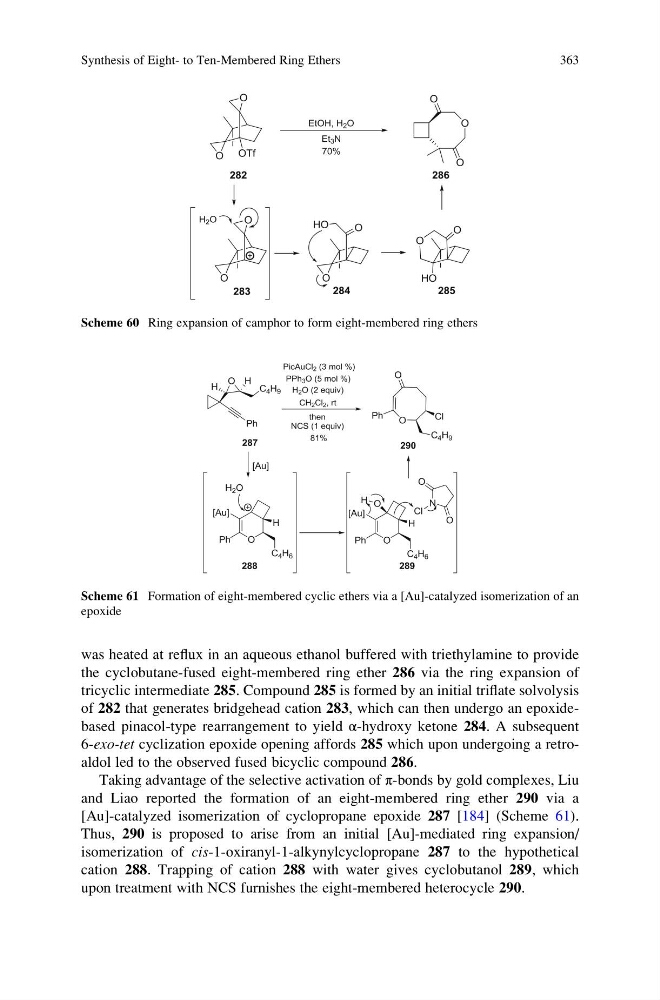
was heated at reflux in an aqueous ethanol buffered with triethylamine to provide
the cyclobutane-fused eight-membered ring ether 286 via the ring expansion of
tricyclic intermediate 285. Compound 285 is formed by an initial triflate solvolysis
of 282 that generates bridgehead cation 283, which can then undergo an epoxidebased pinacol-type rearrangement to yield α-hydroxy ketone 284. A subsequent
6-exo-tet cyclization epoxide opening affords 285 which upon undergoing a retroaldol led to the observed fused bicyclic compound 286.
Taking advantage of the selective activation of π-bonds by gold complexes, Liu
and Liao reported the formation of an eight-membered ring ether 290 via a
[Au]-catalyzed isomerization of cyclopropane epoxide 287 [184] (Scheme 61).
Thus, 290 is proposed to arise from an initial [Au]-mediated ring expansion/
isomerization of cis-1-oxiranyl-1-alkynylcyclopropane 287 to the hypothetical
cation 288. Trapping of cation 288 with water gives cyclobutanol 289, which
upon treatment with NCS furnishes the eight-membered heterocycle 290.
Scheme 60 Ring expansion of camphor to form eight-membered ring ethers
Scheme 61 Formation of eight-membered cyclic ethers via a [Au]-catalyzed isomerization of an
epoxide
Synthesis of Eight- to Ten-Membered Ring Ethers
363
the cyclobutane-fused eight-membered ring ether 286 via the ring expansion of
tricyclic intermediate 285. Compound 285 is formed by an initial triflate solvolysis
of 282 that generates bridgehead cation 283, which can then undergo an epoxidebased pinacol-type rearrangement to yield α-hydroxy ketone 284. A subsequent
6-exo-tet cyclization epoxide opening affords 285 which upon undergoing a retroaldol led to the observed fused bicyclic compound 286.
Taking advantage of the selective activation of π-bonds by gold complexes, Liu
and Liao reported the formation of an eight-membered ring ether 290 via a
[Au]-catalyzed isomerization of cyclopropane epoxide 287 [184] (Scheme 61).
Thus, 290 is proposed to arise from an initial [Au]-mediated ring expansion/
isomerization of cis-1-oxiranyl-1-alkynylcyclopropane 287 to the hypothetical
cation 288. Trapping of cation 288 with water gives cyclobutanol 289, which
upon treatment with NCS furnishes the eight-membered heterocycle 290.
Scheme 60 Ring expansion of camphor to form eight-membered ring ethers
Scheme 61 Formation of eight-membered cyclic ethers via a [Au]-catalyzed isomerization of an
epoxide
Synthesis of Eight- to Ten-Membered Ring Ethers
363