

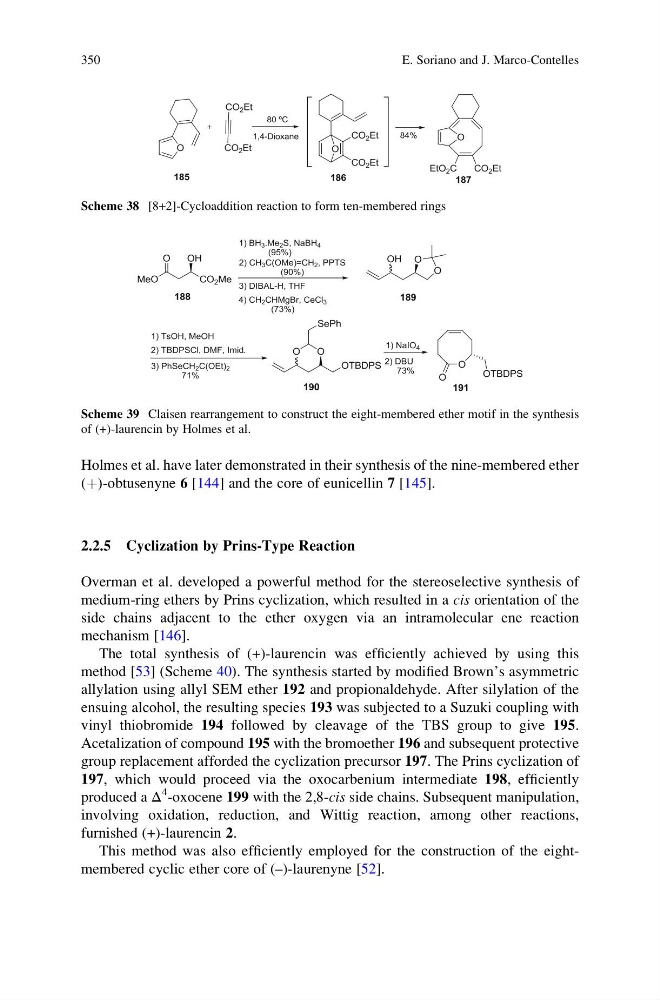
Holmes et al. have later demonstrated in their synthesis of the nine-membered ether
(þ)-obtusenyne 6 [144] and the core of eunicellin 7 [145].
2.2.5 Cyclization by Prins-Type Reaction
Overman et al. developed a powerful method for the stereoselective synthesis of
medium-ring ethers by Prins cyclization, which resulted in a cis orientation of the
side chains adjacent to the ether oxygen via an intramolecular ene reaction
mechanism [146].
The total synthesis of (+)-laurencin was efficiently achieved by using this
method [53] (Scheme 40). The synthesis started by modified Brown’s asymmetric
allylation using allyl SEM ether 192 and propionaldehyde. After silylation of the
ensuing alcohol, the resulting species 193 was subjected to a Suzuki coupling with
vinyl thiobromide 194 followed by cleavage of the TBS group to give 195.
Acetalization of compound 195 with the bromoether 196 and subsequent protective
group replacement afforded the cyclization precursor 197. The Prins cyclization of
197, which would proceed via the oxocarbenium intermediate 198, efficiently
produced a Δ
4 -oxocene 199 with the 2,8-cis side chains. Subsequent manipulation,
involving oxidation, reduction, and Wittig reaction, among other reactions,
furnished (+)-laurencin 2.
This method was also efficiently employed for the construction of the eightmembered cyclic ether core of (–)-laurenyne [52].
.
Scheme 39 Claisen rearrangement to construct the eight-membered ether motif in the synthesis
of (+)-laurencin by Holmes et al.
Scheme 38 [8+2]-Cycloaddition reaction to form ten-membered rings
350
E. Soriano and J. Marco-Contelles
(þ)-obtusenyne 6 [144] and the core of eunicellin 7 [145].
2.2.5 Cyclization by Prins-Type Reaction
Overman et al. developed a powerful method for the stereoselective synthesis of
medium-ring ethers by Prins cyclization, which resulted in a cis orientation of the
side chains adjacent to the ether oxygen via an intramolecular ene reaction
mechanism [146].
The total synthesis of (+)-laurencin was efficiently achieved by using this
method [53] (Scheme 40). The synthesis started by modified Brown’s asymmetric
allylation using allyl SEM ether 192 and propionaldehyde. After silylation of the
ensuing alcohol, the resulting species 193 was subjected to a Suzuki coupling with
vinyl thiobromide 194 followed by cleavage of the TBS group to give 195.
Acetalization of compound 195 with the bromoether 196 and subsequent protective
group replacement afforded the cyclization precursor 197. The Prins cyclization of
197, which would proceed via the oxocarbenium intermediate 198, efficiently
produced a Δ
4 -oxocene 199 with the 2,8-cis side chains. Subsequent manipulation,
involving oxidation, reduction, and Wittig reaction, among other reactions,
furnished (+)-laurencin 2.
This method was also efficiently employed for the construction of the eightmembered cyclic ether core of (–)-laurenyne [52].
.
Scheme 39 Claisen rearrangement to construct the eight-membered ether motif in the synthesis
of (+)-laurencin by Holmes et al.
Scheme 38 [8+2]-Cycloaddition reaction to form ten-membered rings
350
E. Soriano and J. Marco-Contelles