

2.2.4 Cycloaddition and Pericyclic Reaction
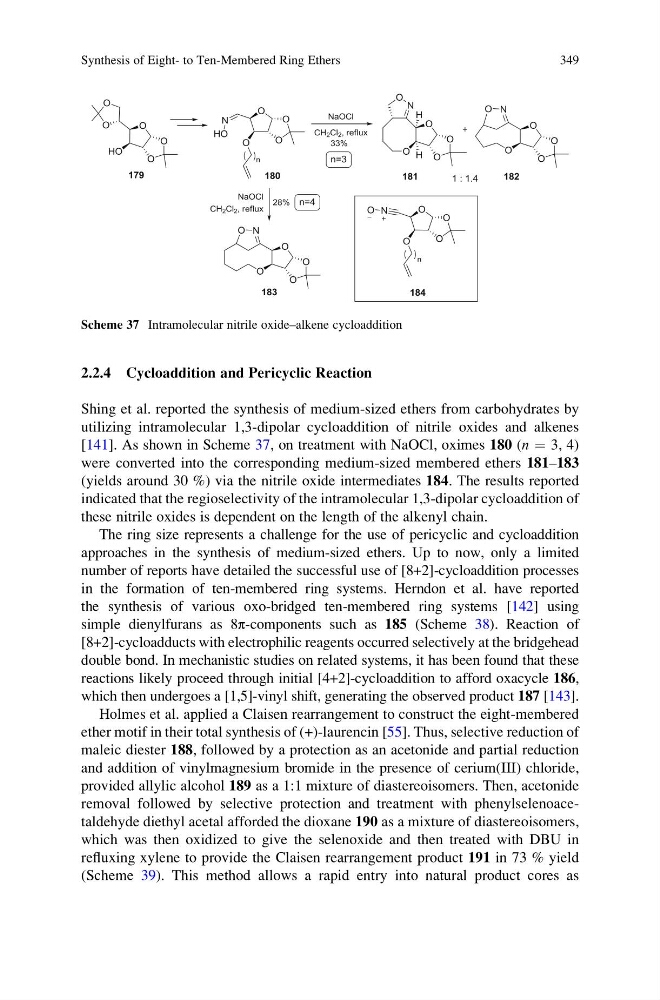
Shing et al. reported the synthesis of medium-sized ethers from carbohydrates by
utilizing intramolecular 1,3-dipolar cycloaddition of nitrile oxides and alkenes
[141]. As shown in Scheme 37, on treatment with NaOCl, oximes 180 (n ¼ 3, 4)
were converted into the corresponding medium-sized membered ethers 181–183
(yields around 30 %) via the nitrile oxide intermediates 184. The results reported
indicated that the regioselectivity of the intramolecular 1,3-dipolar cycloaddition of
these nitrile oxides is dependent on the length of the alkenyl chain.
The ring size represents a challenge for the use of pericyclic and cycloaddition
approaches in the synthesis of medium-sized ethers. Up to now, only a limited
number of reports have detailed the successful use of [8+2]-cycloaddition processes
in the formation of ten-membered ring systems. Herndon et al. have reported
the synthesis of various oxo-bridged ten-membered ring systems [142] using
simple dienylfurans as 8π-components such as 185 (Scheme 38). Reaction of
[8+2]-cycloadducts with electrophilic reagents occurred selectively at the bridgehead
double bond. In mechanistic studies on related systems, it has been found that these
reactions likely proceed through initial [4+2]-cycloaddition to afford oxacycle 186,
which then undergoes a [1,5]-vinyl shift, generating the observed product 187 [143].
Holmes et al. applied a Claisen rearrangement to construct the eight-membered
ether motif in their total synthesis of (+)-laurencin [55]. Thus, selective reduction of
maleic diester 188, followed by a protection as an acetonide and partial reduction
and addition of vinylmagnesium bromide in the presence of cerium(III) chloride,
provided allylic alcohol 189 as a 1:1 mixture of diastereoisomers. Then, acetonide
removal followed by selective protection and treatment with phenylselenoacetaldehyde diethyl acetal afforded the dioxane 190 as a mixture of diastereoisomers,
which was then oxidized to give the selenoxide and then treated with DBU in
refluxing xylene to provide the Claisen rearrangement product 191 in 73 % yield
(Scheme 39). This method allows a rapid entry into natural product cores as
Scheme 37 Intramolecular nitrile oxide–alkene cycloaddition
Synthesis of Eight- to Ten-Membered Ring Ethers
349
Shing et al. reported the synthesis of medium-sized ethers from carbohydrates by
utilizing intramolecular 1,3-dipolar cycloaddition of nitrile oxides and alkenes
[141]. As shown in Scheme 37, on treatment with NaOCl, oximes 180 (n ¼ 3, 4)
were converted into the corresponding medium-sized membered ethers 181–183
(yields around 30 %) via the nitrile oxide intermediates 184. The results reported
indicated that the regioselectivity of the intramolecular 1,3-dipolar cycloaddition of
these nitrile oxides is dependent on the length of the alkenyl chain.
The ring size represents a challenge for the use of pericyclic and cycloaddition
approaches in the synthesis of medium-sized ethers. Up to now, only a limited
number of reports have detailed the successful use of [8+2]-cycloaddition processes
in the formation of ten-membered ring systems. Herndon et al. have reported
the synthesis of various oxo-bridged ten-membered ring systems [142] using
simple dienylfurans as 8π-components such as 185 (Scheme 38). Reaction of
[8+2]-cycloadducts with electrophilic reagents occurred selectively at the bridgehead
double bond. In mechanistic studies on related systems, it has been found that these
reactions likely proceed through initial [4+2]-cycloaddition to afford oxacycle 186,
which then undergoes a [1,5]-vinyl shift, generating the observed product 187 [143].
Holmes et al. applied a Claisen rearrangement to construct the eight-membered
ether motif in their total synthesis of (+)-laurencin [55]. Thus, selective reduction of
maleic diester 188, followed by a protection as an acetonide and partial reduction
and addition of vinylmagnesium bromide in the presence of cerium(III) chloride,
provided allylic alcohol 189 as a 1:1 mixture of diastereoisomers. Then, acetonide
removal followed by selective protection and treatment with phenylselenoacetaldehyde diethyl acetal afforded the dioxane 190 as a mixture of diastereoisomers,
which was then oxidized to give the selenoxide and then treated with DBU in
refluxing xylene to provide the Claisen rearrangement product 191 in 73 % yield
(Scheme 39). This method allows a rapid entry into natural product cores as
Scheme 37 Intramolecular nitrile oxide–alkene cycloaddition
Synthesis of Eight- to Ten-Membered Ring Ethers
349