

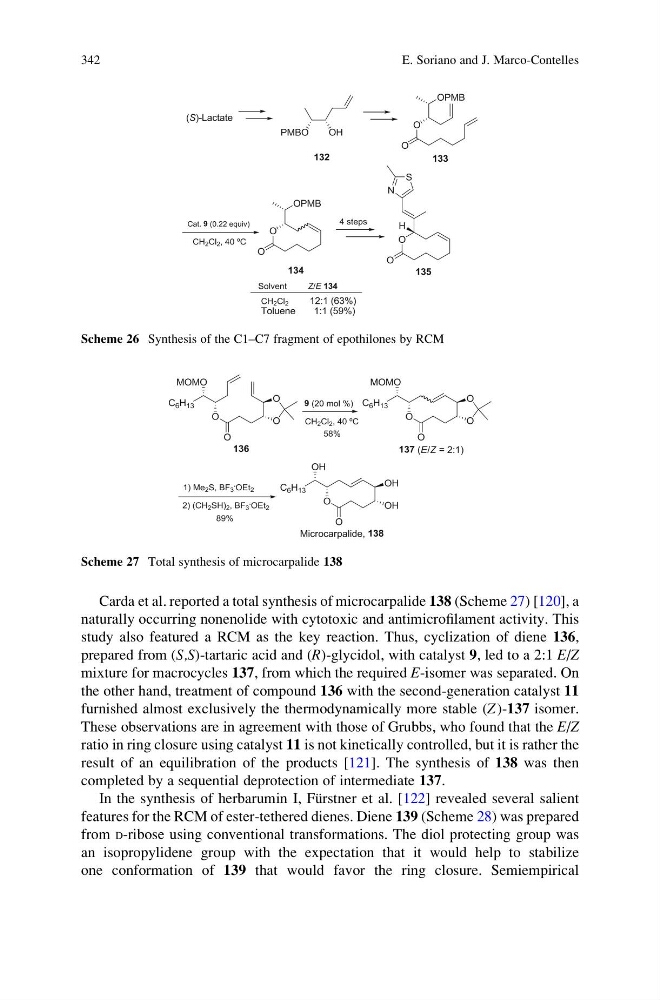
Carda et al. reported a total synthesis of microcarpalide 138 (Scheme 27) [120], a
naturally occurring nonenolide with cytotoxic and antimicrofilament activity. This
study also featured a RCM as the key reaction. Thus, cyclization of diene 136,
prepared from (S,S)-tartaric acid and (R)-glycidol, with catalyst 9, led to a 2:1 E/Z
mixture for macrocycles 137, from which the required E-isomer was separated. On
the other hand, treatment of compound 136 with the second-generation catalyst 11
furnished almost exclusively the thermodynamically more stable (Z)-137 isomer.
These observations are in agreement with those of Grubbs, who found that the E/Z
ratio in ring closure using catalyst 11 is not kinetically controlled, but it is rather the
result of an equilibration of the products [121]. The synthesis of 138 was then
completed by a sequential deprotection of intermediate 137.
In the synthesis of herbarumin I, Fu ¨rstner et al. [122] revealed several salient
features for the RCM of ester-tethered dienes. Diene 139 (Scheme 28) was prepared
from D-ribose using conventional transformations. The diol protecting group was
an isopropylidene group with the expectation that it would help to stabilize
one conformation of 139 that would favor the ring closure. Semiempirical
Scheme 26 Synthesis of the C1–C7 fragment of epothilones by RCM
Scheme 27 Total synthesis of microcarpalide 138
342
E. Soriano and J. Marco-Contelles
naturally occurring nonenolide with cytotoxic and antimicrofilament activity. This
study also featured a RCM as the key reaction. Thus, cyclization of diene 136,
prepared from (S,S)-tartaric acid and (R)-glycidol, with catalyst 9, led to a 2:1 E/Z
mixture for macrocycles 137, from which the required E-isomer was separated. On
the other hand, treatment of compound 136 with the second-generation catalyst 11
furnished almost exclusively the thermodynamically more stable (Z)-137 isomer.
These observations are in agreement with those of Grubbs, who found that the E/Z
ratio in ring closure using catalyst 11 is not kinetically controlled, but it is rather the
result of an equilibration of the products [121]. The synthesis of 138 was then
completed by a sequential deprotection of intermediate 137.
In the synthesis of herbarumin I, Fu ¨rstner et al. [122] revealed several salient
features for the RCM of ester-tethered dienes. Diene 139 (Scheme 28) was prepared
from D-ribose using conventional transformations. The diol protecting group was
an isopropylidene group with the expectation that it would help to stabilize
one conformation of 139 that would favor the ring closure. Semiempirical
Scheme 26 Synthesis of the C1–C7 fragment of epothilones by RCM
Scheme 27 Total synthesis of microcarpalide 138
342
E. Soriano and J. Marco-Contelles