

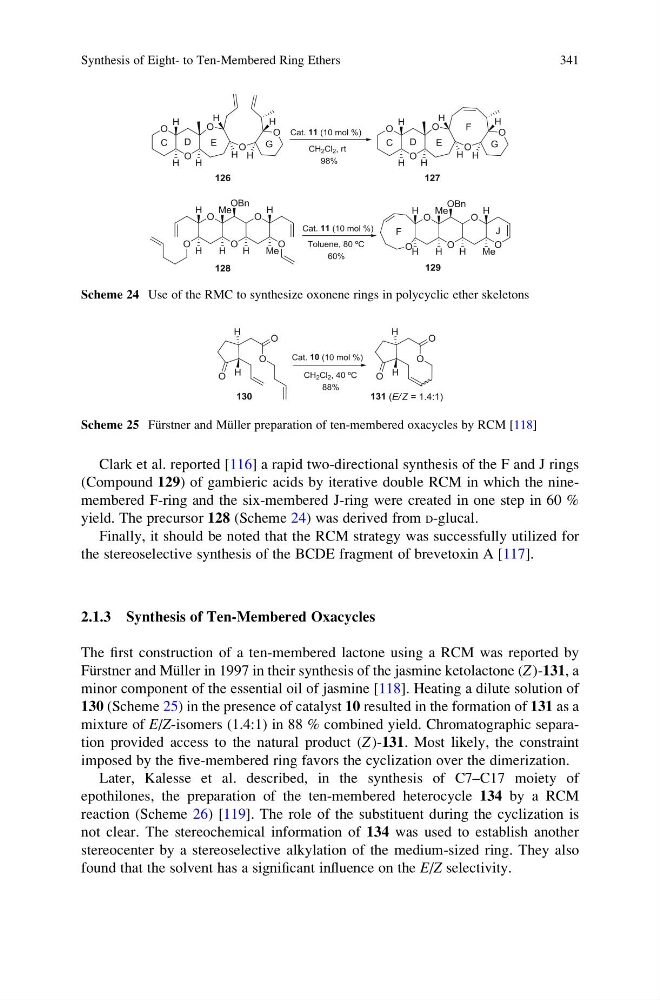
Clark et al. reported [116] a rapid two-directional synthesis of the F and J rings
(Compound 129) of gambieric acids by iterative double RCM in which the ninemembered F-ring and the six-membered J-ring were created in one step in 60 %
yield. The precursor 128 (Scheme 24) was derived from D-glucal.
Finally, it should be noted that the RCM strategy was successfully utilized for
the stereoselective synthesis of the BCDE fragment of brevetoxin A [117].
2.1.3 Synthesis of Ten-Membered Oxacycles
The first construction of a ten-membered lactone using a RCM was reported by
Fu ¨rstner and Mu ¨ller in 1997 in their synthesis of the jasmine ketolactone (Z)-131, a
minor component of the essential oil of jasmine [118]. Heating a dilute solution of
130 (Scheme 25) in the presence of catalyst 10 resulted in the formation of 131 as a
mixture of E/Z-isomers (1.4:1) in 88 % combined yield. Chromatographic separation provided access to the natural product (Z )-131. Most likely, the constraint
imposed by the five-membered ring favors the cyclization over the dimerization.
Later, Kalesse et al. described, in the synthesis of C7–C17 moiety of
epothilones, the preparation of the ten-membered heterocycle 134 by a RCM
reaction (Scheme 26) [119]. The role of the substituent during the cyclization is
not clear. The stereochemical information of 134 was used to establish another
stereocenter by a stereoselective alkylation of the medium-sized ring. They also
found that the solvent has a significant influence on the E/Z selectivity.
Scheme 25 Fu ¨rstner and Mu ¨ller preparation of ten-membered oxacycles by RCM [118]
Scheme 24 Use of the RMC to synthesize oxonene rings in polycyclic ether skeletons
Synthesis of Eight- to Ten-Membered Ring Ethers
341
(Compound 129) of gambieric acids by iterative double RCM in which the ninemembered F-ring and the six-membered J-ring were created in one step in 60 %
yield. The precursor 128 (Scheme 24) was derived from D-glucal.
Finally, it should be noted that the RCM strategy was successfully utilized for
the stereoselective synthesis of the BCDE fragment of brevetoxin A [117].
2.1.3 Synthesis of Ten-Membered Oxacycles
The first construction of a ten-membered lactone using a RCM was reported by
Fu ¨rstner and Mu ¨ller in 1997 in their synthesis of the jasmine ketolactone (Z)-131, a
minor component of the essential oil of jasmine [118]. Heating a dilute solution of
130 (Scheme 25) in the presence of catalyst 10 resulted in the formation of 131 as a
mixture of E/Z-isomers (1.4:1) in 88 % combined yield. Chromatographic separation provided access to the natural product (Z )-131. Most likely, the constraint
imposed by the five-membered ring favors the cyclization over the dimerization.
Later, Kalesse et al. described, in the synthesis of C7–C17 moiety of
epothilones, the preparation of the ten-membered heterocycle 134 by a RCM
reaction (Scheme 26) [119]. The role of the substituent during the cyclization is
not clear. The stereochemical information of 134 was used to establish another
stereocenter by a stereoselective alkylation of the medium-sized ring. They also
found that the solvent has a significant influence on the E/Z selectivity.
Scheme 25 Fu ¨rstner and Mu ¨ller preparation of ten-membered oxacycles by RCM [118]
Scheme 24 Use of the RMC to synthesize oxonene rings in polycyclic ether skeletons
Synthesis of Eight- to Ten-Membered Ring Ethers
341