

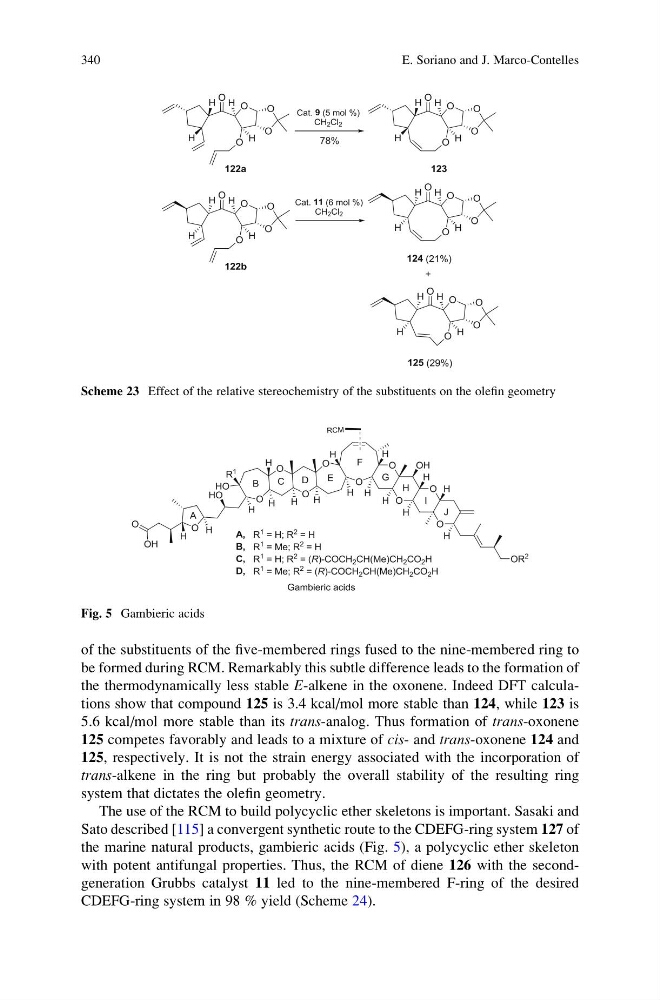
of the substituents of the five-membered rings fused to the nine-membered ring to
be formed during RCM. Remarkably this subtle difference leads to the formation of
the thermodynamically less stable E-alkene in the oxonene. Indeed DFT calculations show that compound 125 is 3.4 kcal/mol more stable than 124, while 123 is
5.6 kcal/mol more stable than its trans-analog. Thus formation of trans-oxonene
125 competes favorably and leads to a mixture of cis- and trans-oxonene 124 and
125, respectively. It is not the strain energy associated with the incorporation of
trans-alkene in the ring but probably the overall stability of the resulting ring
system that dictates the olefin geometry.
The use of the RCM to build polycyclic ether skeletons is important. Sasaki and
Sato described [115] a convergent synthetic route to the CDEFG-ring system 127 of
the marine natural products, gambieric acids (Fig. 5), a polycyclic ether skeleton
with potent antifungal properties. Thus, the RCM of diene 126 with the secondgeneration Grubbs catalyst 11 led to the nine-membered F-ring of the desired
CDEFG-ring system in 98 % yield (Scheme 24).
Scheme 23 Effect of the relative stereochemistry of the substituents on the olefin geometry
Fig. 5 Gambieric acids
340
E. Soriano and J. Marco-Contelles
be formed during RCM. Remarkably this subtle difference leads to the formation of
the thermodynamically less stable E-alkene in the oxonene. Indeed DFT calculations show that compound 125 is 3.4 kcal/mol more stable than 124, while 123 is
5.6 kcal/mol more stable than its trans-analog. Thus formation of trans-oxonene
125 competes favorably and leads to a mixture of cis- and trans-oxonene 124 and
125, respectively. It is not the strain energy associated with the incorporation of
trans-alkene in the ring but probably the overall stability of the resulting ring
system that dictates the olefin geometry.
The use of the RCM to build polycyclic ether skeletons is important. Sasaki and
Sato described [115] a convergent synthetic route to the CDEFG-ring system 127 of
the marine natural products, gambieric acids (Fig. 5), a polycyclic ether skeleton
with potent antifungal properties. Thus, the RCM of diene 126 with the secondgeneration Grubbs catalyst 11 led to the nine-membered F-ring of the desired
CDEFG-ring system in 98 % yield (Scheme 24).
Scheme 23 Effect of the relative stereochemistry of the substituents on the olefin geometry
Fig. 5 Gambieric acids
340
E. Soriano and J. Marco-Contelles