

spectroscopic or chromatographic evidence for the formation of either the E-isomer
or other side products.
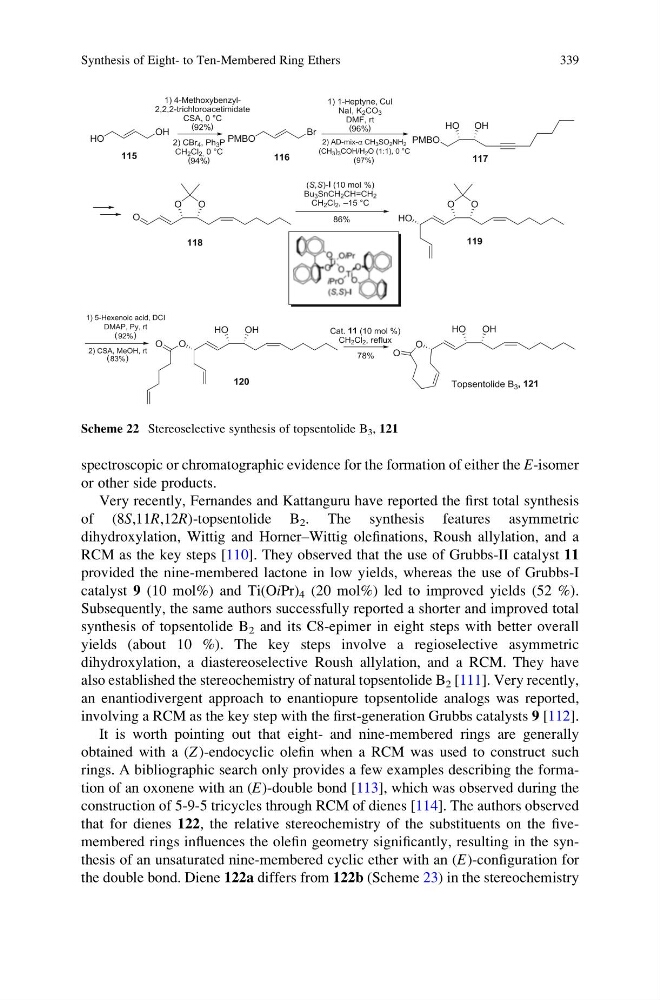
Very recently, Fernandes and Kattanguru have reported the first total synthesis
of (8S,11R,12R)-topsentolide B 2 . The synthesis features asymmetric
dihydroxylation, Wittig and Horner–Wittig olefinations, Roush allylation, and a
RCM as the key steps [110]. They observed that the use of Grubbs-II catalyst 11
provided the nine-membered lactone in low yields, whereas the use of Grubbs-I
catalyst 9 (10 mol%) and Ti(OiPr) 4 (20 mol%) led to improved yields (52 %).
Subsequently, the same authors successfully reported a shorter and improved total
synthesis of topsentolide B 2 and its C8-epimer in eight steps with better overall
yields (about 10 %). The key steps involve a regioselective asymmetric
dihydroxylation, a diastereoselective Roush allylation, and a RCM. They have
also established the stereochemistry of natural topsentolide B 2 [111]. Very recently,
an enantiodivergent approach to enantiopure topsentolide analogs was reported,
involving a RCM as the key step with the first-generation Grubbs catalysts 9 [112].
It is worth pointing out that eight- and nine-membered rings are generally
obtained with a (Z )-endocyclic olefin when a RCM was used to construct such
rings. A bibliographic search only provides a few examples describing the formation of an oxonene with an (E)-double bond [113], which was observed during the
construction of 5-9-5 tricycles through RCM of dienes [114]. The authors observed
that for dienes 122, the relative stereochemistry of the substituents on the fivemembered rings influences the olefin geometry significantly, resulting in the synthesis of an unsaturated nine-membered cyclic ether with an (E)-configuration for
the double bond. Diene 122a differs from 122b (Scheme 23) in the stereochemistry
Scheme 22 Stereoselective synthesis of topsentolide B 3 , 121
Synthesis of Eight- to Ten-Membered Ring Ethers
339
or other side products.
Very recently, Fernandes and Kattanguru have reported the first total synthesis
of (8S,11R,12R)-topsentolide B 2 . The synthesis features asymmetric
dihydroxylation, Wittig and Horner–Wittig olefinations, Roush allylation, and a
RCM as the key steps [110]. They observed that the use of Grubbs-II catalyst 11
provided the nine-membered lactone in low yields, whereas the use of Grubbs-I
catalyst 9 (10 mol%) and Ti(OiPr) 4 (20 mol%) led to improved yields (52 %).
Subsequently, the same authors successfully reported a shorter and improved total
synthesis of topsentolide B 2 and its C8-epimer in eight steps with better overall
yields (about 10 %). The key steps involve a regioselective asymmetric
dihydroxylation, a diastereoselective Roush allylation, and a RCM. They have
also established the stereochemistry of natural topsentolide B 2 [111]. Very recently,
an enantiodivergent approach to enantiopure topsentolide analogs was reported,
involving a RCM as the key step with the first-generation Grubbs catalysts 9 [112].
It is worth pointing out that eight- and nine-membered rings are generally
obtained with a (Z )-endocyclic olefin when a RCM was used to construct such
rings. A bibliographic search only provides a few examples describing the formation of an oxonene with an (E)-double bond [113], which was observed during the
construction of 5-9-5 tricycles through RCM of dienes [114]. The authors observed
that for dienes 122, the relative stereochemistry of the substituents on the fivemembered rings influences the olefin geometry significantly, resulting in the synthesis of an unsaturated nine-membered cyclic ether with an (E)-configuration for
the double bond. Diene 122a differs from 122b (Scheme 23) in the stereochemistry
Scheme 22 Stereoselective synthesis of topsentolide B 3 , 121
Synthesis of Eight- to Ten-Membered Ring Ethers
339