

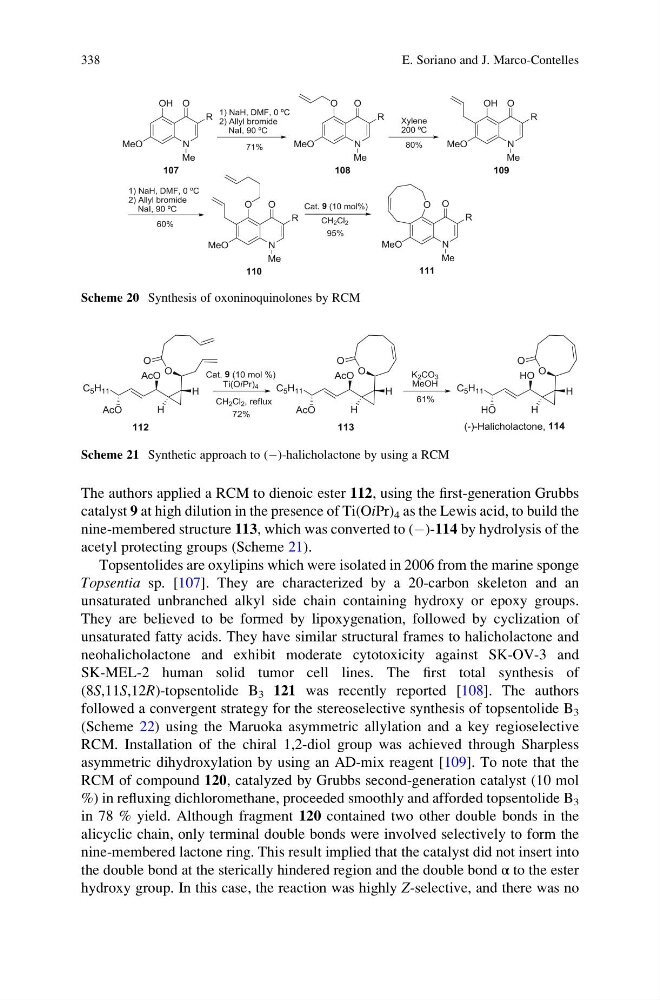
The authors applied a RCM to dienoic ester 112, using the first-generation Grubbs
catalyst 9 at high dilution in the presence of Ti(OiPr) 4 as the Lewis acid, to build the
nine-membered structure 113, which was converted to (À)-114 by hydrolysis of the
acetyl protecting groups (Scheme 21).
Topsentolides are oxylipins which were isolated in 2006 from the marine sponge
Topsentia sp. [107]. They are characterized by a 20-carbon skeleton and an
unsaturated unbranched alkyl side chain containing hydroxy or epoxy groups.
They are believed to be formed by lipoxygenation, followed by cyclization of
unsaturated fatty acids. They have similar structural frames to halicholactone and
neohalicholactone and exhibit moderate cytotoxicity against SK-OV-3 and
SK-MEL-2 human solid tumor cell lines. The first total synthesis of
(8S,11S,12R)-topsentolide B 3 121 was recently reported [108]. The authors
followed a convergent strategy for the stereoselective synthesis of topsentolide B 3
(Scheme 22) using the Maruoka asymmetric allylation and a key regioselective
RCM. Installation of the chiral 1,2-diol group was achieved through Sharpless
asymmetric dihydroxylation by using an AD-mix reagent [109]. To note that the
RCM of compound 120, catalyzed by Grubbs second-generation catalyst (10 mol
%) in refluxing dichloromethane, proceeded smoothly and afforded topsentolide B 3
in 78 % yield. Although fragment 120 contained two other double bonds in the
alicyclic chain, only terminal double bonds were involved selectively to form the
nine-membered lactone ring. This result implied that the catalyst did not insert into
the double bond at the sterically hindered region and the double bond α to the ester
hydroxy group. In this case, the reaction was highly Z-selective, and there was no
Scheme 21 Synthetic approach to (À)-halicholactone by using a RCM
Scheme 20 Synthesis of oxoninoquinolones by RCM
338
E. Soriano and J. Marco-Contelles
catalyst 9 at high dilution in the presence of Ti(OiPr) 4 as the Lewis acid, to build the
nine-membered structure 113, which was converted to (À)-114 by hydrolysis of the
acetyl protecting groups (Scheme 21).
Topsentolides are oxylipins which were isolated in 2006 from the marine sponge
Topsentia sp. [107]. They are characterized by a 20-carbon skeleton and an
unsaturated unbranched alkyl side chain containing hydroxy or epoxy groups.
They are believed to be formed by lipoxygenation, followed by cyclization of
unsaturated fatty acids. They have similar structural frames to halicholactone and
neohalicholactone and exhibit moderate cytotoxicity against SK-OV-3 and
SK-MEL-2 human solid tumor cell lines. The first total synthesis of
(8S,11S,12R)-topsentolide B 3 121 was recently reported [108]. The authors
followed a convergent strategy for the stereoselective synthesis of topsentolide B 3
(Scheme 22) using the Maruoka asymmetric allylation and a key regioselective
RCM. Installation of the chiral 1,2-diol group was achieved through Sharpless
asymmetric dihydroxylation by using an AD-mix reagent [109]. To note that the
RCM of compound 120, catalyzed by Grubbs second-generation catalyst (10 mol
%) in refluxing dichloromethane, proceeded smoothly and afforded topsentolide B 3
in 78 % yield. Although fragment 120 contained two other double bonds in the
alicyclic chain, only terminal double bonds were involved selectively to form the
nine-membered lactone ring. This result implied that the catalyst did not insert into
the double bond at the sterically hindered region and the double bond α to the ester
hydroxy group. In this case, the reaction was highly Z-selective, and there was no
Scheme 21 Synthetic approach to (À)-halicholactone by using a RCM
Scheme 20 Synthesis of oxoninoquinolones by RCM
338
E. Soriano and J. Marco-Contelles