

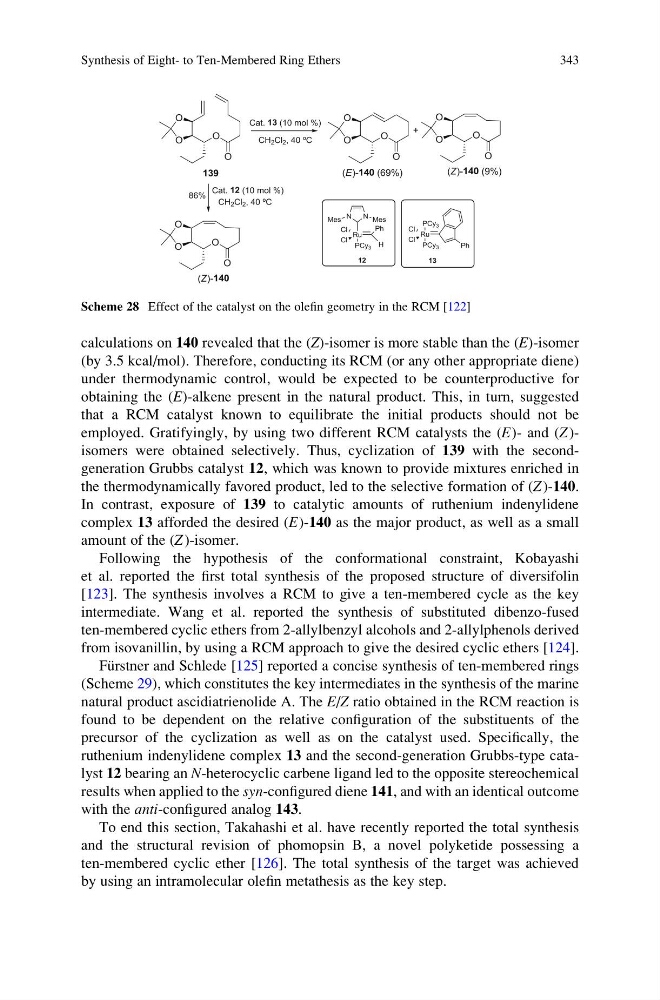
calculations on 140 revealed that the (Z)-isomer is more stable than the (E)-isomer
(by 3.5 kcal/mol). Therefore, conducting its RCM (or any other appropriate diene)
under thermodynamic control, would be expected to be counterproductive for
obtaining the (E)-alkene present in the natural product. This, in turn, suggested
that a RCM catalyst known to equilibrate the initial products should not be
employed. Gratifyingly, by using two different RCM catalysts the (E)- and (Z )isomers were obtained selectively. Thus, cyclization of 139 with the secondgeneration Grubbs catalyst 12, which was known to provide mixtures enriched in
the thermodynamically favored product, led to the selective formation of (Z)-140.
In contrast, exposure of 139 to catalytic amounts of ruthenium indenylidene
complex 13 afforded the desired (E)-140 as the major product, as well as a small
amount of the (Z )-isomer.
Following the hypothesis of the conformational constraint, Kobayashi
et al. reported the first total synthesis of the proposed structure of diversifolin
[123]. The synthesis involves a RCM to give a ten-membered cycle as the key
intermediate. Wang et al. reported the synthesis of substituted dibenzo-fused
ten-membered cyclic ethers from 2-allylbenzyl alcohols and 2-allylphenols derived
from isovanillin, by using a RCM approach to give the desired cyclic ethers [124].
Fu ¨rstner and Schlede [125] reported a concise synthesis of ten-membered rings
(Scheme 29), which constitutes the key intermediates in the synthesis of the marine
natural product ascidiatrienolide A. The E/Z ratio obtained in the RCM reaction is
found to be dependent on the relative configuration of the substituents of the
precursor of the cyclization as well as on the catalyst used. Specifically, the
ruthenium indenylidene complex 13 and the second-generation Grubbs-type catalyst 12 bearing an N-heterocyclic carbene ligand led to the opposite stereochemical
results when applied to the syn-configured diene 141, and with an identical outcome
with the anti-configured analog 143.
To end this section, Takahashi et al. have recently reported the total synthesis
and the structural revision of phomopsin B, a novel polyketide possessing a
ten-membered cyclic ether [126]. The total synthesis of the target was achieved
by using an intramolecular olefin metathesis as the key step.
Scheme 28 Effect of the catalyst on the olefin geometry in the RCM [122]
Synthesis of Eight- to Ten-Membered Ring Ethers
343
(by 3.5 kcal/mol). Therefore, conducting its RCM (or any other appropriate diene)
under thermodynamic control, would be expected to be counterproductive for
obtaining the (E)-alkene present in the natural product. This, in turn, suggested
that a RCM catalyst known to equilibrate the initial products should not be
employed. Gratifyingly, by using two different RCM catalysts the (E)- and (Z )isomers were obtained selectively. Thus, cyclization of 139 with the secondgeneration Grubbs catalyst 12, which was known to provide mixtures enriched in
the thermodynamically favored product, led to the selective formation of (Z)-140.
In contrast, exposure of 139 to catalytic amounts of ruthenium indenylidene
complex 13 afforded the desired (E)-140 as the major product, as well as a small
amount of the (Z )-isomer.
Following the hypothesis of the conformational constraint, Kobayashi
et al. reported the first total synthesis of the proposed structure of diversifolin
[123]. The synthesis involves a RCM to give a ten-membered cycle as the key
intermediate. Wang et al. reported the synthesis of substituted dibenzo-fused
ten-membered cyclic ethers from 2-allylbenzyl alcohols and 2-allylphenols derived
from isovanillin, by using a RCM approach to give the desired cyclic ethers [124].
Fu ¨rstner and Schlede [125] reported a concise synthesis of ten-membered rings
(Scheme 29), which constitutes the key intermediates in the synthesis of the marine
natural product ascidiatrienolide A. The E/Z ratio obtained in the RCM reaction is
found to be dependent on the relative configuration of the substituents of the
precursor of the cyclization as well as on the catalyst used. Specifically, the
ruthenium indenylidene complex 13 and the second-generation Grubbs-type catalyst 12 bearing an N-heterocyclic carbene ligand led to the opposite stereochemical
results when applied to the syn-configured diene 141, and with an identical outcome
with the anti-configured analog 143.
To end this section, Takahashi et al. have recently reported the total synthesis
and the structural revision of phomopsin B, a novel polyketide possessing a
ten-membered cyclic ether [126]. The total synthesis of the target was achieved
by using an intramolecular olefin metathesis as the key step.
Scheme 28 Effect of the catalyst on the olefin geometry in the RCM [122]
Synthesis of Eight- to Ten-Membered Ring Ethers
343