

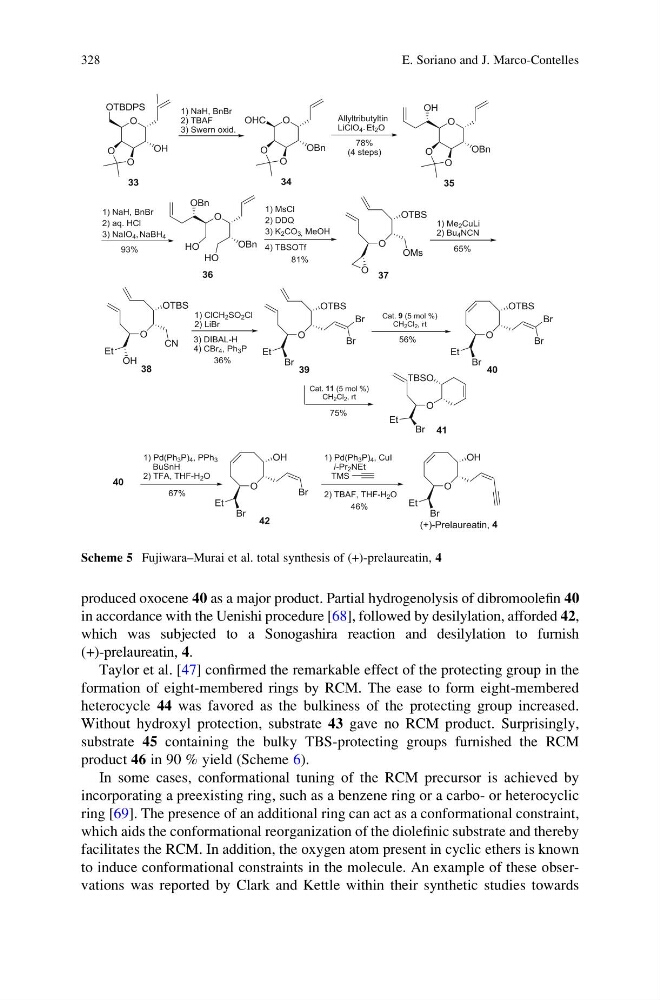
produced oxocene 40 as a major product. Partial hydrogenolysis of dibromoolefin 40
in accordance with the Uenishi procedure [68], followed by desilylation, afforded 42,
which was subjected to a Sonogashira reaction and desilylation to furnish
(+)-prelaureatin, 4.
Taylor et al. [47] confirmed the remarkable effect of the protecting group in the
formation of eight-membered rings by RCM. The ease to form eight-membered
heterocycle 44 was favored as the bulkiness of the protecting group increased.
Without hydroxyl protection, substrate 43 gave no RCM product. Surprisingly,
substrate 45 containing the bulky TBS-protecting groups furnished the RCM
product 46 in 90 % yield (Scheme 6).
In some cases, conformational tuning of the RCM precursor is achieved by
incorporating a preexisting ring, such as a benzene ring or a carbo- or heterocyclic
ring [69]. The presence of an additional ring can act as a conformational constraint,
which aids the conformational reorganization of the diolefinic substrate and thereby
facilitates the RCM. In addition, the oxygen atom present in cyclic ethers is known
to induce conformational constraints in the molecule. An example of these observations was reported by Clark and Kettle within their synthetic studies towards
.
Scheme 5 Fujiwara–Murai et al. total synthesis of (+)-prelaureatin, 4
328
E. Soriano and J. Marco-Contelles
in accordance with the Uenishi procedure [68], followed by desilylation, afforded 42,
which was subjected to a Sonogashira reaction and desilylation to furnish
(+)-prelaureatin, 4.
Taylor et al. [47] confirmed the remarkable effect of the protecting group in the
formation of eight-membered rings by RCM. The ease to form eight-membered
heterocycle 44 was favored as the bulkiness of the protecting group increased.
Without hydroxyl protection, substrate 43 gave no RCM product. Surprisingly,
substrate 45 containing the bulky TBS-protecting groups furnished the RCM
product 46 in 90 % yield (Scheme 6).
In some cases, conformational tuning of the RCM precursor is achieved by
incorporating a preexisting ring, such as a benzene ring or a carbo- or heterocyclic
ring [69]. The presence of an additional ring can act as a conformational constraint,
which aids the conformational reorganization of the diolefinic substrate and thereby
facilitates the RCM. In addition, the oxygen atom present in cyclic ethers is known
to induce conformational constraints in the molecule. An example of these observations was reported by Clark and Kettle within their synthetic studies towards
.
Scheme 5 Fujiwara–Murai et al. total synthesis of (+)-prelaureatin, 4
328
E. Soriano and J. Marco-Contelles