

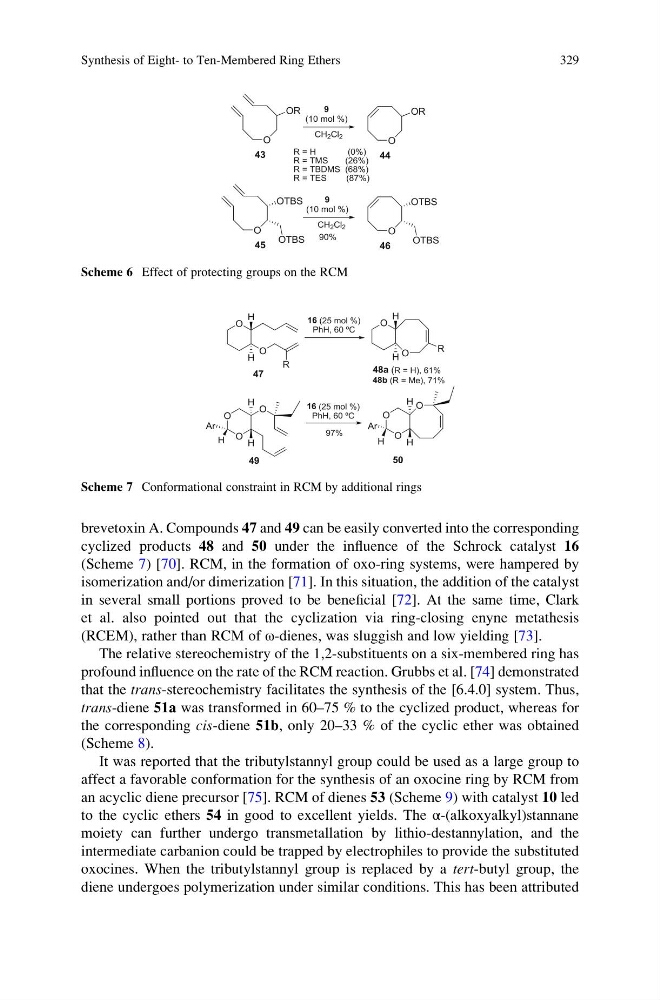
brevetoxin A. Compounds 47 and 49 can be easily converted into the corresponding
cyclized products 48 and 50 under the influence of the Schrock catalyst 16
(Scheme 7) [70]. RCM, in the formation of oxo-ring systems, were hampered by
isomerization and/or dimerization [71]. In this situation, the addition of the catalyst
in several small portions proved to be beneficial [72]. At the same time, Clark
et al. also pointed out that the cyclization via ring-closing enyne metathesis
(RCEM), rather than RCM of ω-dienes, was sluggish and low yielding [73].
The relative stereochemistry of the 1,2-substituents on a six-membered ring has
profound influence on the rate of the RCM reaction. Grubbs et al. [74] demonstrated
that the trans-stereochemistry facilitates the synthesis of the [6.4.0] system. Thus,
trans-diene 51a was transformed in 60–75 % to the cyclized product, whereas for
the corresponding cis-diene 51b, only 20–33 % of the cyclic ether was obtained
(Scheme 8).
It was reported that the tributylstannyl group could be used as a large group to
affect a favorable conformation for the synthesis of an oxocine ring by RCM from
an acyclic diene precursor [75]. RCM of dienes 53 (Scheme 9) with catalyst 10 led
to the cyclic ethers 54 in good to excellent yields. The α-(alkoxyalkyl)stannane
moiety can further undergo transmetallation by lithio-destannylation, and the
intermediate carbanion could be trapped by electrophiles to provide the substituted
oxocines. When the tributylstannyl group is replaced by a tert-butyl group, the
diene undergoes polymerization under similar conditions. This has been attributed
Scheme 7 Conformational constraint in RCM by additional rings
Scheme 6 Effect of protecting groups on the RCM
Synthesis of Eight- to Ten-Membered Ring Ethers
329
cyclized products 48 and 50 under the influence of the Schrock catalyst 16
(Scheme 7) [70]. RCM, in the formation of oxo-ring systems, were hampered by
isomerization and/or dimerization [71]. In this situation, the addition of the catalyst
in several small portions proved to be beneficial [72]. At the same time, Clark
et al. also pointed out that the cyclization via ring-closing enyne metathesis
(RCEM), rather than RCM of ω-dienes, was sluggish and low yielding [73].
The relative stereochemistry of the 1,2-substituents on a six-membered ring has
profound influence on the rate of the RCM reaction. Grubbs et al. [74] demonstrated
that the trans-stereochemistry facilitates the synthesis of the [6.4.0] system. Thus,
trans-diene 51a was transformed in 60–75 % to the cyclized product, whereas for
the corresponding cis-diene 51b, only 20–33 % of the cyclic ether was obtained
(Scheme 8).
It was reported that the tributylstannyl group could be used as a large group to
affect a favorable conformation for the synthesis of an oxocine ring by RCM from
an acyclic diene precursor [75]. RCM of dienes 53 (Scheme 9) with catalyst 10 led
to the cyclic ethers 54 in good to excellent yields. The α-(alkoxyalkyl)stannane
moiety can further undergo transmetallation by lithio-destannylation, and the
intermediate carbanion could be trapped by electrophiles to provide the substituted
oxocines. When the tributylstannyl group is replaced by a tert-butyl group, the
diene undergoes polymerization under similar conditions. This has been attributed
Scheme 7 Conformational constraint in RCM by additional rings
Scheme 6 Effect of protecting groups on the RCM
Synthesis of Eight- to Ten-Membered Ring Ethers
329