

of the C6 and C7 oxygen substituents to accelerate the ring closure, thus illustrating
the efficiency and power of this protocol for the construction of complex mediumring ethers [57].
Kim et al. have achieved a concise total synthesis of (+)-laurencin, 2, based on an
intermolecular allylation RCM strategy [62, 63]. Fujiwara–Murai et al. have accomplished the total synthesis of 2 from a sugar derivative (β-D-galactose pentaacetate)
[56], showing that the combined use of ether synthesis and ring-closing olefin
metathesis with second-generation Grubbs catalyst provided an efficient synthetic
strategy for medium-ring ethers [34, 64]. In 2002, this group also reported a successful application of this combination of RCM and C-glycoside ring cleavage in the total
synthesis of (+)-prelaureatin, 4 [65]. The total synthesis, shown in Scheme 5, started
from β-D-galactose pentaacetate which was transformed to 33. Protection of 33 as a
benzyl ether followed by desilylation and Swern oxidation gave 34 [47], which was
allylated according to Grieco procedure [66] providing 35 stereoselectively. The Cglycoside 35 was subjected to a ring-cleavage process including benzyl protection,
removal of the acetonide group, oxidative cleavage of the diol moiety, and reduction
of the resulting dialdehyde to produce acyclic diol 36. After mesylation of 36,
followed by removal of the benzyl groups with DDQ [67], the resulting dimesylate
ester was transformed to 37 through a basic treatment followed by TBS protection.
Selective methylation of the epoxide of 37 and subsequent cyanation of the mesylate
ester provided 38, which was converted to 39 by bromination and formation of
dibromoolefin. Although the RCM of 39 with the second-generation Grubbs catalyst
mainly gave cyclohexene 41, the cyclization with the first-generation Grubbs catalyst
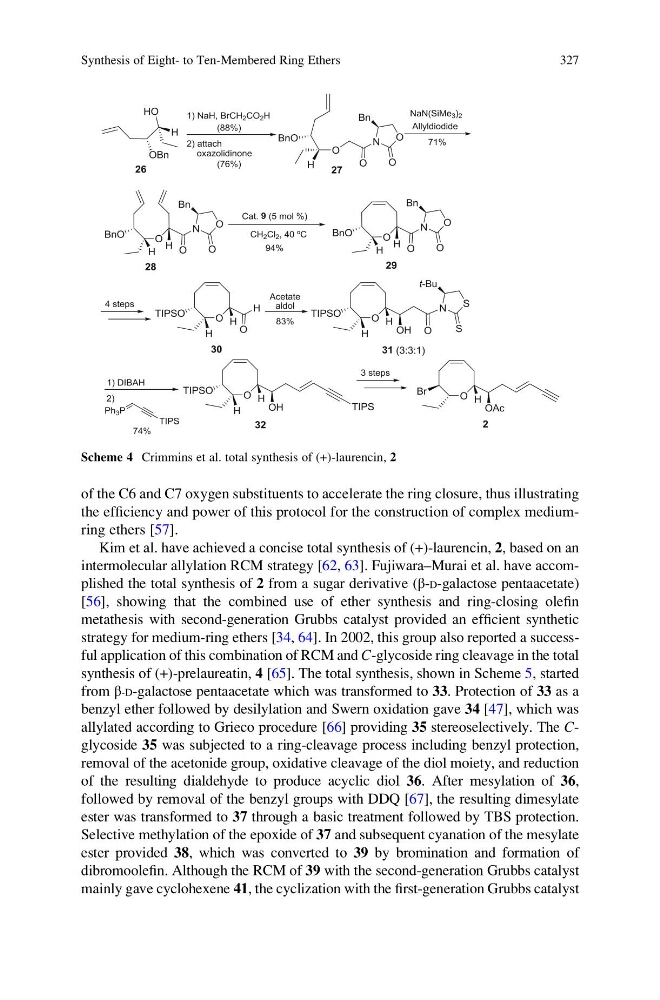
Scheme 4 Crimmins et al. total synthesis of (+)-laurencin, 2
Synthesis of Eight- to Ten-Membered Ring Ethers
327
the efficiency and power of this protocol for the construction of complex mediumring ethers [57].
Kim et al. have achieved a concise total synthesis of (+)-laurencin, 2, based on an
intermolecular allylation RCM strategy [62, 63]. Fujiwara–Murai et al. have accomplished the total synthesis of 2 from a sugar derivative (β-D-galactose pentaacetate)
[56], showing that the combined use of ether synthesis and ring-closing olefin
metathesis with second-generation Grubbs catalyst provided an efficient synthetic
strategy for medium-ring ethers [34, 64]. In 2002, this group also reported a successful application of this combination of RCM and C-glycoside ring cleavage in the total
synthesis of (+)-prelaureatin, 4 [65]. The total synthesis, shown in Scheme 5, started
from β-D-galactose pentaacetate which was transformed to 33. Protection of 33 as a
benzyl ether followed by desilylation and Swern oxidation gave 34 [47], which was
allylated according to Grieco procedure [66] providing 35 stereoselectively. The Cglycoside 35 was subjected to a ring-cleavage process including benzyl protection,
removal of the acetonide group, oxidative cleavage of the diol moiety, and reduction
of the resulting dialdehyde to produce acyclic diol 36. After mesylation of 36,
followed by removal of the benzyl groups with DDQ [67], the resulting dimesylate
ester was transformed to 37 through a basic treatment followed by TBS protection.
Selective methylation of the epoxide of 37 and subsequent cyanation of the mesylate
ester provided 38, which was converted to 39 by bromination and formation of
dibromoolefin. Although the RCM of 39 with the second-generation Grubbs catalyst
mainly gave cyclohexene 41, the cyclization with the first-generation Grubbs catalyst
Scheme 4 Crimmins et al. total synthesis of (+)-laurencin, 2
Synthesis of Eight- to Ten-Membered Ring Ethers
327