

attention of synthetic chemists for a long time because their unusual structural
features have provided synthetic challenges. Since the pioneering first total synthesis of 2, achieved by Masamune et al. [49], other Laurencia natural medium-ring
ethers have been synthesized. So far, diverse contributions to the total and formal
total syntheses have been reported [50–59].
Crimmins and Emmitte [60] have also published a direct synthesis of
(+)-laurencin, in which the side chain was included early in the synthesis (Scheme 4).
Instead of aldolizations, asymmetric alkylations were used to set up two of the
stereocenters. Thus, diol 26 was prepared by allylation of a benzyl glycolate imide
followed by a chelation-controlled ethynylation of the derived aldehyde. Another
allylation of 27 provided diene 28 that cyclized to oxocene 29. Further steps were
needed to change the protecting group, generate the aldehyde 30, and homologate the
side chain. The addition of the chlorotitanium enolate of (S)-(+)-3-acetyl-4-isobutyl2-thiazolidininone gave a diastereomeric mixture of alcohols 31 in a ratio of 3:3:1.
Finally, a Wittig reaction led to the natural product (+)-laurencin, 2.
Further reports from Crimmins et al. described the first total synthesis of
(Æ)-prelaureatin, 4, 3E-prelaureatin, and (+)-laurallene, demonstrating that both
the laurenan and lauthisan derivatives are accessible through similar asymmetric
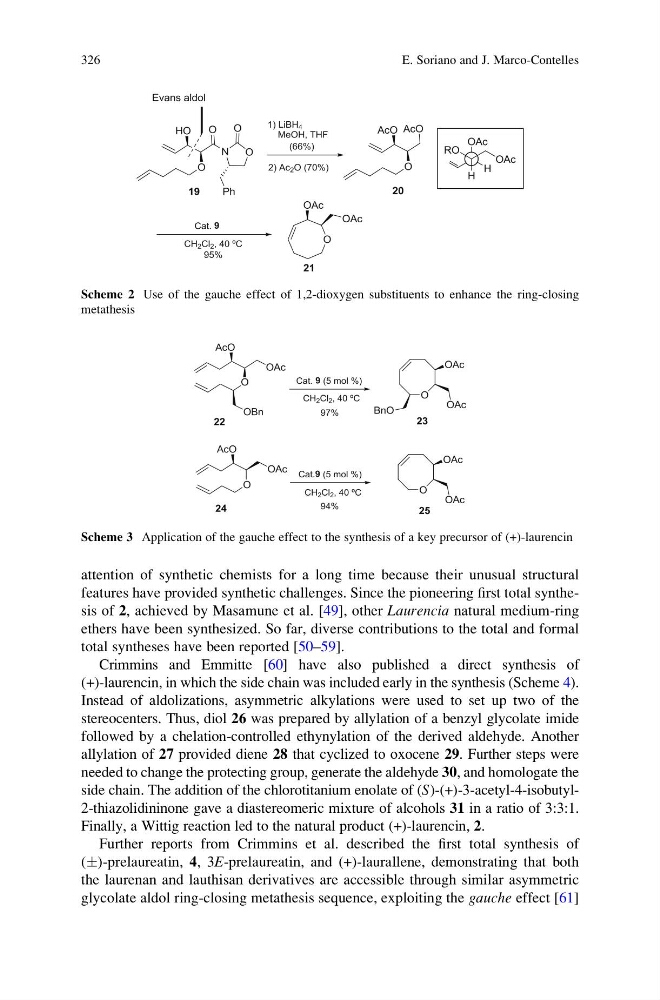
glycolate aldol ring-closing metathesis sequence, exploiting the gauche effect [61]
Scheme 2 Use of the gauche effect of 1,2-dioxygen substituents to enhance the ring-closing
metathesis
Scheme 3 Application of the gauche effect to the synthesis of a key precursor of (+)-laurencin
326
E. Soriano and J. Marco-Contelles
features have provided synthetic challenges. Since the pioneering first total synthesis of 2, achieved by Masamune et al. [49], other Laurencia natural medium-ring
ethers have been synthesized. So far, diverse contributions to the total and formal
total syntheses have been reported [50–59].
Crimmins and Emmitte [60] have also published a direct synthesis of
(+)-laurencin, in which the side chain was included early in the synthesis (Scheme 4).
Instead of aldolizations, asymmetric alkylations were used to set up two of the
stereocenters. Thus, diol 26 was prepared by allylation of a benzyl glycolate imide
followed by a chelation-controlled ethynylation of the derived aldehyde. Another
allylation of 27 provided diene 28 that cyclized to oxocene 29. Further steps were
needed to change the protecting group, generate the aldehyde 30, and homologate the
side chain. The addition of the chlorotitanium enolate of (S)-(+)-3-acetyl-4-isobutyl2-thiazolidininone gave a diastereomeric mixture of alcohols 31 in a ratio of 3:3:1.
Finally, a Wittig reaction led to the natural product (+)-laurencin, 2.
Further reports from Crimmins et al. described the first total synthesis of
(Æ)-prelaureatin, 4, 3E-prelaureatin, and (+)-laurallene, demonstrating that both
the laurenan and lauthisan derivatives are accessible through similar asymmetric
glycolate aldol ring-closing metathesis sequence, exploiting the gauche effect [61]
Scheme 2 Use of the gauche effect of 1,2-dioxygen substituents to enhance the ring-closing
metathesis
Scheme 3 Application of the gauche effect to the synthesis of a key precursor of (+)-laurencin
326
E. Soriano and J. Marco-Contelles