

5.2 Halolactonisation
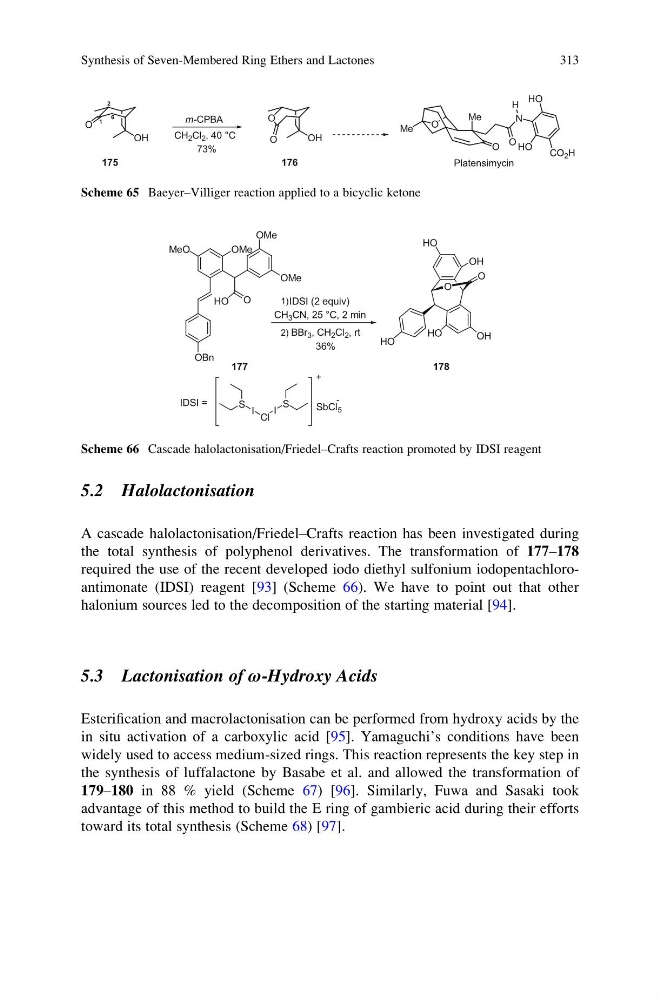
A cascade halolactonisation/Friedel–Crafts reaction has been investigated during
the total synthesis of polyphenol derivatives. The transformation of 177–178
required the use of the recent developed iodo diethyl sulfonium iodopentachloroantimonate (IDSI) reagent [93] (Scheme 66). We have to point out that other
halonium sources led to the decomposition of the starting material [94].
5.3 Lactonisation of ω-Hydroxy Acids
Esterification and macrolactonisation can be performed from hydroxy acids by the
in situ activation of a carboxylic acid [95]. Yamaguchi’s conditions have been
widely used to access medium-sized rings. This reaction represents the key step in
the synthesis of luffalactone by Basabe et al. and allowed the transformation of
179–180 in 88 % yield (Scheme 67) [96]. Similarly, Fuwa and Sasaki took
advantage of this method to build the E ring of gambieric acid during their efforts
toward its total synthesis (Scheme 68) [97].
OH
O
OH
O
O
m-CPBA
CH 2 Cl 2 , 40 °C
176
175
1
2
6
73%
Me
O
O
Me
N
O
HO
HO
CO 2 H
H
Platensimycin
Scheme 65 Baeyer–Villiger reaction applied to a bicyclic ketone
OBn
IDSI (2 equiv)
CH 3 CN, 25 °C, 2 min
1)
2) BBr 3 , CH 2 Cl 2 , rt
OMe
OMe
MeO
OMe
HO O
HO
HO
OH
HO
OH
O
O
178
S I Cl
I
S
SbCl 5
IDSI =
177
+
-
36%
Scheme 66 Cascade halolactonisation/Friedel–Crafts reaction promoted by IDSI reagent
Synthesis of Seven-Membered Ring Ethers and Lactones
313
A cascade halolactonisation/Friedel–Crafts reaction has been investigated during
the total synthesis of polyphenol derivatives. The transformation of 177–178
required the use of the recent developed iodo diethyl sulfonium iodopentachloroantimonate (IDSI) reagent [93] (Scheme 66). We have to point out that other
halonium sources led to the decomposition of the starting material [94].
5.3 Lactonisation of ω-Hydroxy Acids
Esterification and macrolactonisation can be performed from hydroxy acids by the
in situ activation of a carboxylic acid [95]. Yamaguchi’s conditions have been
widely used to access medium-sized rings. This reaction represents the key step in
the synthesis of luffalactone by Basabe et al. and allowed the transformation of
179–180 in 88 % yield (Scheme 67) [96]. Similarly, Fuwa and Sasaki took
advantage of this method to build the E ring of gambieric acid during their efforts
toward its total synthesis (Scheme 68) [97].
OH
O
OH
O
O
m-CPBA
CH 2 Cl 2 , 40 °C
176
175
1
2
6
73%
Me
O
O
Me
N
O
HO
HO
CO 2 H
H
Platensimycin
Scheme 65 Baeyer–Villiger reaction applied to a bicyclic ketone
OBn
IDSI (2 equiv)
CH 3 CN, 25 °C, 2 min
1)
2) BBr 3 , CH 2 Cl 2 , rt
OMe
OMe
MeO
OMe
HO O
HO
HO
OH
HO
OH
O
O
178
S I Cl
I
S
SbCl 5
IDSI =
177
+
-
36%
Scheme 66 Cascade halolactonisation/Friedel–Crafts reaction promoted by IDSI reagent
Synthesis of Seven-Membered Ring Ethers and Lactones
313